Home
Class 12
PHYSICS
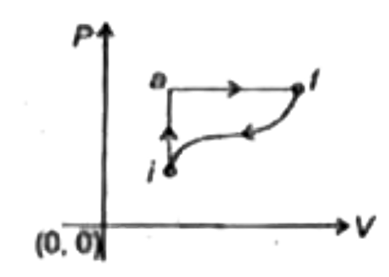
In the diagram shown Q(iaf)= 80 cal and ...

In the diagram shown `Q_(iaf)= 80` cal and `W_(iaf)= 50 `cal. If W = - 30 cal for the curved path fi,value of Q for path fi, will be

A

60 cal

B

30 cal

C

`-30 cal`

D

`-60 cal`

Text Solution

Verified by Experts

The correct Answer is:

D
Promotional Banner

Topper's Solved these Questions

  • THERMODYNAMICS

    AAKASH INSTITUTE ENGLISH|Exercise ASSIGNMENT (SECTION -B) (Objective Type Questions)|30 Videos
  • THERMODYNAMICS

    AAKASH INSTITUTE ENGLISH|Exercise ASSIGNMENT (SECTION -C) (Previous Year Questions)|63 Videos
  • THERMODYNAMICS

    AAKASH INSTITUTE ENGLISH|Exercise EXERCISE|20 Videos
  • THERMAL PROPERTIES OF MATTER

    AAKASH INSTITUTE ENGLISH|Exercise Assignment (Section-J) Akash Challengers Questions|7 Videos
  • UNITS AND MEASUREMENTS

    AAKASH INSTITUTE ENGLISH|Exercise ASSIGNMENT (SECTION - D)|15 Videos

Similar Questions

Explore conceptually related problems

When a system is taken from state f along path iaf, Q = 50 J and W = 20 J . Along path ibf, Q = 35 J . If W = -13 J for the curved return path f I, Q for this path is

a thermodynamic system is taken from the state i to statef along the path iaf. It is found that the heat absorbed by the system is 40 cal and work done by the system is 16.19 cal. Along the path i bf, the heat absorbed is 35 cal. (a) Find the work done along the path i bf. (b) If W = - 10 cal for the curved return path fi, what is for this path ? (c) Take U_(b) = 20 cal, what is U _(f)? (d) If U _(b) = 20 cal, what is for the process ib?

When a thermodynamic system is taken from an initial state I to a final state F along the path IAF, as shown in Fig. the heat energy absorbed by the system is Q = 55 J and work done by the system is W = 25 J . If the same system is taken along the path IBF, the value of Q = 35 J . (a) If W = - 15 J for the curved path FI, how much heat energy is lost by the system along this path ? (b) If U_(1) = 10 J , what is U_(F) ? (d) If U_(B) = 20 J , what is Q for the process BF and IB ?

When a system is taken from state i to state f along the path iaf, it is found that Q=50 cal and W=20 cal . Along the path ibf Q=36cal . W along the path ibf is

When a system is taken from state i to state f along the path iaf, it is found that Q=50 cal and W=20 cal . Along the path ibf Q=36cal . W along the path ibf is

A thermodynamic system is taken from an initial state I with internal energy U_i=-100J to the final state f along two different paths iaf and ibf, as schematically shown in the figure. The work done by the system along the pat af, ib and bf are W_(af)=200J, W_(ib)=50J and W_(bf)=100J respectively. The heat supplied to the system along the path iaf, ib and bf are Q_(iaf), Q_(ib),Q_(bf) respectively. If the internal energy of the system in the state b is U_b=200J and Q_(iaf)=500J , The ratio (Q_(bf))/(Q_(ib)) is

A thin non conducting disc of mass M = 2 kg, charge Q = 2 xx 10^(2-) C and radius R = (1)/(6)m is placed on a frictionless horizontal plane with its centre at the origin of the coordinate system. A non- uniform, radial magnetic field vecB = B_(0) hat(r) is exists in space, where B_(0)= 10 T and hat(r) is a unit vector in the radially outward direction. The disc is set in motion with an angular velocity omega = x xx 10^(2)" rad s"^(-1) , about an axis passing through its centre and perpendicular to its plane, as shown in the figure. At what value of x, the disc will lift off from the surface.

A gas is taken along the path AB as shown in fig, if 70 cal of heat is extracted from the gas in the process, calculate the change in the internal energy of the system.

A givne mass of a gas expands from a state A to the state B by three paths 1, 2 and 3 as shown in T-V indicator diagram. If W_(1),W_(2) and W_(3) respectively be the work done by the gas along the three paths, then

A system goes from P to Q by two different paths in the p-V diagram as shown in figure. Heat given to the system in path 1 is 1000 J. The work done by the system along path 1 is more than path 2 by 100 J. What is the heat exchanged by the system in path 2 ?

AAKASH INSTITUTE ENGLISH-THERMODYNAMICS-ASSIGNMENT (SECTION -A) (Objective Type Questions)
  1. An ideal gas with adiabatic exponent gamma is heated at constant press...

    Text Solution

    |

  2. If vec a and vec b are two unit vectors and theta is the angle between...

    Text Solution

    |

  3. In the diagram shown Q(iaf)= 80 cal and W(iaf)= 50 cal. If W = - 30 ca...

    Text Solution

    |

  4. A mass of dry air at N.T.P. is compressed to (1)/(32) th of its origin...

    Text Solution

    |

  5. Two sample A and B of a gas initially at the same pressure and tempera...

    Text Solution

    |

  6. The adiabatic elasticity of hydrogen gas (gamma=1.4) at NTP

    Text Solution

    |

  7. For an isomertric process

    Text Solution

    |

  8. A mixture of gases at NTP for which gamma = 1.5 si suddenly compressed...

    Text Solution

    |

  9. In which process P-V diagramis a stright line parallel to the volume a...

    Text Solution

    |

  10. p-V plots for two gases during adiabatic process as shown in figure pl...

    Text Solution

    |

  11. The pressure and volume of a gas are changed as shown in the p-V diagr...

    Text Solution

    |

  12. The figure shows P-V diagram of a thermodynamic cycle. Which correspon...

    Text Solution

    |

  13. During the thermodynamic process shown in figure for an ideal gas

    Text Solution

    |

  14. For P-V diagram of a thermodynamic cycle as shown in figure,process BC...

    Text Solution

    |

  15. Work done for the process shownin the figure is

    Text Solution

    |

  16. During which of the following thermodynamic process represented by PV ...

    Text Solution

    |

  17. The specific heat of a gas in a polytropic process is given by-

    Text Solution

    |

  18. For a certain process, pressure of diatomic gas varies according to th...

    Text Solution

    |

  19. In a thermodynamic process two moles of a monatomic ideal gas obeys PV...

    Text Solution

    |

  20. entropy of a system decreases

    Text Solution

    |
