Home
Class 12
PHYSICS
An ideal gas goes from state A to state ...

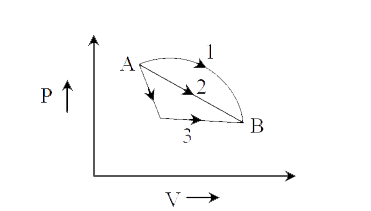
An ideal gas goes from state A to state B via three different processes as indicated in the P-V diagram -
If `Q_(1),Q_(2),Q_(3)` indicate the heat absorbed by the gas along the three process and `DeltaU_(1),DeltaU_(2),DeltaU_(3)`, indicate the change in internal energy along the three processes respectively, then -

A

`Q_(1) gt Q_(2) gt Q_(3)` and `Delta U_(1) = Delta U_(2) = Delta U_(3)`

B

`Q_(3) gt Q_(2) gt Q_(1)` and `Delta U_(1) = Delta U_(2) = Delta U_(3)`

C

`Q_(1) = Q_(2) = Q_(3)` and `Delta U_(1) gt Delta U_(2) gt Delta U_(3)`

D

`Q_(3) gt Q_(2) gt Q_(1)` and `Delta U_(1) gt Delta U_(2) Delta U_(3)`

Text Solution

Verified by Experts

The correct Answer is:

A
Promotional Banner

Topper's Solved these Questions

  • THERMODYNAMICS

    AAKASH INSTITUTE ENGLISH|Exercise ASSIGNMENT (SECTION -D) (Assertion - Reason Type Questions)|10 Videos
  • THERMODYNAMICS

    AAKASH INSTITUTE ENGLISH|Exercise ASSIGNMENT (SECTION -B) (Objective Type Questions)|30 Videos
  • THERMAL PROPERTIES OF MATTER

    AAKASH INSTITUTE ENGLISH|Exercise Assignment (Section-J) Akash Challengers Questions|7 Videos
  • UNITS AND MEASUREMENTS

    AAKASH INSTITUTE ENGLISH|Exercise ASSIGNMENT (SECTION - D)|15 Videos

Similar Questions

Explore conceptually related problems

An ideal gas of mass m in a state A goes to another state B via three different processes as shown in Fig. If Q_(1), Q_(2) and Q_(3) denote the heat absorbed by the gas along the three paths, then

An ideal gas is taken from state A to state B via three different processes as shown in the pressure volume (P-V) diagram. If Q_1 , Q_2 & Q_3 indicates the heat absorbed by the gas and Delta U_1 , Delta U_2 & Delta U_3 indicate change in internal energy in three processes, then

One mole of an ideal gas is taken from state A to state B by three different processes (a) ACB , (b) ADB and (c ) AEB as shown in the P - V diagram. The heat absorbed by the gas is

One mole of an ideal gas is taken from state A to state B by three different processes (a) ACB , (b) ADB and (c ) AEB as shown in the P - V diagram. The heat absorbed by the gas is

Refer to figure. Let DeltaU_(1) and DeltaU_(2) be the changes in internal energy of the system in the processes A and B. then

A system goes from A and B via two processes. I and II as shown in figure. If DeltaU_1 and DeltaU_2 are the changes in internal energies in the processes I and II respectively, then

A system goes from A and B via two processes. I and II as shown in figure. If DeltaU_1 and DeltaU_2 are the changes in internal energies in the processes I and II respectively, then

A system goes from A and B via two processes. I and II as shown in figure. If DeltaU_1 and DeltaU_2 are the changes in internal energies in the processes I and II respectively, then

A given mass of gas expands from state A to state B by three paths 1, 2, and 3 as shown in the figure : If w_(1),w_(2)and w_(3) respectively, be the work done by the gas along three paths, then

A gas is expanded form volume V_(0) to 2V_(0) under three different processes as shown in the figure . Process 1 is isobaric process process 2 is isothermal and and process 3 is adiabatic . Let DeltaU_(1),DeltaU_(2) and DeltaU_(3) be the change in internal energy of the gas in these three processes then

AAKASH INSTITUTE ENGLISH-THERMODYNAMICS-ASSIGNMENT (SECTION -C) (Previous Year Questions)
  1. One mole of an ideal gas goes form an initial stateA to final state B...

    Text Solution

    |

  2. A thermodynamics system is taken trough the cycle ABCD as shown in fig...

    Text Solution

    |

  3. An ideal gas goes from state A to state B via three different processe...

    Text Solution

    |

  4. During an isothermal expansion , a confined ideal gas does -150J of wo...

    Text Solution

    |

  5. A mass of diatomic gas (gamma = 1.4) at a pressure of 2 atmosphere is ...

    Text Solution

    |

  6. If Delta U and Delta W represent the increase in internal energy and w...

    Text Solution

    |

  7. If C(p) and C(v) denote the specific heats (per unit mass) of an ideal...

    Text Solution

    |

  8. A monoatomic gas at pressure P(1) and volume V(1) is compressed adiaba...

    Text Solution

    |

  9. In thermodynamic processes which of the following statements is not tr...

    Text Solution

    |

  10. The internal energy change in a system that has absorbed 2 kcal of hea...

    Text Solution

    |

  11. If Q, E and W denote respectively the heat added, change in internal e...

    Text Solution

    |

  12. At 10^(@)C the value of the density of a fixed mass of an ideal gas di...

    Text Solution

    |

  13. The efficiency of a heat engine is 1//6Its efficiency double when the ...

    Text Solution

    |

  14. A Carnot engine whose sink is at 300K has an efficiency of 40%. By how...

    Text Solution

    |

  15. The molar specific heat at constant pressure of an ideal gas is (7/2)R...

    Text Solution

    |

  16. Which of the following processes is reversible

    Text Solution

    |

  17. An ideal gas heat engine operates in Carnot cycle between 227^(@)C and...

    Text Solution

    |

  18. A system is taken from state a to state c by two paths abc and abc as ...

    Text Solution

    |

  19. Consider two insulated chambers (A,B) of same volume connected by a cl...

    Text Solution

    |

  20. A Carnot engine has efficiency 25%. It operates between reservoirs of ...

    Text Solution

    |
