Home
Class 12
PHYSICS
Velocity of the ball A after collision w...

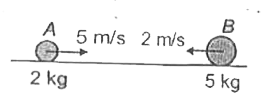
Velocity of the ball A after collision with the ball B as shown in the figure is (Assume perfectly inelastic and head - on collision)

A

`(3)/(7)m//s`

B

`(5)/(7)m//s`

C

`(1)/(7)m//s`

D

Zero

Text Solution

Verified by Experts

The correct Answer is:

D
Promotional Banner

Topper's Solved these Questions

  • WORK, ENERGY AND POWER

    AAKASH INSTITUTE ENGLISH|Exercise Assignment (SECTION - C)|80 Videos
  • WORK, ENERGY AND POWER

    AAKASH INSTITUTE ENGLISH|Exercise Assignment (SECTION - D)|13 Videos
  • WORK, ENERGY AND POWER

    AAKASH INSTITUTE ENGLISH|Exercise Assignment (SECTION - A)|64 Videos
  • WAVES

    AAKASH INSTITUTE ENGLISH|Exercise ASSIGNMENT ( SECTION-D ( Assertion - Reason Type Questions ))|12 Videos

Similar Questions

Explore conceptually related problems

STATEMENT - 1 : Two identical balls B and C lie on a horizontal smooth straight groove so that they are touching. A third identical ball A moves at a speed v along the groove. And collides with B as shown in figure. If the collisions are perfectly elastic, then after the collision, balls A and B will come to rest and ball C moves with velocity v to the right. because STATEMENT - 2 : In an elastic collision, linear momentum and kinetic energy are both conserved.

The figure below shows three identical balls A , B and C. Initially , the baiis B and C are at rest and the ball A while moving with a veiocity v, collides with ball B. if the collision is perfectiy elastic , then after the collision

A ball is projected on a very long floor. There may be two conditions (i) floor is smooth & (ii) the collision is elastic If both the considered then the path of ball is as follows. Now if collision is inelastic and surface is rough then the path is as follows. Successive range is decreasing . Roughness of surface decreases the horizontal component of ball during collision and inelastic nature of collision decreases the vertical component of velocity of ball. In first case both components remain unchanged in magnitude and in second case both the components of the velocity will change. Let us consider a third case here surface is rough but the collision of ball with floor is elastic. A ball is projected withe speed u at an angle 30^(@) with horizontal and it is known that after collision with the floor its speed becomes (u)/(sqrt(3)) . Then answer the following questions. If the ball after first collision with the floor has rebounded vertically then the speed of the ball just after the collision with the floor would have been :

Is whole of the kinetic energy lost in a perfectly inelastic collision ?

A ball of mass 4 kg moving on a smooth horizontal surface makes an elastic collision with another ball of mass m at rest in the line of motion of first ball. If after collision first ball moves in the same direction with one fourth of its velocity before collision, then mass of second ball is

A hollow circular tube of radius R and negligible internal diameter is fixed on horizontal surface ball A of mas m is given velocity v_(o) in the shown direction. It collides with ball B of mass 2 m . Collision is perfectly elastic. If centre of loop is origin of co-ordinates system, then co-ordinate of next collision is

A ball of mass m is pushed with a horizontal velocity v_(0) from one end of a sledge of mass M and length l . if the ball stops after is first collision with the sledge, find the speeds of the ball ad sledge after the second collision of the ball with the sledge.

An object is moving towards a mirror with a velocity of 10 ms^(-1) as shown in the figure. If the collision between the mirror and the object is perfectly elastic, then the velocity of the image after collision with mirror in vector form is

Choose the correct answer: A ball collides at B with velocity 10m//s at 30^(@) with vertical. There is a flag at A and a wall at C . Collision of ball with ground is perfectly inelastic (e=0) and that with wall is elastic (e=1) . Given AB = BC=10 m . Find the time after which ball will collide with the flag.

A metal ball of mass 2 kg moving with a velocity of 36km//h has a head on collision with a stationery ball of mass 3 kg. If after the collision, the two balls move together, the loss in kinetic energy dur to collision is

AAKASH INSTITUTE ENGLISH-WORK, ENERGY AND POWER-Assignment (SECTION - B)
  1. A shell at rest on a smootyh horizontal surface explodes into two frag...

    Text Solution

    |

  2. In case of pure rolling what will be velocity of point A of the ring o...

    Text Solution

    |

  3. A particle of mass m attached to the end of string of length l is rele...

    Text Solution

    |

  4. If F=2x^(2)-3x-2, then select the correct statement

    Text Solution

    |

  5. When a conservation force does positive work on a body, then the

    Text Solution

    |

  6. The variation of force F acting on a body moving along x - axis varies...

    Text Solution

    |

  7. A particle located in one dimensional potential field has potential en...

    Text Solution

    |

  8. The force required to row a boat at constant velocity is proportional ...

    Text Solution

    |

  9. A body of mass m is projected from ground with speed u at an angle the...

    Text Solution

    |

  10. The rate of doing work by force acting on a particle moving along x-ax...

    Text Solution

    |

  11. A small ball of mass m moving with speed v ( gt sqrt(2gL)) undergoes ...

    Text Solution

    |

  12. Two balls of masses m each are moving at right angle to each other wit...

    Text Solution

    |

  13. Sphere A of mass m moving with a constant velocity u hits another stat...

    Text Solution

    |

  14. A neutron collides elastically with the stationary nucleus of an atom ...

    Text Solution

    |

  15. Velocity of the ball A after collision with the ball B as shown in the...

    Text Solution

    |

  16. An object of mass M(1) moving horizontally with speed u colides elstic...

    Text Solution

    |

  17. A ball of mass m moving with speed u collides with a smooth horizontal...

    Text Solution

    |

  18. A ball is dropped from a height h on a floor. The coefficient of resti...

    Text Solution

    |

  19. The PE of a 2 kg particle, free to move along x-axis is given by V(x)=...

    Text Solution

    |

  20. A bullet of mass m moving with velocity v strikes a suspended wooden b...

    Text Solution

    |
