Home
Class 12
CHEMISTRY
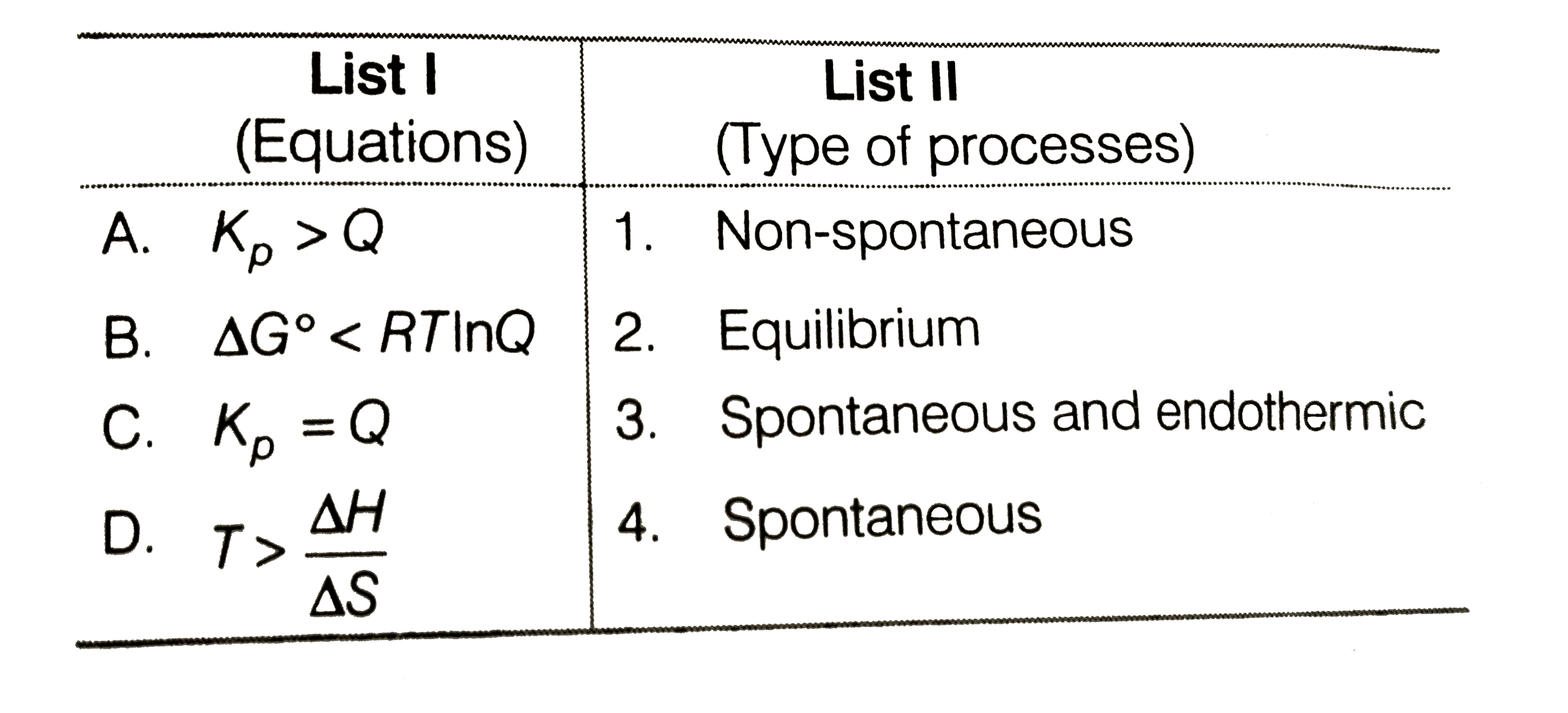
Match List I ( Equations) with List II ...

Match List I ( Equations) with List II (Type of processes) and select the correct option.

(a) a ( i ) , b ( i i ) , c ( i i i ) , d ( i v )
(b) a ( i i i ) , b ( i v ) , c ( i i ) , d ( i )
(c) a ( i v ) , b ( i ) , c ( i i ) , d ( i i i )
(d) a ( i i ) , b ( i ) , c ( i v ) , d ( i i i )

A

`a(i), b(ii), c(iii), d(iv)`

B

`a(iii), b(iv), c(ii), d(i)`

C

`a(iv), b(i), c(ii), d(iii)`

D

`a(ii), b(i), c(iv), d(iii)`

Text Solution

Verified by Experts

The correct Answer is:

C
Promotional Banner

Topper's Solved these Questions

  • THERMODYNAMICS

    AAKASH INSTITUTE ENGLISH|Exercise ASSIGNMENT (Section -D) Assertion-Reason Type Questions|15 Videos
  • THERMODYNAMICS

    AAKASH INSTITUTE ENGLISH|Exercise ASSIGNMENT (Section - B) Objective Type Questions|35 Videos
  • THE SOLID STATE

    AAKASH INSTITUTE ENGLISH|Exercise Assignment (SECTION - D) (ASSERTION-REASON TYPE QUESTION)|20 Videos

Similar Questions

Explore conceptually related problems

1 a(iii), b(ii), c(i), d(iv) 2 a(i), b(iv), c(i), d(iii) 3 a(iv), b(i), c(iii), d(iv) 4 a(ii), b(iii), c(iv), d(i)

Match the column I and column II and choose the correct option (Column I) a.ADH b.Renin c.ANF d.angiotensin II (Column II) i.Vasoconstrictor ii.Vasodilator iii.Released from pituitary gland iv.Released by JG cells 1) a(iii),b(iv),c(I),d(ii) 2) a(iv),b(iii),c(ii),d(i) 3) a(iv),b(iii),c(i),d(ii) 4) a(iii),b(iv),c(ii),d(i)

Match Column - I with Column - II and select the CORRECT option form the codes given below (a) A - (iv) , B - (ii) , C - (i) , D - (iii) (b) A - (iii) , B - (ii) , C - (i) , D - (iv) (c) A - (iv) , B - (iii) , C - (i) , D - (ii) (d) A - (i) , B - (ii) , C - (iii) , D - (iv)

Match the disease in Column I with the appropriate items (vector/ pathogen/ diagnostic test/ treatment) in Column II {:(,"Column - I",,"Column - II"),(a.,"Ringworm",i.,"Aedes"),(b.,"Ascariasis",ii.,"Widal test "),(c.,"Dengue",iii.,"Blockage of the intestinal passage"),(d.,"Typhoid",iv.,"Trichophyton"):} (1) a-(iv) ,b-(iii), c-(i), d- (ii) (2) a-(ii) ,b-(iii), c-(i), d- (iv) (3) a-(iv) ,b-(i), c-(ii), d- (iii) (4) a-(i) ,b-(ii), c-(iii), d- (iv)

Find the correct matches (1) a-iii, b-i, c-iv, d-ii (2) a-ii, b-i, c-iii, d-iv (3) a-iii, b-iv, c-ii, d-i (4) a-iv, b-iii, c-I, d-ii

Express the following in the form of a + b i :(i) (-5i)(1/8i) (ii) (-i)(2i)(-1/8i)^3

Match List -I (substances) with List -II (processes) employed in the manufacture of the substances and select the correct option. {:(,"List -I",,"List -II"),(,"Substances",,"Processes"),((a),"Sulphuric acid",(i),"Haber's Process"),((b),"Steel",(ii),"Bessemer's Process"),((c ),"Sodium hydroxide",(iii),"Leblanc Process"),((d),"Ammonia",(iv),"contact Process"):}

Match column I with column II and select the correct option from the given codes. {:(,"Column I",,"Column II"),(A.,"Rhinoceros",(i),"High endemism"),(B.,"In situ conservation",(ii),"Off site conservation"),(C.,"Ex situ conservation",(iii),"On site conservation"),(D.,"Hotspots",(iv),"Kaziranga"):} (a) A-(iv), B-(iii), C-(ii), D-(i) (b) A-(iv), B-(i), C-(ii), D-(iii) (c) A-(iv), B-(ii), C-(iii), D-(i) (d) A-(iv), B-(i), C-(iii), D-(ii)

Match column I with column II with respect to the nomenclature of restriction enzyme EcoRl and select the correct answer from the given codes. {:(Column I,Column II),(A.E,(i)1^(st)"in order of identification"),(B.co,(ii)"Name of genus"),(C.R,(iii)"Name of species"),(D.l,(iv)"Name of strain"):} (a) A-(iii),B-(i),C-(ii),D-(iv) (b) A-(ii),B-(i),C-(iii),D-(iv) (c) A-(i),B-(ii),C-(iii),D-(iv) (d) A-(ii),B-(iii),C-(iv),D-(i)

Match column I with column II and select the correct option from the given codes. {:("Column I",,"Column II"),("Lungs of the planet",(i),"Lantana camara"),("Reserpine",(ii),"Amazon rainforests"),("Anti-cancer drug",(iii),"Yew tree"),("Exotic species",(iv),"Rauwolfia"):} (a) A-(ii), B-(iv), C-(iii), D-(i) (b) A-(ii), B-(iii), C-(iv), D-(i) (c) A-(iv), B-(iii), C-(i), D-(ii) (d) A-(ii), B-(iv), C-(i), D-(iii)

AAKASH INSTITUTE ENGLISH-THERMODYNAMICS-ASSIGNMENT (Section - C) Previous Years Questions
  1. Consider the following processes : {:(,DeltaH(kJ//"mol")),(1/2ArarrB...

    Text Solution

    |

  2. Standard entropies of X(2), Y(2) and XY(3) are 60, 40 and 50 JK^(–1) m...

    Text Solution

    |

  3. Match List I ( Equations) with List II (Type of processes) and select...

    Text Solution

    |

  4. 1 moles of an ideal gas expanded spontaneously into vaccum. The work d...

    Text Solution

    |

  5. For vaporization of water at 1 atmospheric pressure the values of Delt...

    Text Solution

    |

  6. The following teo reaction are known : Fe(2)O(3)(s)+3CO(g)rarr2Fe(s)...

    Text Solution

    |

  7. The values of DeltaH and DeltaS for the reaction, C("graphite")+CO(2...

    Text Solution

    |

  8. From the following bond energies H-H bond energy 431.37 kJ mol^(-1) ...

    Text Solution

    |

  9. Bond dissociation enthalpy of H(2), Cl(2) and HCl are 434, 242 and 431...

    Text Solution

    |

  10. For the gas-phase decomposition, PCl(5)(g)LeftrightarrowPCl(3)(g)+Cl...

    Text Solution

    |

  11. Which of the following are not state functions ? I. q+w II. Q ...

    Text Solution

    |

  12. Consider the following reactions: (i) H^(+)(aq)+OH^(-)(aq)rarrH(2)O(...

    Text Solution

    |

  13. Given that bond energies of H–H and Cl–Cl are 430 kJ mol^(-1) and 240...

    Text Solution

    |

  14. Identify the correct statement for change of Gibbs free energy for a s...

    Text Solution

    |

  15. Assume each reaction is carried out in an open container. For which r...

    Text Solution

    |

  16. The enthalpy and entropy change for the reaction Br(2)(l) + Cl(2)(g)...

    Text Solution

    |

  17. The enthalpy of combustion of H(2), cyclohexene (C(6)H(10)) and cycloh...

    Text Solution

    |

  18. A reaction occurs spontaneouly if

    Text Solution

    |

  19. Which of the following pairs of a chemical reaction is certain to resu...

    Text Solution

    |

  20. The magnitude of enthalpy change for neutralization of the reaction , ...

    Text Solution

    |
