
Home
Class 12
CHEMISTRY
Hydrolysis of dimethyldichloro silane , ...

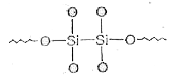
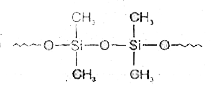
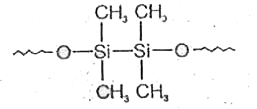
Hydrolysis of dimethyldichloro silane , `(CH_(3))_(2) SiCl_(2)` followed by condensation polymerisation yields straight chain polymer of

A

B

C

D

Text Solution

AI Generated Solution

The correct Answer is:

To solve the question regarding the hydrolysis of dimethyldichlorosilane, `(CH3)2SiCl2`, followed by condensation polymerization, we can follow these steps: ### Step 1: Understand the Structure of Dimethyldichlorosilane Dimethyldichlorosilane has the formula `(CH3)2SiCl2`. This means that the silicon (Si) atom is bonded to two methyl groups (CH3) and two chlorine (Cl) atoms. **Hint:** Draw the molecular structure to visualize the bonding. ### Step 2: Hydrolysis of Dimethyldichlorosilane When dimethyldichlorosilane undergoes hydrolysis, the chlorine atoms are replaced by hydroxyl (OH) groups. The reaction can be represented as follows: \[ (CH3)2SiCl2 + 2H2O \rightarrow (CH3)2Si(OH)2 + 2HCl \] In this reaction, the two chlorine atoms are replaced by two hydroxyl groups, resulting in the formation of dimethylsilandiol, `(CH3)2Si(OH)2`. **Hint:** Remember that hydrolysis involves the reaction of a compound with water, leading to the substitution of functional groups. ### Step 3: Condensation Polymerization The next step is condensation polymerization. In this process, the hydroxyl groups from the dimethylsilandiol can react with other dimethylsilandiol molecules. During this reaction, water (H2O) is eliminated, and a siloxane (Si-O-Si) bond is formed. The general reaction for the polymerization can be represented as: \[ n \cdot (CH3)2Si(OH)2 \rightarrow [Si(CH3)2O]_n + nH2O \] Here, `n` represents the number of repeating units in the polymer. **Hint:** In condensation reactions, always consider the byproducts like water that are formed. ### Step 4: Identify the Resulting Polymer The resulting polymer from this condensation reaction will be a straight-chain polymer consisting of alternating silicon and oxygen atoms, with methyl groups attached to the silicon atoms. The structure can be represented as: \[ \text{[-Si(CH3)2-O-]}_n \] This indicates that the polymer is a siloxane polymer with a straight-chain structure. **Hint:** Visualize the repeating unit to understand the overall structure of the polymer. ### Conclusion The straight-chain polymer formed from the hydrolysis of dimethyldichlorosilane followed by condensation polymerization is a siloxane polymer with the general structure of `[-Si(CH3)2-O-]_n`. **Final Answer:** The straight-chain polymer is `[-Si(CH3)2-O-]_n`.
Promotional Banner

Similar Questions

Explore conceptually related problems

Straight chain polymer is formed by hydrolysis of [x] which is tetrasubstituted chloromethylsilane then followed by condensation polymerization. Atomicity of [x] is:

Alkyl substituted chlorosilane, R_n SiCl_((4-n)) , on hydrolysis and then condensation polymerisation yield silicones What is the value of n is the alkyl substituted chlorosilane used for the preparation of cross linked silicone.

Which one of the following polymers in not obtained by condensation polymerisation ?

The hydrolysis of trialkylchlorosilane , R_3 SiCl , yields ……………………..,

Hydrolysis of Ba_(3) N_(2) will yield

Hydrolysis of Ca_(3) N_(2) will yield

Be_(2)C on hydrolysis yields

On controlled hydrolysis and condensation, R_(3)SiCl yields

(CH_(3))_(2)SiCl_(2) underboes hydrolysis but (CH_(3))_(2)"CC"l_(2) does not why?
