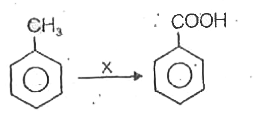
X may be

A

`KMnO_(4)(aq)`

B

`NH_(2)-NH_(2)//KOH`

C

`H_(2)//Pt`

D

`PCl_(5)`

Text Solution

Verified by Experts

The correct Answer is:

A
Promotional Banner

Similar Questions

Explore conceptually related problems

A student plots a graph from his reading on the determination of Young's modulus of a metal wire but forgets to label. The quantities on X and Y may be respectively.

The value of y which will satisfy the equations 2x^(2)+6x +5y +1 = 0 and 2x +y +3 = 0 may be found by solving:-

Find the direction in which a straight line must be drawn through the point (1,2) so that its point of intersection with the line x+y" = "4 may be at a distance of 3 units from this point.

Find the direction in which a straight line must be drawn through the point (-1," "2) so that its point of intersection with the line x" "+" "y" "=" "4 may be at a distance of 3 units from this point.

Find the direction in which a straight line must be drawn through the point (-1, 2) so that its point of intersection with the line x + y =4 may be at a distance of 3 units from this point.

Find the direction in which a straight line must be drawn through the point (1,2) so that its point of intersection with the line x+ y =4 may be at a distance of 3 units from this point.

Find the condition that the zeroes of the polynomial f(x) = x^3 – px^2 + qx - r may be in arithmetic progression.

Which of the following is true about point of extremum x=a of function y=f(x)? At x=a , function y=f(x) may be discontinuous. At x=a , function y=f(x) may be continuous but non-differentiable. At x=a ,function y=f(x) may have point of inflection. none of these

Characteristics X-rays may be used to identify the element from which they are coming. Can continuous X-rays be used for this purpose?
