Home
Class 12
CHEMISTRY
An aromatic compound X with molecular fo...

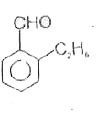
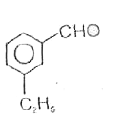
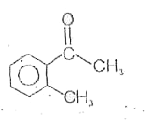
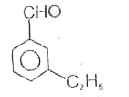
An aromatic compound X with molecular formula `C_(9)H_(10)O` gives following chemical tests:
(i) Form 2,4-DNP derivative
(ii) Reduces Tollen's reagent
(iii) undergoes Cannizzaro's reaction
(iv) On vigorous oxidation 1, 2-Benzene dicarboxylic acid is obtained
The compound X is ,

A

B

C

D

Text Solution

AI Generated Solution

The correct Answer is:

To solve the problem, we need to analyze the given information about the aromatic compound X with the molecular formula C9H10O and the results of its chemical tests. ### Step-by-Step Solution: 1. **Identify the Molecular Formula**: The compound has a molecular formula of C9H10O. This indicates that it is an aromatic compound since it contains a benzene ring. **Hint**: Look for the presence of a benzene ring in the structure based on the molecular formula. 2. **Chemical Tests Analysis**: - **Test (i)**: The compound forms a 2,4-DNP derivative. This indicates that the compound contains a carbonyl group (C=O), which is characteristic of aldehydes and ketones. - **Test (ii)**: The compound reduces Tollen's reagent. This is a specific test for aldehydes, confirming that the compound is likely an aldehyde. - **Test (iii)**: The compound undergoes Cannizzaro's reaction. This reaction occurs with aldehydes that do not have alpha-hydrogens, indicating that the carbonyl group is directly attached to the benzene ring. - **Test (iv)**: On vigorous oxidation, the compound yields 1,2-benzene dicarboxylic acid. This suggests that the compound is ortho-substituted, as only ortho-substituted benzaldehydes can give this product upon oxidation. **Hint**: Each test provides clues about the functional groups and structure of the compound. Pay attention to the implications of each test. 3. **Determine the Structure**: Given that the compound is an aldehyde (from tests i and ii) and undergoes Cannizzaro's reaction (test iii), we can conclude that the carbonyl group (CHO) is directly attached to the benzene ring. Since the oxidation leads to 1,2-benzene dicarboxylic acid, the compound must be an ortho-substituted benzaldehyde. **Hint**: Consider the structural implications of being ortho-substituted when determining the final structure. 4. **Count the Carbons**: The molecular formula C9H10O indicates: - 6 carbons in the benzene ring - 1 carbon in the carbonyl group (CHO) - This leaves 2 carbons, which must be part of an ethyl group (C2H5). Therefore, the structure of the compound can be deduced as 2-ethylbenzaldehyde. **Hint**: Use the molecular formula to deduce the number of substituents and their positions. 5. **Final Structure**: The final structure of compound X is 2-ethylbenzaldehyde, which can be represented as follows: - A benzene ring with an ethyl group (C2H5) at the ortho position relative to the carbonyl group (CHO). **Hint**: Visualize the structure to confirm the placement of the substituents based on the deductions made. ### Conclusion: The compound X is 2-ethylbenzaldehyde (C9H10O).
Promotional Banner

Similar Questions

Explore conceptually related problems

(a) Give a possible explaination for each one of the following : - (i) There are two - NH_(2) groups in semicarbazide. However, only one such group is involvedin the formation of semicarbazones. (ii) Cyclohexanone forms cyanohydrin in good yield but 2,4,6 -trimethylcyclohexanone does not. (b) An organic compound with molecular formula C_(9)H_(10)O forms, 2,4 - DNP derivative, reduces Tollens' reagent and undergoes Cannizzaro reaction. On vigorous oxidation it gives 1,2-benzene-di-carboxylic acid. Identify the compound.
