Home
Class 12
PHYSICS
Two charges 3 xx 10^(-8) C and -2 xx 10^...

Two charges `3 xx 10^(-8) C` and `-2 xx 10^(-8)C` are located 15 cm apart. At what point on the line joining the two charges is the electric potential zero? Take the potential at infinity to be zero.

Text Solution

Verified by Experts
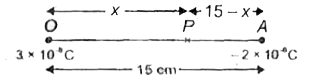
Let us take the origin O at the location of the positive charge. The line joining the two charges is taken to be the x-axis the negative charge is taken to be on the right side of the origin

Let P be the required point on the x -axis where the potential is zero . If x is the x-coordinate of P obviously x mus be positive . (There is no possibility of potentials due to the two charges adding up to zero for `x lt0` ). If x lies between O and A we have
`(1)/(4piepsilon_(0))[(3xx10^(-8))/(x xx10^(-2))-(2xx10^(-8))/((15-x)xx10^(-2))]=0`
where x is in cm .i.e
`(3)/(x) - (2)/(15-x)=0`
which gives x =9 cm.
If x lies on the extended line OA the required condition is
`(3)/(x)-(2)/(x-15) =0`
x= 45 cm
Thus electric potential is zero at 9 cm and 45 cm away from the positive charge on the side of the negative charge . Note that the formula for potential used in the calculation required choosing potential to be zero at infinity.
Promotional Banner

Topper's Solved these Questions

  • ELECTROSTATIC POTENTIAL AND CAPACITANCE

    AAKASH INSTITUTE ENGLISH|Exercise EXERCISE|20 Videos
  • ELECTROSTATIC POTENTIAL AND CAPACITANCE

    AAKASH INSTITUTE ENGLISH|Exercise ASSIGNMENT SECTION - A|44 Videos
  • ELECTROSTATIC POTENTIAL AND CAPACITANCE

    AAKASH INSTITUTE ENGLISH|Exercise SECTION-J Aakash Challengers Questions|5 Videos
  • ELECTROMAGNETIC WAVES

    AAKASH INSTITUTE ENGLISH|Exercise ASSIGNMENT SECTION - D Assertion-Reason Type Questions|25 Videos
  • GRAVITATION

    AAKASH INSTITUTE ENGLISH|Exercise ASSIGNMENT SECTION - D (ASSERTION-REASON TYPE QUESTIONS)|15 Videos

Similar Questions

Explore conceptually related problems

Two charges 3xx10^(-8) C and -2xx10^(-8)C are located 15 cm apart. At what point on the line joining the two charges is the electric potential zero ? Take the potential at infinity to be zero.

Two charges 5xx10^(-8)C and -3xx10^(-8)C are located 16 cm apart. At what points on the line joining the two charges is the electric potential zero ? Take the potential at infinity to be zero.

Two point charge - 5 mu C and + 3 mu C are placed 64 cm apart. At what points on the line joining the two charges is the electric potential zero. Assume the potential at infinity to be zero.

Two point charges 4 mu C and -2 mu C are separated by a distance of 1m in air. Calculate at what point on the line joining the two charges is the electric potential zero ?

Two point charges +4q and +q are placed 30cm apart. At what point on the line joining them is the electric field zero

Two charges -10C and + 10 C are placed 10 cm apart. Potential at the centre of th eline joining the two charges is

Two charges -4 mu C and 8 mu C are 27 cm apart. The distance from the first charge on line of joining between two charges where electric potential would be zero is

Two tiny spheres carrying charges 1.8 muC and 2.8 mu C are located at 40 cm apart. The potential at the mid-point of the line joining the two charges is

Two point charges 4Q, Q are separated by 1m in air. At what point on the line joining the charges is the electric field intensity zero ? Also calculate the electrostatic potential energy of the system of charges, taking the value of charge, Q=2xx10^(-7)C .

Two charges 4 xx 10^(-9)C and -16 xx 10^(-9)C are separated by a distance 20cm in air. The position of the neutral point from the small charge is

AAKASH INSTITUTE ENGLISH-ELECTROSTATIC POTENTIAL AND CAPACITANCE -EXAMPLE
  1. A charge q(1) = 2.00 mu C is located at the origin , and a charge q(2)...

    Text Solution

    |

  2. Suppose that three point charges q(a), q(b) and q(c) are arranged at t...

    Text Solution

    |

  3. Two charges 3 xx 10^(-8) C and -2 xx 10^(-8)C are located 15 cm apart....

    Text Solution

    |

  4. There are four point charges placed at the vertices of a square of sid...

    Text Solution

    |

  5. Two point charge - 5muC and + 3muC are placed 64 cm apart. At what poi...

    Text Solution

    |

  6. If vec(E ) equals zero at a given point mus V equal for that point .

    Text Solution

    |

  7. If you know ( E) at a given point, can you calculate V at that point ?...

    Text Solution

    |

  8. How can you check whether the electric potential in a given region of ...

    Text Solution

    |

  9. An isolated conducting spherical shell carries a negative charge. What...

    Text Solution

    |

  10. Some equipotential surfaces are shown in figure(29.E3) What can you sa...

    Text Solution

    |

  11. The electric potential existing in space is V(x,y,z)= A (xy+ yz+zx).(a...

    Text Solution

    |

  12. An electric field E = (20 hat(i)+30 hat(j)) newton/coulomb exists in t...

    Text Solution

    |

  13. An electric field vec(E ) = hat(i) Cx exists in the space, where C = ...

    Text Solution

    |

  14. In a certain region of space the electric potential V is known to be ...

    Text Solution

    |

  15. A spherical oil drop, radius 10^(-4) cm has on it at a certain a total...

    Text Solution

    |

  16. A spherical drop of water carrying a charge of 3 xx 10^(-19)C has a po...

    Text Solution

    |

  17. A charge Q is distributed over two concentric conducting thin spherica...

    Text Solution

    |

  18. Electric charge Q is uniformly distributed around a thin ring of radiu...

    Text Solution

    |

  19. Two charges, +q and -q, each of mass m , are revolving in a circle of ...

    Text Solution

    |

  20. A proton is fixed at origin. Another proton is released from rest, fro...

    Text Solution

    |

