Home
Class 12
PHYSICS
Some equipotential surfaces are shown in...

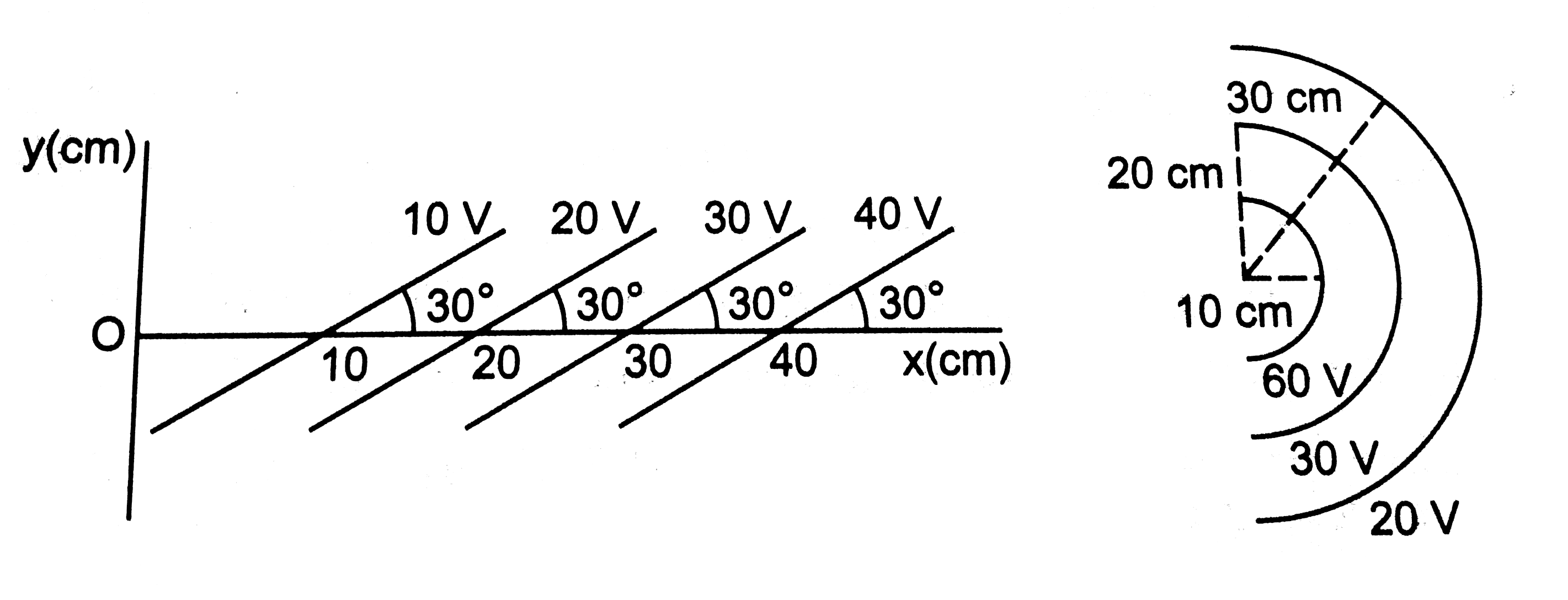
Some equipotential surfaces are shown in figure(29.E3) What can you say about the magnitude and the direction of the electric field?

Text Solution

Verified by Experts
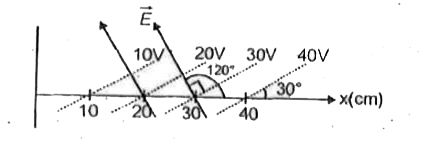
First we will find the direction of the `vec(E )` noting that the `vec(E )` lines are always perpendicular to the local equipotential surfaces and points in that direction in which the potential is decreasing . So it will be as shown below.

Note that we have drawn the `vec(E )` lines perpendicular to all equipotential surface and it si pointing in that direction in which the potential is decreasing. so the total angle `vec(E ) ` is making with the positve x-axis is `120^(@)` as shown . .

Now, how to calculate the magnitude of the electric field for this we need to jump from one equipotential surface to another through shortest (perpendicular ) distance
then calculate, E = `("Change in potential")/("distance travelled")`
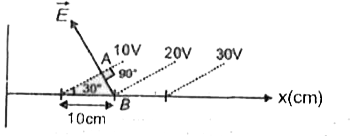
Let us suppose we are jumping from 20 V line to 10V line from B to A. note that the BA line is the shortest length between the two equipotential surface . the potential difference between the two lines is (20 V-10 V) = 10 volt now, calculate the length AB = 10sin `30^(@)` cm = 5 cm = `5xx 10^(-2)` m
Therefore, E `= (10V)/(5 xx 10^(-2)m)` = 200 [ V/m]
Hence, the complete answer is that the `vec(E )` has the value 200 V/m and makes `120^(@)` with positve x-axis.
Promotional Banner

Topper's Solved these Questions

  • ELECTROSTATIC POTENTIAL AND CAPACITANCE

    AAKASH INSTITUTE ENGLISH|Exercise EXERCISE|20 Videos
  • ELECTROSTATIC POTENTIAL AND CAPACITANCE

    AAKASH INSTITUTE ENGLISH|Exercise ASSIGNMENT SECTION - A|44 Videos
  • ELECTROSTATIC POTENTIAL AND CAPACITANCE

    AAKASH INSTITUTE ENGLISH|Exercise SECTION-J Aakash Challengers Questions|5 Videos
  • ELECTROMAGNETIC WAVES

    AAKASH INSTITUTE ENGLISH|Exercise ASSIGNMENT SECTION - D Assertion-Reason Type Questions|25 Videos
  • GRAVITATION

    AAKASH INSTITUTE ENGLISH|Exercise ASSIGNMENT SECTION - D (ASSERTION-REASON TYPE QUESTIONS)|15 Videos

Similar Questions

Explore conceptually related problems

Equipotential surfaces are shown in figure. Then the electric field strength will be

Equipotential surfaces associated with an electric field which is increasing in magnitude along the x-direction are

A plane electromagnetic wave travels in vacuum along z- direction. What can you say about the directions of ots electric and magnetic field vectors. If the frequency of the wave is 30 MHz , what is its wavelength?

A plane electromagnetic wave travels in vacuum along z- direction. What can you say about the directions of ots electric and magnetic field vectors. If the frequency of the wave is 30 MHz , what is its wavelength?

What can you infer about the structures shown in figure?

Define an equipotential surface. Draw equipotential surfaces : (i) in the case of single point charge and (ii) in a constant electric field in Z -direction. Why the equpotential surfaces about a single charge are not equidistant ? (iii) Can electric field exist tangential to an equipotential surface ? Given reason.

A plane electromagnetic wave travels in vacuum along z-direction. What can you say about the direction of electric and magnetic field vectors?

A plane electroagnetic wave travels in vacum along x-direction. What can you say about the direction of electric and magnetic field vectors?

A plane electromagnetic wave travels in vacuum along y-direction. What can you say about the direction of electric and magnetic field vectors?

A few spherical equipotential surfaces are shown in the figure. The electric field at any point, at a distance x from the centre, is

AAKASH INSTITUTE ENGLISH-ELECTROSTATIC POTENTIAL AND CAPACITANCE -EXAMPLE
  1. How can you check whether the electric potential in a given region of ...

    Text Solution

    |

  2. An isolated conducting spherical shell carries a negative charge. What...

    Text Solution

    |

  3. Some equipotential surfaces are shown in figure(29.E3) What can you sa...

    Text Solution

    |

  4. The electric potential existing in space is V(x,y,z)= A (xy+ yz+zx).(a...

    Text Solution

    |

  5. An electric field E = (20 hat(i)+30 hat(j)) newton/coulomb exists in t...

    Text Solution

    |

  6. An electric field vec(E ) = hat(i) Cx exists in the space, where C = ...

    Text Solution

    |

  7. In a certain region of space the electric potential V is known to be ...

    Text Solution

    |

  8. A spherical oil drop, radius 10^(-4) cm has on it at a certain a total...

    Text Solution

    |

  9. A spherical drop of water carrying a charge of 3 xx 10^(-19)C has a po...

    Text Solution

    |

  10. A charge Q is distributed over two concentric conducting thin spherica...

    Text Solution

    |

  11. Electric charge Q is uniformly distributed around a thin ring of radiu...

    Text Solution

    |

  12. Two charges, +q and -q, each of mass m , are revolving in a circle of ...

    Text Solution

    |

  13. A proton is fixed at origin. Another proton is released from rest, fro...

    Text Solution

    |

  14. Three charges are placed along x- axis at x = -a , x=0 and x=a as sho...

    Text Solution

    |

  15. Calculate the work required to be done to make an arrangement of thre...

    Text Solution

    |

  16. Determine the interaction energy of the point charge located at the ...

    Text Solution

    |

  17. When an electric dipole is placed in a uniform electric field making a...

    Text Solution

    |

  18. A molecule of a substance has a permanent electric dipole moment of ma...

    Text Solution

    |

  19. Two protons are separated by a distance R. What will be the speed of e...

    Text Solution

    |

  20. A bullet of mass 2 g is having a charge of 2 muC. Through what potenti...

    Text Solution

    |