Home
Class 12
PHYSICS
(i) Find the equivalent capacitance of t...


(i) Find the equivalent capacitance of the combination shown in the figure (a), when `C_(1)=2.0 muF,C_(2)=4.0 muF and C_(3) = 3.0 muF`
(ii) The input terminals A and B in Fig. (a) are connected to a battery of 12 V. Find the potential and the charge of each capacitor.

Text Solution

Verified by Experts
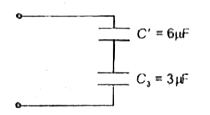
(a) `C_(1) "and " C_(2)` are in parallel hence their equivalent capacitance is
`C'=C_(1)+C_(2)=2.0 muF+4.0muF=6.0muF`
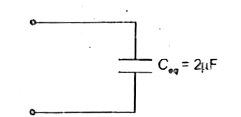
Figure (b) shows the combination of C' and `C_(3)` in series. The final equivalent capacitance shown in figure ( c) is given by
`(1)/(C_(epsilonq))=(1)/(C')+(1)/(C_(3))=(1)/(6.0muF)+(1)/(3.0muF)=(1)/(2.0 muF)`
or `C_(eq)=2.0muF`
(b) To find the charge or potential difference , we retrace the path to the original in figure (a) The charge supplied by the battery is
`q=C_(eq)`V when the inputs are joined to a V-volt battery
`=(2.0muF) (12.0 V) =24.0 muC`
The charge on each capacitor in series in figure (b ) is
`q_(3)=q=q=24.0 mu C`
So `V_(3)= (q_(3))/(C_(3))=(24.0muC)/(3.0muF) 8 V `
The potential difference across C in figure ( b) is

`V=(q)/(C) =(24.0muC)/(6.0 muF) = 4 V " " `(b) `C_(1) "and" C_(2)` in figure (a) and hence the charges on them are
`q_(1)=C_(1)V_(1)=(2.0muF)(4.0 V) = 8.0 mu C`
and `q_(2)= C_(2)V_(2)= (4.0muF) (4.0V) = 16.muC `
Thus we have `V_(1)=V_(2)=4.0V, V_(3)= 8 V`

and `q_(1)=8.0 mu C , q_(2) =16.0 muC , q_(3)=24.0 muC " " ` (c) C' and `C_(3)` are replaced by `C_(eq)`
Promotional Banner

Topper's Solved these Questions

  • ELECTROSTATIC POTENTIAL AND CAPACITANCE

    AAKASH INSTITUTE ENGLISH|Exercise EXERCISE|20 Videos
  • ELECTROSTATIC POTENTIAL AND CAPACITANCE

    AAKASH INSTITUTE ENGLISH|Exercise ASSIGNMENT SECTION - A|44 Videos
  • ELECTROSTATIC POTENTIAL AND CAPACITANCE

    AAKASH INSTITUTE ENGLISH|Exercise SECTION-J Aakash Challengers Questions|5 Videos
  • ELECTROMAGNETIC WAVES

    AAKASH INSTITUTE ENGLISH|Exercise ASSIGNMENT SECTION - D Assertion-Reason Type Questions|25 Videos
  • GRAVITATION

    AAKASH INSTITUTE ENGLISH|Exercise ASSIGNMENT SECTION - D (ASSERTION-REASON TYPE QUESTIONS)|15 Videos

Similar Questions

Explore conceptually related problems

Find the charges on the three capacitors connected to a bettery as shown in figure (31.E1). Take C_1=2.0,muF, C_2=4.0,muf, C_3=6.0,muF and V=12 volts.

The equivalent capacity between A and B in the given circuit is (C_(1) =4muF,C_(2)=12 muF,C_(3)=8muF , C_(4)=4muF,C_(5)=8muF)

(i) Find equivalent capacitance between A and B in the combination give below . Each capacitor is a of 2 muF capacitance .

In the given network capacitance, C_(1) = 10muF, C_(2) = 5 muF and C_(3) = 4muF . What is the resultant capacitance between A and B ?

In the given network capacitance, C_(1) = 10muF, C_(2) = 5 muF and C_(3) = 4muF . What is the resultant capacitance between A and B ?

Three capacitors C_(1)=6muF,C_(2)=12muF and C_(3)=20muF are connected to a 100 V battery, as shown in figure below: (i) Charge on each plate of capacitor C_(1) . (ii) Electrostatic potential energy stored in capacitor C_(3) .

A potential of V = 3000 V is applied to a combination of four initially uncharged capacitors as shown in the figure. Capacitors A, B, C and D have capacitances C_(A)=6.0 muF,C_(B)=5.2 muF,C_(C)=1.5 muF and C_(D) = 3.8 muF , respectiely. If the battery is disconnected, then potential difference across capacitor B is (approximately)

If the equivalent capacitance between points P and Q of the combination of the capacitors show in figure below us 30 muF , the capacitor C is

(a) Find the equivalent capacitance of the combination between A and B in the figure If the points A and B are maintained at 15 V and 0 V respectively then (b) Find the charges on 3mu F, 4 mu F "and " 5 muF capacitors (c ) What are the potentials of the points C and D ?

In, given C_(1)=3 muF, C_(2)=5muF, C_(3)=9 muF , and C_(4)=13 muF . What is the potential differnce between points A and B ? .

AAKASH INSTITUTE ENGLISH-ELECTROSTATIC POTENTIAL AND CAPACITANCE -EXAMPLE
  1. A parallel -plate capacitor is connected to a battery that maintains a...

    Text Solution

    |

  2. In the arrangement shown find the equivalent capacitance between A an...

    Text Solution

    |

  3. (i) Find the equivalent capacitance of the combination shown in the fi...

    Text Solution

    |

  4. Find the equivalent capacitance of the combination between A and B in ...

    Text Solution

    |

  5. The arrangement shows a part of complete circuit. The potentials at po...

    Text Solution

    |

  6. For the following arrangement, find the equivalent capacitance between...

    Text Solution

    |

  7. Find the equivalent capacitance of each of the two combinations betwee...

    Text Solution

    |

  8. (a) Find the equivalent capacitance of the combination between A and ...

    Text Solution

    |

  9. Figure shows a combination of twelve capacitors, each pf capacitance C...

    Text Solution

    |

  10. Find the charge on each plate given area of each plate is A and separa...

    Text Solution

    |

  11. Find the equivalent capacitance of the infinite ladder shown in the fi...

    Text Solution

    |

  12. Consider the following arrangement of four plates interconnected as fo...

    Text Solution

    |

  13. Find the equivalent capacitance between point a and b in the following...

    Text Solution

    |

  14. Five identical capacitor plates, each of area A, are arranged such tha...

    Text Solution

    |

  15. An air-cored capacitor of plate area A and separation d has a capacity...

    Text Solution

    |

  16. Calculate the capacitance of the parallel plate capacitor shown in the...

    Text Solution

    |

  17. An air capacitor of capacitance C plate area A and plate separation d ...

    Text Solution

    |

  18. Two capacitors of capacitance C(1)=2muF and C(2) = 8 muF are connected...

    Text Solution

    |

  19. An air-cored parallel plate capacitor having a capacitance C is charge...

    Text Solution

    |

  20. A parallel plate capacitor of capacitance C has been charged, so that ...

    Text Solution

    |