Home
Class 12
CHEMISTRY
Most stable radical among the following ...

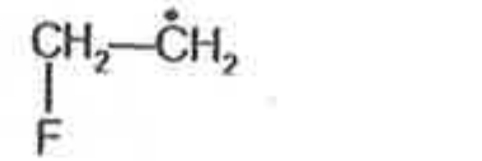
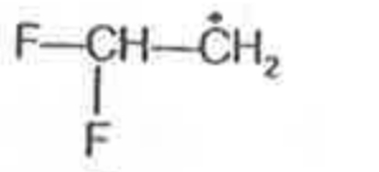
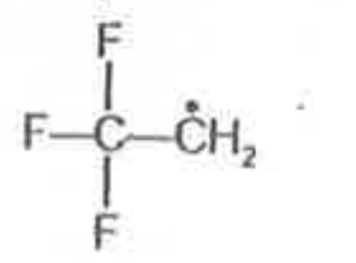
Most stable radical among the following is

A

B

C

D

Text Solution

AI Generated Solution

The correct Answer is:

To determine the most stable radical among the given compounds, we can analyze the stability of each radical based on the principles of radical stability, which is similar to the stability of carbocations. Here’s a step-by-step breakdown of the solution: ### Step 1: Understand Radical Stability Radical stability is influenced by the degree of substitution and the presence of electron-donating or electron-withdrawing groups. The stability order for radicals is similar to that of carbocations: - Tertiary (3°) > Secondary (2°) > Primary (1°) > Methyl (CH3) ### Step 2: Analyze Each Compound 1. **Compound 1: CH3-CH2• (Ethyl Radical)** - This is a primary radical. However, it has an ethyl group that can donate electrons, which stabilizes the radical. 2. **Compound 2: CH2F-CH2• (Fluoroethyl Radical)** - The presence of fluorine, an electronegative atom, withdraws electron density from the radical center, making it less stable. This is an example of a primary radical affected by a -I (inductive) effect. 3. **Compound 3: CH2=CH-CH2• (Allyl Radical)** - This is also a primary radical, but it has resonance stabilization due to the double bond. However, it is still affected by the presence of electronegative atoms if they are nearby. 4. **Compound 4: CF3-CH2• (Trifluoroethyl Radical)** - This radical is destabilized significantly due to the presence of three fluorine atoms, which exert a strong -I effect, withdrawing electron density from the radical center. ### Step 3: Compare Stability - **CH3-CH2• (Ethyl Radical)** is stabilized by the electron-donating effect of the ethyl group. - **CH2F-CH2• (Fluoroethyl Radical)** is destabilized by one fluorine. - **CH2=CH-CH2• (Allyl Radical)** has some resonance but is still a primary radical. - **CF3-CH2• (Trifluoroethyl Radical)** is the least stable due to the strong electron-withdrawing effect of three fluorine atoms. ### Conclusion The most stable radical among the given options is **CH3-CH2• (Ethyl Radical)** due to the electron-donating effect of the ethyl group. ### Final Answer **The most stable radical is CH3-CH2• (Option A).**
Promotional Banner

Topper's Solved these Questions

  • MOCK TEST 3

    AAKASH INSTITUTE ENGLISH|Exercise EXAMPLE|30 Videos
  • MOCK TEST 32

    AAKASH INSTITUTE ENGLISH|Exercise Example|22 Videos

Similar Questions

Explore conceptually related problems

Least stable radical among the following is :

The most stable free radical among the following is

The most stable carbanion among the following is

Most stable carbanion among the following is

The least stable ion among the following is

Thermally most stable carbonate among the following is

Most stable carbocation among the following is

AAKASH INSTITUTE ENGLISH-MOCK TEST 31-Example
  1. The shape of CH3^(+) and CH3^(-) is respectively

    Text Solution

    |

  2. Non-aromatic compound is

    Text Solution

    |

  3. Most stable radical among the following is

    Text Solution

    |

  4. In the given species, carbanion is sp^3 hybridised?

    Text Solution

    |

  5. Which of the following carbocation is most stable?

    Text Solution

    |

  6. The correct stability order of the given carbanions is

    Text Solution

    |

  7. Aromaticity order for the following aromatic compound will be

    Text Solution

    |

  8. An octahedral complex is prepared by mixing CoCl3 and NH3 in the molar...

    Text Solution

    |

  9. Identify the incorrect characteristic of carbenes,: CR2

    Text Solution

    |

  10. Which is the correct stability order for the given carbonium ions? A.M...

    Text Solution

    |

  11. Among the following species, how many are aromatic in nature?

    Text Solution

    |

  12. Peroxide plays a vital role in producing

    Text Solution

    |

  13. Products formed in the above reaction are result of

    Text Solution

    |

  14. An aldehyde reacts with KCN to form cyanohydrin. In this reaction

    Text Solution

    |

  15. Why do alkenes prefer to undergo electrophilec addition reaction while...

    Text Solution

    |

  16. What are homogeneous catalysts? state one example

    Text Solution

    |

  17. Why are alkyl halides insoluble in water?

    Text Solution

    |

  18. The following reaction falls under the category of

    Text Solution

    |

  19. The intermediate formed in the electrophilic addition of HBr to propen...

    Text Solution

    |

  20. How many elimination products are formed when the given dibrom...

    Text Solution

    |
