Home
Class 12
PHYSICS
A body moves from point A to B under the...

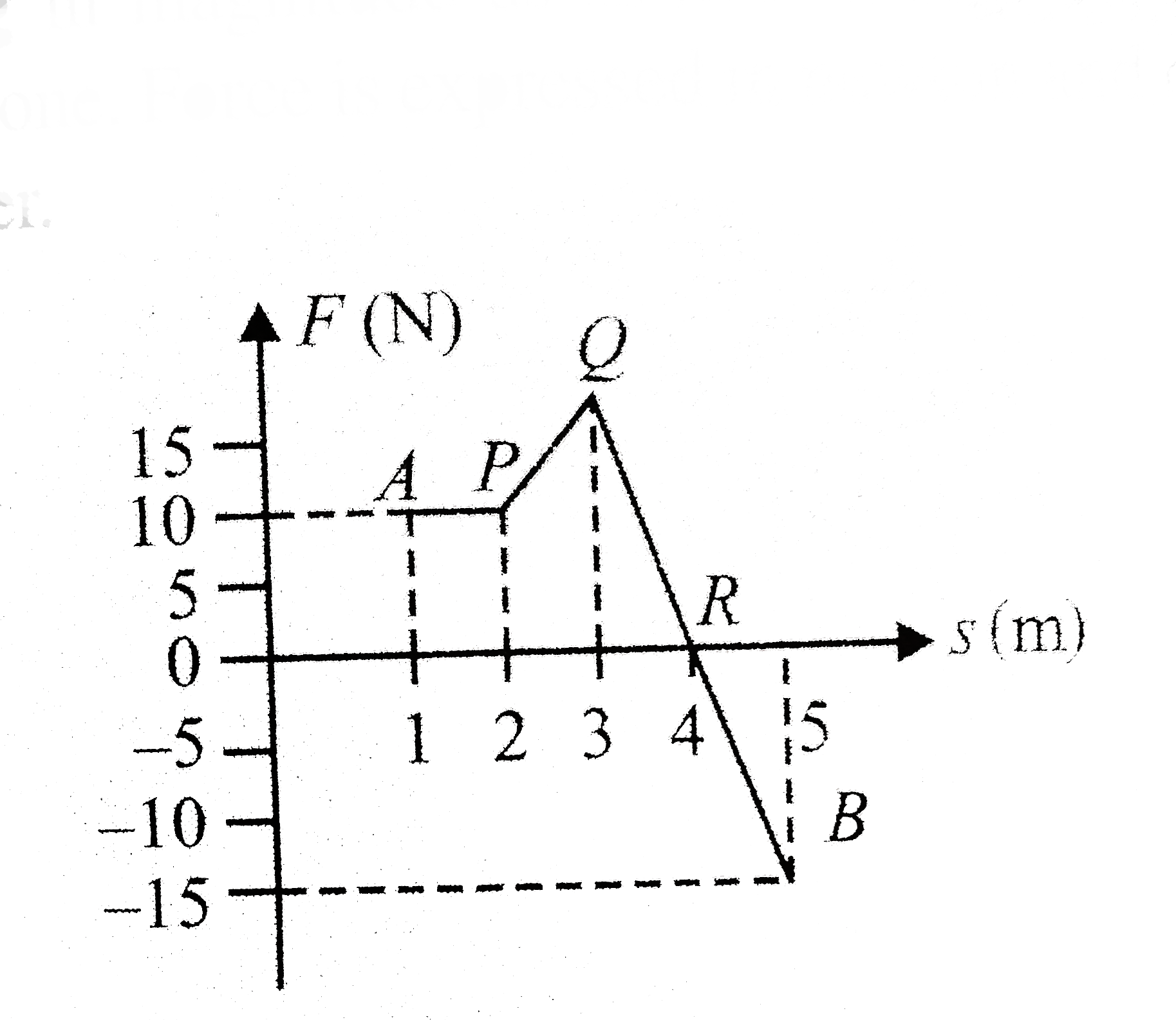
A body moves from point A to B under the action of a force, varying in magnitude as shown in figure. Obtain the work done. Force is expressed in newton and displacement in meter.

A

`1xx10^5` J

B

`3xx10^5` J

C

`9xx10^5` J

D

`12xx10^5` J

Text Solution

Verified by Experts

The correct Answer is:

C
Promotional Banner

Topper's Solved these Questions

  • Mock Test 24: PHYSICS

    AAKASH INSTITUTE ENGLISH|Exercise Example|35 Videos
  • Mock test 26

    AAKASH INSTITUTE ENGLISH|Exercise EXAMPLE|27 Videos

Similar Questions

Explore conceptually related problems

Force acting on a particle varies with displacement as shown in figure. Find the total work done by the force.

A force F acting on a particle varies with the position x as shown in figure. Find the work done by this force in displacing the particle from

A body is in equilibrium under the action of three coplanar forces P,Q and R as shown in figure. Select the correct statement.

A 10-kg block moves in a straight line under the action of a force that varies with position as shown in figure. How much work does the force do as the block moves from origin to x=8m ?

Under the action of a force F = Cx, the position of a body changes from 0 to x. The work done is

A particle moves from a point (2m, 3m, 0) to (3 m, 2m, 0) under the action of force of magnitude 5N acting along the line y= x . The work done by the force on the particle during the displacement is

A body is moving with an acceleration 'a' under the action of a force 'g'. The weight of the body is

Four forces are acting on a body as shown in figure. The magnitude of resultant of the forces is

A particle moves from point P(1,2,3) to (2,1,4) under the action of a constant force F=(2hati+hatj+hatk)N . Work done by the force is

A particle moves from point P(1,2,3) to (2,1,4) under the action of a constant force F=(2hati+hatj+hatk)N . Work done by the force is

AAKASH INSTITUTE ENGLISH-Mock Test 25: PHYSICS-Example
  1. Two charges -4 muC and 8 muC are 27 cm apart. The distance from the fi...

    Text Solution

    |

  2. An electric field vec E=20y hat j exist in space . The potential at (...

    Text Solution

    |

  3. A body moves from point A to B under the action of a force, varying in...

    Text Solution

    |

  4. Potential of electric ield vector is given by V= 9 (x^3 - y^3 ), (wher...

    Text Solution

    |

  5. In the figure given below , the zero potential is taken at infinity. T...

    Text Solution

    |

  6. The electric field strenth vector is given by E=2.5x hat I + 1.5y hat...

    Text Solution

    |

  7. Two point charges 4 mu C and -2 mu C are separated by a distance of 1...

    Text Solution

    |

  8. Two electric dipoles are placed parallel to each other as shown in fig...

    Text Solution

    |

  9. The potential due to a short electric field dipole moment2xx10^-6 C-m ...

    Text Solution

    |

  10. Six charges , q1 = +1 muC , q2 = +3 muC , q3 = +4 muC , q4 = -2 muC , ...

    Text Solution

    |

  11. A test charge q is taken from point A to B in electrostatic field of o...

    Text Solution

    |

  12. Two charges are placed s shown in figure below. The potential at point...

    Text Solution

    |

  13. Two Charges 5 muC and 20 muC are placed on two concentric circes of ra...

    Text Solution

    |

  14. Three charges 2q,-q,-q are located at the vertices of an equilateral t...

    Text Solution

    |

  15. Three concentric spherical shells have radii a, b and c(a lt b lt c) a...

    Text Solution

    |

  16. Two charges +6 'mu'C and -6 'mu'C are placed 15 cm apart as shown . At...

    Text Solution

    |

  17. The electric potential at a point (x,y,z) is given by V =- x^(2) y - x...

    Text Solution

    |

  18. The electric field in a certain region is given by E=5 hat(i)-3hat(j) ...

    Text Solution

    |

  19. Twenty seven drops of mercury are charged simultaneously to the same p...

    Text Solution

    |

  20. Two charged spheres of radii R(1) and R(2) having equal surface charge...

    Text Solution

    |
