Home
Class 12
PHYSICS
If extension in the spring at equilibriu...

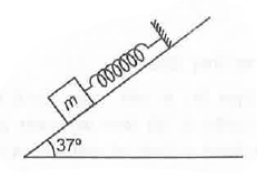
If extension in the spring at equilibrium position is 6 cm then acceleration of block if it is released by further stretching 4 cm.

A

`1/2`

B

3

C

1

D

2

Text Solution

Verified by Experts

Promotional Banner

Topper's Solved these Questions

  • TEST 1

    AAKASH INSTITUTE ENGLISH|Exercise EXERCISE|21 Videos
  • TEST 3

    AAKASH INSTITUTE ENGLISH|Exercise EXAMPLE|74 Videos

Similar Questions

Explore conceptually related problems

A block tied between two identical springs is in equilibrium. If upper spring is cut then the acceleration of the block just after cut is 6m//s^(2) downwards. Now, if instead of upper spring, lower spring is being cut then the acceleration of the block just after the cut will be.

A block tied between identical springs is in equilibrium. If upper spring is cut, then the acceleration of the block just after cut is 5 ms^(1) Now if instead of upper string lower spring is cut, then the acceleration of the block just after the cut will be (Take g=10 m//s^(2) ).

A block of mass m is suddenly released from the top of a spring of stiffness constant k. a. Find the acceleration of block just after release. b. What is the compression in the spring at equilibrium. c. What is the maximum compression in the spring. d. Find the acceleration of block at maximum compression in the spring.

Consider the situation shown in figure. Mass of block A is m and that of blcok B is 2m. The force constant of string is k. Friction is absent everywhere. System is released from rest with the spring unstretched. Find (a) The maximum extension of the spring x_(m) (b) The speed of block A when the extension in the springt is x=(x_(m))/(2) (c ) The net acceleration of block B when extension in the spring is x=(x_(m))/(4).

The block of mass m_1 shown in figure is fastened to the spring and the block of mass m_2 is placed asgainst ilt. A. Find the compression of the spring in the equilibrium position. b.The blocks are pushed a further distance (2/k)(m_1+m_2)gsintheta against the spring and released. Find the position where the two blocks separate.

A rectangular tank having base 15 cm xx 20 cm is filled with water (density rho = 1000 kg//m^(3)) up to 20 cm and force constant K = 280 N//m is fixed to the bottom of the tank so that the spring remains vertical. This system is in an elevator moving downwards with acceleration a = 2 m//s^(2) . A cubical block of side l = 10 cm and mass m = 2 kg is gently placed over the spring and released gradually, as shown in the figure. a. Calculate compression of the spring in equilibrium position. b. If the block is slightly pushed down from equilibrium position and released, calculate frequency of its vertical oscillations.

A block of mass m is released from rest onto a spring. A having stiffness k_A=mg//2h as shown in figure. If the block compresses spring B through a distance h, find the: a. stiffness of the spring B b. equilibrium position of the block c. maximum velocity of the block d. maximum acceleration of the block

A block of mass m is released from rest onto a spring. A having stiffness k_A=mg//2h as shown in figure. If the block compresses spring B through a distance h, find the: a. stiffness of the spring B b. equilibrium position of the block c. maximum velocity of the block d. maximum acceleration of the block

A spring has natural length 40 cm and spring constant 500 N//m . A block of mass 1 kg is attached at one end of the spring and other end of the spring is attached to a ceiling. The block is relesed from the position, where the spring has length 45 cm .

A block A of mass m is attached at one end of a light spring and the other end of the spring is connected to another block B of mass 2m through a light string as shown in the figure. A is held and B is in static equilibrium. Now A is released. The acceleration of A just after that instant is a . In the next case, B is held and A is in static equilibrium. Now when B is released, its acceleration immediately after the releas is b . The value of a//b is (pulley, string and the spring are massless).

AAKASH INSTITUTE ENGLISH-TEST 2-Exercise
  1. A lift is going up with variable velocity as shown in figure if mass o...

    Text Solution

    |

  2. A 80 kg man is standing on a weightless weighing machine as shown in t...

    Text Solution

    |

  3. If extension in the spring at equilibrium position is 6 cm then accele...

    Text Solution

    |

  4. The IUPAC name of is

    Text Solution

    |

  5. A person is standing at the floor of lift drops a coin The coin reache...

    Text Solution

    |

  6. A rope of length L is pulled by a constant force F. What is the tensio...

    Text Solution

    |

  7. A balloon of mass m is descending down with an acceleration How much m...

    Text Solution

    |

  8. Two blocks M1. and M2, are tied with string and kept at rough surface ...

    Text Solution

    |

  9. Friction coefficient between block and inclined plane is [mu=1/sqrt(3)...

    Text Solution

    |

  10. If an electron is moving with velocity v produces a magnetic field vec...

    Text Solution

    |

  11. Engine of car of mass m supplies a constant power P. Starting from res...

    Text Solution

    |

  12. Which of the following statement(s) is/are incorrect regarding an elas...

    Text Solution

    |

  13. If both the blocks moving with constant accelerattion then extension i...

    Text Solution

    |

  14. Half length of the chain of mass m and length / is overhanging. What i...

    Text Solution

    |

  15. A particle is given an initial speed u inside a smooth spherical shell...

    Text Solution

    |

  16. Internal forces acting within a system of particles can alter

    Text Solution

    |

  17. A sphere of mass m moving with a constant velocity u hits another stat...

    Text Solution

    |

  18. A particle of mass m1, makes a head on elastic collision with another ...

    Text Solution

    |

  19. The centre of mass of a non-uniform rod of length L whose mass per uni...

    Text Solution

    |

  20. A man of mass m is standing at one end of a trolley of mass Mand lengt...

    Text Solution

    |

