Home
Class 12
PHYSICS
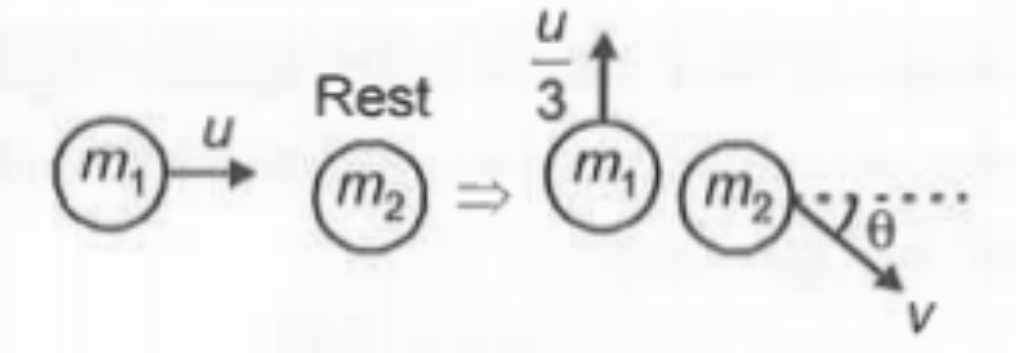
Two spherical balls of masses m1 and m2 ...

Two spherical balls of masses m1 and m2 collide as shown in figure. After collision mass m1 moves with velocity u/3 in a direction perpendicular to original direction. The angle `theta` at which mass m2 will move after collision is

A

`tan^-1(1/2)`

B

`tan^-1(1/3)`

C

`tan^-1(2/3)`

D

`tan^-1(3)`

Text Solution

Verified by Experts

Promotional Banner

Similar Questions

Explore conceptually related problems

Two spherical balls of masses m_1 and m_2 collide as shown in figure. After collision mass m_1 moves with velocity u/3 in a direction perpendicular to original direction. The angle theta at which mass m_2 will move after collision is

Two sphere A and B of masses m_(1) and m_(2) respectivelly colides. A is at rest initally and B is moving with velocity v along x-axis. After collision B has a velocity (v)/(2) in a direction perpendicular to the original direction. The mass A moves after collision in the direction.

Two sphere A and B of masses m_(1) and m_(2) respectivelly colides. A is at rest initally and B is moving with velocity v along x-axis. After collision B has a velocity (v)/(2) in a direction perpendicular to the original direction. The mass A moves after collision in the direction.

A mass m moves with a velocity v and collides inelastically with another identical mass. After collision the 1st mass moves with velocity v/(sqrt3) in a direction perpendicular to the initial direction of motion. Find the speed of the second mass after collision

A sphere of mass m moves with a velocity 2v and collides inelastically with another identical sphere of mass m. After collision the first mass moves with velocity v in a direction perpendicular to the initial direction of motion . Find the speed of the second sphere after collision .

A ball of mass 1 kg moving with a velocity of "0.4 ms"^(-1) collides with another stationary ball. After the collision, the first ball moves with a velocity of 0.3ms^(1) in a direction making an angle of 90^(@) with its initial direction. The momentum of the second ball after the collision will be (in kg ms^(-1) )

Two particles of mass 2m and m moving with speed v and 2v respectively pependicular to each other collides perfectly inelastically, then Find the angle with the horizontal to which the particles move after collision.

Two balls of masses m and 2m moving in opposite directions collide head on elastically with velocities v and 2v . Find their velocities after collision.

Two balls of masses m and 2m moving in opposite directions collide head on elastically with velocities v and 2v . Find their velocities after collision.

Two particles of masses m and 2m moving in opposite directions collide elastically with velocity 2v and v , respectiely. Find their velocities after collision.

