Home
Class 12
PHYSICS
A uniform disc of radius R is in pure ro...

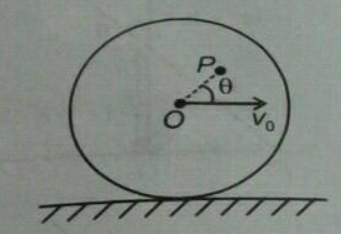
A uniform disc of radius R is in pure rolling on a fixed horizontal surface with constant speed `v_0` as shown in the figure. For what value of `theta`, speed of point P will be `v_0/2√(5+2√3)` ? (OP= R/2 and O is the centre of disc)

A

`30°`

B

`45°`

C

`60°`

D

`53°`

Text Solution

Verified by Experts

Promotional Banner

Similar Questions

Explore conceptually related problems

A disc of radius R is rolling purely on a flat horizontal surface, with a constant angular velocity. The angle between the velocity ad acceleration vectors of point P is

A disc of radius R is rolling purely on a flat horizontal surface, with a constant angular velocity the angle between the velocity ad acceleration vectors of point P is

A disc of radius R is moving on a rough horizontal surface with velocity v and angular speed omega at an instant as shown in figure. Choose the correct statement.

A disc of radius R is rolling purely on a flat horizontal surface, with a constant angular velocity. The angle between the velocity and acceleration vectors of point P is .

A ring of radius R rolls on a horizontal ground with linear speed v and angular speed omega . For what value of theta the velocity of point P is in vertical direction (vltRomega) .

A disc is in the condition of pure rolling on the horizontal surface. The velocity of center of mass is V_0 If radius of disc is R then the speed of point P is (OP =R/3)

A circular disc of radius R rolls without slipping along the horizontal surface with constant velocity v_0 . We consider a point A on the surface of the disc. Then, the acceleration of point A is

A wheel of radius R=2m performs pure rolling on a rough horizontal surface with speed v=10 m/s . In the figure shown, angle theta is angular position of point P on wheel reaches the maximum height from ground. Find the value of "sec"theta (take g=10 m//s^(2) ).

A disc of mass M and radius R rolls on a horizontal surface and then rolls up an inclined plane as shown in the figure. If the velocity of the disc is v, the height to which the disc will rise will be:

From a uniform disc of radius R, an equilateral triangle of side sqrt(3)R is cut as shown in the figure. The new position of centre of mass is :

