Home
Class 11
CHEMISTRY
What are the postulates of Bohr's model ...

What are the postulates of Bohr's model of hydrogen atom ? Discuss the importance of this model to explain various series of line spectra in hydrogen atom.

Text Solution

Verified by Experts
Niels Bohr quantitatively gave the general features of hydrogen atom structure and it.s spectrum. His theory is used to evaluate several points in the atomic structure and spectra. The postulates of Bohr atomic model for hydrogen as follows
Postulates :
The electron in the hydrogen atom can revolve around the nucleus in a circular path of fixed radius and energy. These paths are called orbits (or) stationary states. These circular orbits are concentric (having same center) around the nucleus.
The energy of an electron in the orbit does not change with time.
When an electron moves from lower stationary state to higher stationary state absorption of energy.takes place.
When an electron moves from higher stationary state to lower stationary state emission of energy takes place.
When an electronic transition takes place between two stationary states that differ in energy by
`DeltaE=E_(2)-E_(1)=hv`
`:.` The frequency of radiation absorbed (or) emitted `v=(E_(2)-E_(1))/(h)E_(1)` and `E_(2)` E, are energies of lower, higher energy states respectively.
The angular momentum of an electron is given by `mvr=(nh)/(2pi)`
An electron revolve only in the orbits for which it.s angular momentum is integral multiple of `(h)/(2pi)`
Line spectra of Hydrogen - Bohr.s Theory :
In case of hydrogen atom line spectrum is observed and this can be explained by using Bohr.s Theory.
According to Bohr.s postulate when an electronic transition takes place between two stationary states that differ in energy is given by
`DeltaE=E_(f)-E_(i)" "E_(f)=` final orbit energy
`E_(i)=` intial orbit energy
We know that `E_(n)=-R_(H)[(1)/(n^(2))]`
`:.DeltaE=(-RH)/(n_(1)^(2))-[-(RH)/(n_(F)^(2))]`
`:.DeltaE=R_(H)[(1)/(n_(1)^(2))-(1)/(n_(F)^(2))]`
`DeltaE=hv`
`v=(DeltaE)/(h)=(R_(H))/(h)[(1)/(n_(i)^(2))-(1)/(n_(F)^(2))]`
`v=(2.18xx10^(-18))/(6.625xx10^(-34))[(1)/(n_(1)^(2))-(1)/(n_(F)^(2))]`
`=3.29xx10^(15)[(1)/(n_(i)^(2))-(1)/(n_(F)^(2))]sec^(-1)`
In terms of wave numbers
`barv=(v)/(c)=(3.29xx10^(15))/(3xx10^(8))[(1)/(n_(i)^(2))-(1)/(n_(F)^(2))]`
`=1.09677xx10^(7)[(1)/(n_(i)^(2))-(1)/(n_(F)^(2))]m^(-1)`
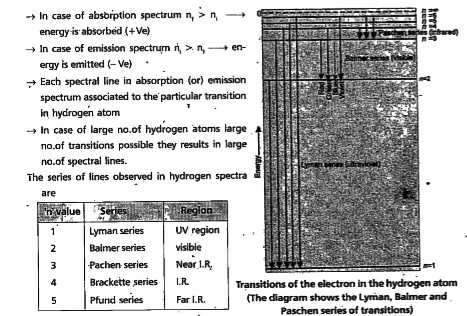
In case of absorption spectrum `n_(f)gtn_(i)to` energy is absorbed (+Ve)
In case of emission spectrum `n_(i)gtn_(f)to` ergy is emitted (-Ve)
Each spectral line in absorption (or) emission spectrum associated to the particular transition in hydrogen atom
In case of large no.of hydrogen atoms large no.of transitions possible they results in large no.of spectral lines.
The series of lines observed in hydrogen spectra are
Promotional Banner

Topper's Solved these Questions

  • ATOMIC STRUCTURE

    VIKRAM PUBLICATION ( ANDHRA PUBLICATION)|Exercise SHORT ANSWER QUESTIONS |21 Videos
  • CHEMICAL EQUILIBRIUM AND ACIDS BASES

    VIKRAM PUBLICATION ( ANDHRA PUBLICATION)|Exercise LONG ANSWER QUESTIONS |31 Videos

Similar Questions

Explore conceptually related problems

What are the postulates of Thomson's model of atom?

What are the limitations of Bohr's theory of hydrogen atom?

Give the main postulates of Bohr's model of an atom.

What are the failures of Bohr's model of atom ?

Write the postulates of Bohr's model of hydrogen atom. What are the limitations of Bohr's model of an atom ?

Bohr's model can explain

