Home
Class 11
CHEMISTRY
How are the quantum numbers n , 1 m(1) ...

How are the quantum numbers n , 1 `m_(1)` for hydrogen atom are obtained ?

Text Solution

Verified by Experts
In general a large no.of orbitals are posible in an atom.
These orbitals are distinguished by their size, shape and orientation.
An orbital of smaller size means there is more chance to find electron near the nucleus.
Atomic orbitals are précisely distinguished by quantum numbers. Each orbital is designated by three major quantum numbers.
1) Principal quantum number.(n)
2) Azimuthal quantum number (l)
3) Magnetic quantum number (m)
1) Principal quantum number : The principal quantum number was introduced by Neils Bohr. It reveals the size of the atom (main energy levels). With increase in the value of .n. the distance between the nucleus, and the orbit also increases.
It is denoted by the letter .n.. It can have any simple integer value 1, 2, 3,......... but not zero. These are also termed as K, L, M, N etc.
The radius and energy of an orbit can be determined basing on "n" value.
The radius of `n^(th)` orbit is `T_(n)=(n^(2)h^(2))/(4pi^(2)me^(2))`
T energy of `n^(th)` orbit is `E_(n)=(-2pi^(2)me^(4))/(n^(2)h^(2))`
2) Azimuthal quantum number : It was proposed by Sommerfeld.. It is also known as angular momentum quantum number or subsidiary quantum number.
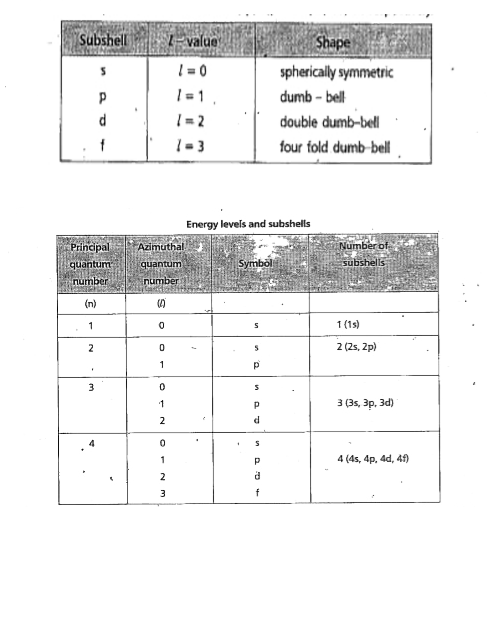
it indicates the shapes of orbitals. It is denoted by .l.. The values of .l. depend on the values of .n., .l. has values ranging from .0. to i.e., I = 0, 1, 2, ..... (n − 1). The maximum number of electrons present in the subshells s, p, d,,fare 2, 6, 10, 14 respectively.

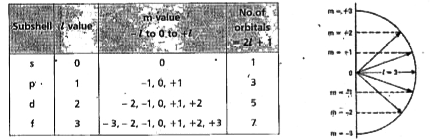
3) Magnetic quantum number: It was proposed by Lande. It shows the orientation of the orbitals in space. .p.- orbital has three orientations. The orbital oriented along the x-axis is called `p_(x)` orbital, along the y-axis is called `p_(y)` orbital and along the z-axis is called `p_(z)` orbital. In a similar way d-orbital has five orientations. They are `d_(xy),d_(yz),d_(zx),d_(x^(2)-y^(2))` and `z^(2)`. It is denoted. by .m.. Its values depends on azimuthal quantum number, .m. can have all the integral values from -l .to + including zero. The total number of .m. values are (2l +1).
Promotional Banner

Topper's Solved these Questions

  • ATOMIC STRUCTURE

    VIKRAM PUBLICATION ( ANDHRA PUBLICATION)|Exercise SHORT ANSWER QUESTIONS |21 Videos
  • CHEMICAL EQUILIBRIUM AND ACIDS BASES

    VIKRAM PUBLICATION ( ANDHRA PUBLICATION)|Exercise LONG ANSWER QUESTIONS |31 Videos

Similar Questions

Explore conceptually related problems

Which combination of quantum numbers n, 1, m, s for the electron in an atom does not provide a permissible solution of the wave equation ?

For how many orbitals, the quantum numbers n = 3, l = 2, m = +2 are possible ?

The values of quantum numbers n, 1 and m for the fifth electron of boron is

The values of quantum numbers n, 1 and m for the fifth electron of boron is

The values of quantum numbers n, l and m for the fifth electron of boron is

The approximate value of principal quantum number for a circular orbit of hydrogen atom of radius 530 nm is