Home
Class 11
CHEMISTRY
What are the important features of equil...

What are the important features of equilibrium constant? Discuss any two applications of equilibrium constant.

Text Solution

Verified by Experts
The ratio of product of molar concentrations of products to the product of molar concentrations of reactants is called equilibrium constant `(K_(c))`
Ex : `aA+bB hArr cC+dD`
`K_(C)=([C]^(2)[D]^(d))/([A]^(a)[B]^(b))`
` to K_(c)` for reverse reaction is the inverse of the `K_(c)` for the reaction in the forward direction.
`to` Concentration equilibrium constant `(K_(C))` and pressure equilibrium constant `(K_(p))` are related as follows
`K_(p)=K_(C)(RT)^(Deltan)`
`Deltan=n_(P)-n_(R)`
`to` While writing Kc expression pure liquids, pure solids concentration are ignored Applications :
a) In predicting the extent of reaction :
The numerical value of the equilibrium constant for a reaction indicates the extent of the react tion. But it is important to note that an.equilibrium constant does not give any information about the rate at which the equilibrium is reached the Magnitude of `k_(e)` or `K_(p)` is directly proportional to the concentrations of products (as these appear in the numerator of equilibrium constant expression) and inversely proportional to the concentrations of the reactants (these appear in the denomina tor). This implies that a high value of K is suggestive of a high concentration of products and vice .versa.
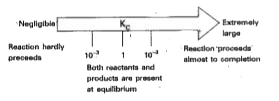
We can make the following generalisation concerning the composition of equilibrium mixtures : If `K gt 10^(3)` products predominate over reactants, i.e., if `K_(c)` is very large, the reaction proceeds nearly to completion. Consider the following examples :
(a) The reaction of `H_(2)` with `O_(2)` at 500 K has a very large equilibrium `K_(c)=2.4xx10^(47)`
(b) `H_(2(g)) hArr 2HCl(g)` at 300 K has `K_(C)=4.0xx10^(31)`
(c) `H_(2_((g)))+Br_(2_(g)) hArr 2HBr_((g))` at 300 K, `K_(c)=5.4xx10^(18)`
If `K_(c) lt 10^(-3)` eactants predominate over products i.e, if `K_(c)` is very small the reaction proceeds rarely. Consider the following examples :
(a) The decomposition of `H_(2)O` into `H_(2) and O_(2)` at 500 K has a very small equilibrium constant.
`K_(c)=4.1xx10^(-48)`
(b) `N_(2_((g)))+O_(2_((g))) hArr 2NO_((g))`
at 298 K has `K_(c)=4.8xx10^(-31)`
If `K_(c)` is in the range of `10^(-3) "to" 10^(3)` appreciable concentrations of both reactants and products are present. Consider the following examples :
(a) for reaction of `H_(2)` with `I_(2)` give HI.

(b) Also, gas phase decomposition of `N_(2) O_(4)` to `No_(2)` is another reaction with a value of `K = 4.64 xx 10^(-3)` at `25^(@)C` which is neither too small nor too large. Hence equilibrium mixtures contain appreciable concentrations of both `N_(2)O and NO_(2)`.
These generarlisations are illustrated. b) In predicting the direction of reaction : A and K are compared to predict the direction of reaction.
(a) Q = K indicates that the reaction mixture is already at equilibrium.
(b) `Q lt K` iQ = K indicates that the reaction mixture is already at equilibrium.
(c) ` Q gt K` indicates that the reaction proceeds in the direction of reactants (Reverse reaction).
Promotional Banner

Topper's Solved these Questions

  • CHEMICAL EQUILIBRIUM AND ACIDS BASES

    VIKRAM PUBLICATION ( ANDHRA PUBLICATION)|Exercise SHORT ANSWER QUESTIONS |70 Videos
  • ATOMIC STRUCTURE

    VIKRAM PUBLICATION ( ANDHRA PUBLICATION)|Exercise LONG ANSWER QUESTIONS |15 Videos
  • CLASSIFICATION OF ELEMENTS AND PERIODICITY IN PROPERTIES

    VIKRAM PUBLICATION ( ANDHRA PUBLICATION)|Exercise Long Answer Questions|24 Videos

Similar Questions

Explore conceptually related problems

Write the characteristics of equilibrium constant.

Write the important characteristics of equilibrium.

With increase in temperature, the value of equilibrium constant

Write any two important applications of the emulsions.

The equilibrium constant of a chemical reaction

In a reversible reaction, if the concentration of reactants are double, the equilibrium constant K will be x times the initial equilibrium constant. x will be equal to

How does the values of equilibrium constant predict the extent of reaction?

VIKRAM PUBLICATION ( ANDHRA PUBLICATION)-CHEMICAL EQUILIBRIUM AND ACIDS BASES - LONG ANSWER QUESTIONS
  1. What is meant by dynamic equilibrium? Explain with suiitable example...

    Text Solution

    |

  2. Give the general characteristics of equilibrium involving physical pro...

    Text Solution

    |

  3. What are the important features of equilibrium constant? Discuss any t...

    Text Solution

    |

  4. What is Le Chatelier's principle? Discuss breifly the factors which ca...

    Text Solution

    |

  5. Discuss the application of LE Chatellier's principle for the industria...

    Text Solution

    |

  6. Dihydrogen gas is obtained from natural gas by partial oxidation with ...

    Text Solution

    |

  7. Dihydrogen gas is obtained from natural gas by partial oxidation with ...

    Text Solution

    |

  8. Dihydrogen gas is obtained from natural gas by partial oxidation with ...

    Text Solution

    |

  9. Dihydrogen gas is obtained from natural gas by partial oxidation with ...

    Text Solution

    |

  10. Describe the effect of: a. addition of H(2) b. addition of CH(3)OH...

    Text Solution

    |

  11. Decribe the effect of : addition of CH(3)OH on the equilibrium of t...

    Text Solution

    |

  12. Decribe the effect of : removal of CO on the equilibrium of the reac...

    Text Solution

    |

  13. Describe the effect of: a. addition of H(2) b. addition of CH(3)OH...

    Text Solution

    |

  14. At 473K, equilibrium constant K(C) for the decompositioni of phosphoru...

    Text Solution

    |

  15. At 473K, equilibrium constant K(C) for the decompositioni of phosphoru...

    Text Solution

    |

  16. At 473K, equilibrium constant K(C) for the decompositioni of phosphoru...

    Text Solution

    |

  17. At 473K, equilibrium constant K(C) for the decompositioni of phosphoru...

    Text Solution

    |

  18. At 473K, equilibrium constant K(C) for the decompositioni of phosphoru...

    Text Solution

    |

  19. Explain the concept of Bronsted acids and Bronsted bases. Illustrate ...

    Text Solution

    |

  20. Explain Lewis acid base theory with suitable example. Classify the fol...

    Text Solution

    |

