Home
Class 11
PHYSICS
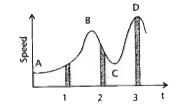
Figure gives a speed-time graph of a par...

Figure gives a speed-time graph of a particle in motion along a constant direction. Three equal intervals of time are shown. In which interval is the average acceleration greatest in magnitude ? In which interval is the average speed greatest ? Choosing the positive direction as the constant direction of motion, give the signs of v and a in the three intervals. What are the accelerations at the points A, B, C and D ?

Text Solution

Verified by Experts

We know that average acceleration in a small interval of time is equal to slope of velocity - time graph in that interval. As the slope of v - t graph is maximum in interval 2 as compared to other intervals 1 and 3, hence the magnitude of avaerge acceleration is greatest in interval 2.
The average speed is greatest in interval 3 for obvious reasons.
In interval 1, the speed of v - t graph is positive. Hence acceleration a is positive. The speed u is positive in this interval due to obvious reasons.
In interval 2, the slope of v - t graph is negaitve, hence acceleration a is negative. The speed u is positive in this interval due to obvious reaosns.
In interval 3, the v - t graph is parallel to time axis, therefore acceleration a is zero in this interval but u is positive due to obvious reasons. At points A, B, C and D the v - t graph is parallel to time axis. Therefore acceleration is zero at all the four points.
Promotional Banner

Similar Questions

Explore conceptually related problems

In the x-t plot of a particle in one dimensional motion. Four different equal intervals of time are shown. In which interval, average speed is greatest

Figure. gives the x-t plot of a particle in one-dimensional motion. Three different equal intervals of time are shown. In which interval is the average speed greatest, and in which is it the least ? Give the sign of average velocity for each interval.

Is the direction of motion constant ?

The average acceleration in one time period in a simple harmonic motion is

Show that when a particle with uniform acceleration, the distances described in consecutive equal intervals of time are in A.P.
