Home
Class 11
BIOLOGY
Give an account of the family Liliaceae....

Give an account of the family Liliaceae.

Text Solution

Verified by Experts

Vegetative characters :
Habitat : Plants may be mesophytes (Allium, Lilium) as well as xerophytes (Asparagus, Ruscus, Aloe) are found in this family.
Habit : Plants are mostly perennial herbs. In some plants like Dracanena, Yucca, Aloe etc., Shrubs or trees are also found. Few are climbers (Glorioa, Smilax).
Root system : It is adventitious root system. In Asparagus fasciculated tuberous roots are present.
Stem : In majority of the species the stem is underground and perennial. It may be a bulb (Scilla, Allium, Lilium), a Rhizome (Gloriosa) or a corm (Colchicum). The aerial stem is weak in tendril climbers like Gloriosa, Smilax etc. Stem is aerial and shows anomalous secondary growth in Dracaena and Yucca. Branches are modified into cladophyllus (Asperagus Ruscus).
Leaf : The leaves may be radical (Alliium, Lilium) or cauline (Smilax, Gloriosa). Alternat phyllotaxy is common. Leaves are petiolate, simple stipulate or exstipulate. Venation is usually parallel, but exceptionally reticulate in Smilax. Leaves are succulent in yucca and Aloe.
Floral Characters :
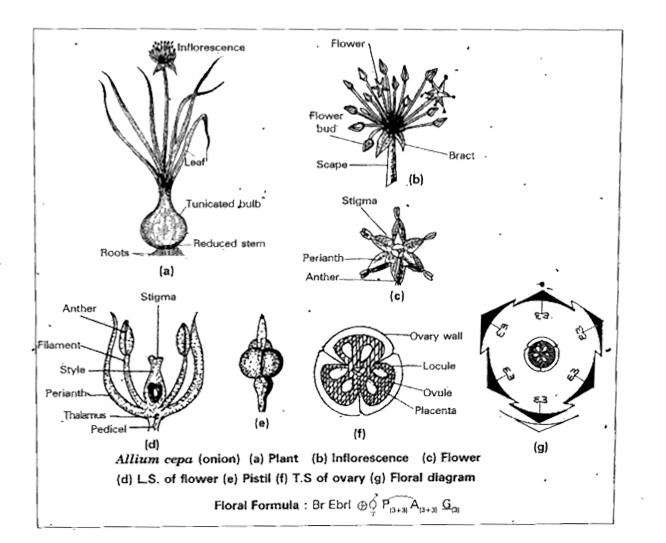
Inflorescence : Solitary cyme or umbel or raceme.
Flower : The flowers are usually bracteate, ebracteolate, pedicellate, actinomorphic, complete. Bisexual, homochlamydeous, trimerous and hypogynous. Exceptionally flowers are unisexual in Smilax and Ruscus.
Perianth : It consists of six tepals arranged in two whorls of three each. The odd tepal is anterior in position. The aestivation is valvate.
Androecium : Stamens are six, arranged into whrols of three each. Epiphyllous (Asparagus). Anthers are dithecous, basifixed, introrse and dehiscence is longitudinal.
Gynoecium : It is tricarpellary and syncarpous. The oary is superior and trilocular with several anatropous ovules on axile placentation. The style is terminal and stigma is trified and capitate.
Floral Formula :
Pollination : It is of entomophilous type. Flowers may be protandrous (Allium) or protogynous (Colchicum) in Glorisa flowers show herkogamy.
Fruit : It may be a berry (Asparagus, Smilax) or loculicidal capsule (Lilium) or septicidal capsule (Gloriosa).
Seed : It is endospermic with straight or sometimes curved embryo and monocotyledonous. Polyembryony is seen in some memebrs (Allium).
Promotional Banner

Topper's Solved these Questions

  • TAXONOMY OF ANGIOSPERMS

    VIKRAM PUBLICATION ( ANDHRA PUBLICATION)|Exercise IMPORTANT QUESTIONS |10 Videos
  • TAXONOMY OF ANGIOSPERMS

    VIKRAM PUBLICATION ( ANDHRA PUBLICATION)|Exercise SHORT ANSWER TYPE QUSTIONS |7 Videos
  • STRUCTURAL ORGANISATION IN ANIMALS

    VIKRAM PUBLICATION ( ANDHRA PUBLICATION)|Exercise Important Question|24 Videos
  • THE LIVING WORLD

    VIKRAM PUBLICATION ( ANDHRA PUBLICATION)|Exercise TEXTUAL EXERCISES|9 Videos

Similar Questions

Explore conceptually related problems

Give an account of the "formed elements" of Blood.

Give an account of the following i) silicones ii) Zeolites iii) SiCI.

Give an account of floral diagram.

Give an account of the main types of reactions in organic chemistry?

Give an account of the biological importance of Na^(+) and K^(+) ions.

Give an account of pseudopodia.

Give an account of the ultra structure of an axoneme.