Home
Class 11
BIOLOGY
Describe the internal structure of a dor...

Describe the internal structure of a dorsiventral leaf with the help of labelled diagrams.

Text Solution

Verified by Experts
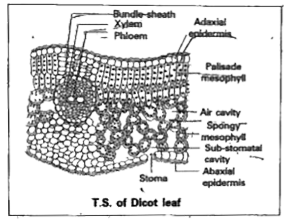
Transverse section of a dorsiventral leaf (dicot leaf ) shows 3 important parts . They are : 1 .Epidermis , 2 Mesophyll and 3. Vascular bundles .
1 . Epidermis : Epidermis is present on the both the upper surface (adaxial ) and the lower surface (abaxial ) of the leaf . The epidermis present on the adaxial surface is called upper epidermis and on the abaxial surface is called lower epidermis . The epidermis is amde up of one row of barrel shaped cells , which are arranged compactly without intercellular spaces. The cells are filled with cacuolated and nucleated protoplast . On outerside of the epidermis a waxy layer called Cuticle is present .Stomata are present , more on the lower surface than on the upper surface . each stoma is surrounded by two kidney shaped guard cells . They are chlorophyllous and regulate the opening , and closing of stomata . Epidermis shows multicellular uniseriate hairs . The cells of leaf hairs are filled with water . They protect the inner tissues by absorbing the uniseriate hairs . The cells of leaf hairs are filled with water . they protect the inner tissues by absorbing the heat and prevents evaporation of water from the leaf surface . The stomata help in the gaseous exchange and also promote transpiration .
(2) . Mesophyll : The ground tissue that extends betweeen the upper and lower epidermal layers is called the mesophyll . It is composed of thin walled parenchyma with chloroplasts . It is chiefly concerned with the synthesis of carbohydrates .In dicot leaves mesophyll is differentiated into two parts namely ,
(i) Palisade parenchyma : Part of the mesophyll found towards the lower epidermis is called spongy tissue . It shows 3-5 rows of irregular shaped cells that are arranged loosely with large intercellualr spaces . Some intercellular spaces present in the vicinity of the stomata are very large , forming air chambers green and the lower surface is light green in colour . Spongy tissue has a primary role in gaseous exchange apart from the synthesis of food materials .
(3) . Vascular bundles Vscular bundles are extended in the mesophyll in the form of veins . They help in supplying water , mineral salts and food materials all over the leaf surface . Veins also provide mechanical strength to the leaf .
The vascular bundles are conjoint , collateral and closed . The xylem is present on the upper side and phloem on the lower side . Cambium is absent between them .Xylem shows vessels , trancheids , parenchyma and fibres . Phloem shows sieve tubes companion cells and phloem parnechyma .
Each vascular bundle is surrounded by a layer of specialised mesophyll cells that are arranged closely and compactly without intercellular spaces . This layer is called bundle sheath or border parenchyma .The bundle sheath cells divide and grow towards the upper and lower epidermal layers . These are called bundle sheath extensions . They help in the conduction of food materials form the mesophyll to the vascular bundles .
Promotional Banner

Topper's Solved these Questions

  • HISTOLOGY AND ANATOMY OF FLOWERING PLANTS

    VIKRAM PUBLICATION ( ANDHRA PUBLICATION)|Exercise TEXTUAL EXERCISES|3 Videos
  • HISTOLOGY AND ANATOMY OF FLOWERING PLANTS

    VIKRAM PUBLICATION ( ANDHRA PUBLICATION)|Exercise IMPORTANT QUESTIONS |7 Videos
  • HISTOLOGY AND ANATOMY OF FLOWERING PLANTS

    VIKRAM PUBLICATION ( ANDHRA PUBLICATION)|Exercise SHORT ANSWER TYPE QUESTIONS |10 Videos
  • ECOLOGY AND ENVIRONMENT

    VIKRAM PUBLICATION ( ANDHRA PUBLICATION)|Exercise IMPORTANT QUESTIONS |45 Videos
  • LOCOMOTION AND REPRODUCTION IN PROTOZOA

    VIKRAM PUBLICATION ( ANDHRA PUBLICATION)|Exercise Important Questions|13 Videos

Similar Questions

Explore conceptually related problems

Describe the internal structure of a Dicot Root .

Describe the internal structures of a Monocot Root .

Describe the structure of synovial joint with the help of a neat labelled diagram.

Describe the structure of the following with the help of labelled diagrams. (i) Nucleus " " (ii) Centrosome

Describe the structure of the following with the help of labelled diagrams. Centrosome

VIKRAM PUBLICATION ( ANDHRA PUBLICATION)-HISTOLOGY AND ANATOMY OF FLOWERING PLANTS -LONG ANSWER TYPE QUESTIONS
  1. Explain the process of secondary growth in stems of woody angiosperm w...

    Text Solution

    |

  2. Draw illustrations to bring out the anatomical difference betweeen ...

    Text Solution

    |

  3. Draw illustrations to bring out the anatomical difference betweeen ...

    Text Solution

    |

  4. Simple tissues is/are

    Text Solution

    |

  5. Complex tissues are

    Text Solution

    |

  6. Describe the internal structure of a dorsiventral leaf with the help o...

    Text Solution

    |

  7. Describe the internal structure of a dorsiventral leaf with the help o...

    Text Solution

    |

  8. Distinguish between the following Exarch and endarch condition or pr...

    Text Solution

    |

  9. Distinguish between the following Stele and vascular bundle .

    Text Solution

    |

  10. Distinguish between the following Protoxylem and metaxylem .

    Text Solution

    |

  11. Interfascicular cambium and cork cambium are

    Text Solution

    |

  12. What do you mean by closed vascular bundles

    Text Solution

    |

  13. Distinguish between the following Stem hair and root hair .

    Text Solution

    |

  14. Distinguish between the following Heart wood and sap wood .

    Text Solution

    |

  15. Distinguish between the following Spring wood and Autumn wood .

    Text Solution

    |

  16. What is stomatal apparatus? Explain the structure of stomata with a la...

    Text Solution

    |

  17. Describe the T.S of a dicot stem .

    Text Solution

    |

  18. Describe the T.S of a Monocot stem .

    Text Solution

    |

  19. Describe the internal structure of a Dicot Root .

    Text Solution

    |

  20. Describe the internal structures of a Monocot Root .

    Text Solution

    |

