Home
Class 11
BIOLOGY
Describe the T.S of a dicot stem ....

Describe the T.S of a dicot stem .

Text Solution

Verified by Experts
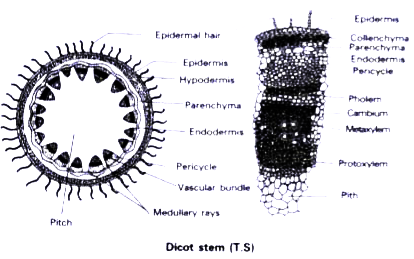
The structure of young dicot stem can be clearly understood by observing the transverse section of stem of Helianthus annus (sunflower ).It shows three major zones , namely epidermis , cortex and stele .
1. Epidermis : It is the outer most layer of rectangular or tubular cells arranged compactly without any intercellular spaces . On outer surface of epidermis , a waxy layer called Cuticle is fund . The cuticle is chemically composed of a substance cutin . The cell wall of epidermis also show the presence of cutin Stomata are present in the epidermis . Multicellular trichomes develop on the epidermis . The cuticle and the trichomes check the evaporation of water and protect the stem from high temperature .
The epidermal layer gives protection to the inner tissues and also prevents teh evaporation of water and protect the stem from high temperature .
The eidermal layer gives protection to the inner tissues and also prevents the evaporation of water from the plant body . through stomata , the epidermis allows the exchange of gases and promotes transpiration . Trichomes prevent entry of pathogens .
2.Cortex : The part extending between the epidermis and the stele is known as cortex . The cortex is smaller than the stele . It shows three sub - zones , namely , (i) Hypoderms (ii) general Cortex and (iii) Endormis .
(i) Hypodermis : This is the outermost part of cortex and composed of 3-6 rows of collenchymatous cells . It is found beneath the epidermis and helps in providing tensile stregth (elasticity ) to the stem . The cells are arranged compactly without intercellular spaces and show excessively thickened corners . The cells are filled with active vacuolated cytoplasm possessing chloroplasts . thus , the hypodermis also helps in the assimilation of food materials . It also gives mechanical strength .
(ii) General Cortex : It is found beneath the hypodermal layer layer and is made up of 5- 10 rows of thin walled , living parenchyma cells with or without intercellular spaces. these cells may be isodiametric or oval or spherical . the outer layers of cells contain chloroplasts and in the inner layers leucoplasts are found . the general cortex is primarily concerned with the assimilation and storage of food materials .
(iii) Endodermis : The inner most layer of cortex is called endormis . The cells are barrel shaped , compactly arranged without intercellular spaces . the endodermis cells contain vacuolated protoplasts and show starch grains . So it is also known as Starch Sheath .
3. Stele : The central conducting cylinder is called the Stele .It occupies a major part of the stem . It is composed of 4 parts .
(i) Pericycle (ii) Vascular bundles (iii) Pith or Medulla and (iv) Medullary rays .
(i) Pericycle : It is present in the form of a discontinuous ring and is made up 3-5 rows of the thick walled , dead , lignified cells which gives mechanical strength to the stele . it appears as semilunar patches of sclerenchyma above the vascular bundles with intervening masses of parenchyma .
(ii) Vascular bundles : About 15 - 20 vascular bundles are arranged in the form of a ring . this arrangement is called eustele . Each vascular bundle is wedge or top shaped . In the vascular bundles xylem and phloem are arranged on the same radius . A meristematic layer of cells called cambium is present in between the xylem and phloem . So they are called conjoint , collateral , open vascular bundles .Xylem is at lower side and phloem at the upper side of the vascular bundle .
Xylem consists of vessels and xylem parenchyma . There may be few tracheids and xylem fibres . The metaxylem is towards the pericycle and protoxylem towards the pith . This is called endarch xylem . Phloem consists of sieve tubes companion cells and phloem parenchyma . Xylem and phloem are vascular tissues which conduct water , mineral salts and organic solutes respectively .
(iii) Medulla : It is the central part of the stele and filled with thin walled parenchymatous cels , showing intercellular -spaces . It is well -developed , extensive and occupies a large part of the stele . The chief function of the medulla is to store food materials .
(iv) Medullary rays : The cells of the medulla extend to the periphery in between the vascular bundles . These cells are horizontal rows of thin walled , living and elongate radially , forming primary medullary rays .
The medullary rays connect the stele with the cortex and are helpful in lateral conduction .
.
Promotional Banner

Topper's Solved these Questions

  • HISTOLOGY AND ANATOMY OF FLOWERING PLANTS

    VIKRAM PUBLICATION ( ANDHRA PUBLICATION)|Exercise TEXTUAL EXERCISES|3 Videos
  • HISTOLOGY AND ANATOMY OF FLOWERING PLANTS

    VIKRAM PUBLICATION ( ANDHRA PUBLICATION)|Exercise IMPORTANT QUESTIONS |7 Videos
  • HISTOLOGY AND ANATOMY OF FLOWERING PLANTS

    VIKRAM PUBLICATION ( ANDHRA PUBLICATION)|Exercise SHORT ANSWER TYPE QUESTIONS |10 Videos
  • ECOLOGY AND ENVIRONMENT

    VIKRAM PUBLICATION ( ANDHRA PUBLICATION)|Exercise IMPORTANT QUESTIONS |45 Videos
  • LOCOMOTION AND REPRODUCTION IN PROTOZOA

    VIKRAM PUBLICATION ( ANDHRA PUBLICATION)|Exercise Important Questions|13 Videos

Similar Questions

Explore conceptually related problems

Describe the T.S of a Monocot stem .

In dicot stem

Draw the diagram of the T.S. of Dicot stem.

In a dicot root

T.S.A. of a cube is

Describe the internal structure of a Dicot Root .

During secondary growth of dicot stem, the growth of the phloem rays in relation to vascular cambium is

VIKRAM PUBLICATION ( ANDHRA PUBLICATION)-HISTOLOGY AND ANATOMY OF FLOWERING PLANTS -LONG ANSWER TYPE QUESTIONS
  1. Explain the process of secondary growth in stems of woody angiosperm w...

    Text Solution

    |

  2. Draw illustrations to bring out the anatomical difference betweeen ...

    Text Solution

    |

  3. Draw illustrations to bring out the anatomical difference betweeen ...

    Text Solution

    |

  4. Simple tissues is/are

    Text Solution

    |

  5. Complex tissues are

    Text Solution

    |

  6. Describe the internal structure of a dorsiventral leaf with the help o...

    Text Solution

    |

  7. Describe the internal structure of a dorsiventral leaf with the help o...

    Text Solution

    |

  8. Distinguish between the following Exarch and endarch condition or pr...

    Text Solution

    |

  9. Distinguish between the following Stele and vascular bundle .

    Text Solution

    |

  10. Distinguish between the following Protoxylem and metaxylem .

    Text Solution

    |

  11. Interfascicular cambium and cork cambium are

    Text Solution

    |

  12. What do you mean by closed vascular bundles

    Text Solution

    |

  13. Distinguish between the following Stem hair and root hair .

    Text Solution

    |

  14. Distinguish between the following Heart wood and sap wood .

    Text Solution

    |

  15. Distinguish between the following Spring wood and Autumn wood .

    Text Solution

    |

  16. What is stomatal apparatus? Explain the structure of stomata with a la...

    Text Solution

    |

  17. Describe the T.S of a dicot stem .

    Text Solution

    |

  18. Describe the T.S of a Monocot stem .

    Text Solution

    |

  19. Describe the internal structure of a Dicot Root .

    Text Solution

    |

  20. Describe the internal structures of a Monocot Root .

    Text Solution

    |

