Home
Class 11
BIOLOGY
Describe the T.S of a Monocot stem ....

Describe the T.S of a Monocot stem .

Text Solution

Verified by Experts
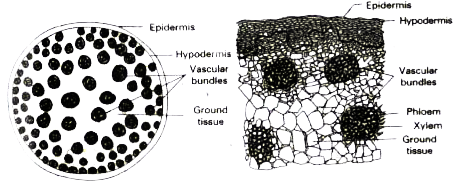
The structure of monocot stem can be understood well by observing the T.S of stem of Zea mays .It shows 4 distinct parts ., namely 1 . Epidermis , 2. Hypodermis 3. Ground tissue and 4 . Vascular bundles .
(1) Epidermis : It is the outermost layer composed of rectangular or tubular living cells arranged closely and compactly without intercellular spaces . The cells contain vacuolated protoplasts with a single nucleus but chloroplasts are absent . A waxy layer called .cuticle. is deposited on the external surface of the epidermis . Cuticle prevents the evaporation of water from the plant body . Trichomes are absent Numerous stomata are found in the epidermis through which exchange of gases occurs .
Epidermis gives protection to the inner tissues , helps in the exchange of gases and also prevents the evaporation of water .
Hypodermis : A distinct cortex is absent in Monocot stems . However a thick walled hypodermis is found beneath the epidermis .The cells of hypodermis are sclerenchymatous and are arranged compactly in 3-4 rows, without any intercellular spaces. It gives machanical strength of the stem .
Ground tissue : A major part of the stem is formed by an extensive soft , parencymatous tissue called the ground tissue . The peripheral layer consists of smaller cells while the inner layers show bigger cells . The cells of peripheral layers are chlorenchymatous and are connected with a assimilation of food materials .the inner layers of cells are concerned with storage of food materials . In monocot stem endodermis is absent .
Vascular bundles : Numerous vascular bundles are found scattered irregularly in the ground tissue . This kind of arrangement is called .atactostele. .It is considered an on advanced character . The inner vascular bundles are bigger in size and far apart from one another . The outer vascular bundles are smaller and are close to one another and found in one or teo circles .
Each vascular bundle is oval in shape and shows xylem and phloem together on the same radius . There is no cambium between xylem and phloem at the upper side of the vascular bundle . Each vascular bundle is enchosed by a sheath of sclenrenchymatous fibres . Hence it is called fibro vascular bundle .
Xylem consists of tracids , vessels ,fibres and parenchyma . Xylem vessels are few in number (4) and are arranged in "Y" shape . one or two protoxylem cells are crushed forming lysigeneous cavity called protoxylem lacunae which store water pholem consists of sieve tubes and companion cells . Phloem parenchyma is absent Medulla , Medullary rays and pericycle are also absent .
Promotional Banner

Topper's Solved these Questions

  • HISTOLOGY AND ANATOMY OF FLOWERING PLANTS

    VIKRAM PUBLICATION ( ANDHRA PUBLICATION)|Exercise TEXTUAL EXERCISES|3 Videos
  • HISTOLOGY AND ANATOMY OF FLOWERING PLANTS

    VIKRAM PUBLICATION ( ANDHRA PUBLICATION)|Exercise IMPORTANT QUESTIONS |7 Videos
  • HISTOLOGY AND ANATOMY OF FLOWERING PLANTS

    VIKRAM PUBLICATION ( ANDHRA PUBLICATION)|Exercise SHORT ANSWER TYPE QUESTIONS |10 Videos
  • ECOLOGY AND ENVIRONMENT

    VIKRAM PUBLICATION ( ANDHRA PUBLICATION)|Exercise IMPORTANT QUESTIONS |45 Videos
  • LOCOMOTION AND REPRODUCTION IN PROTOZOA

    VIKRAM PUBLICATION ( ANDHRA PUBLICATION)|Exercise Important Questions|13 Videos

Similar Questions

Explore conceptually related problems

Describe the T.S of a dicot stem .

Monocots have

In dicot stem

Draw the diagram of the T.S. of Dicot stem.

Cut a transverse section of young stem of a plant from your school garden and observe it under the microscope. How would you ascertain whether it is a monocot stem or dicot stem? Give reasons.

Describe the internal structures of a Monocot Root .

Describe modifications of stem with suitable examples

T.S.A. of a cube is

VIKRAM PUBLICATION ( ANDHRA PUBLICATION)-HISTOLOGY AND ANATOMY OF FLOWERING PLANTS -LONG ANSWER TYPE QUESTIONS
  1. Explain the process of secondary growth in stems of woody angiosperm w...

    Text Solution

    |

  2. Draw illustrations to bring out the anatomical difference betweeen ...

    Text Solution

    |

  3. Draw illustrations to bring out the anatomical difference betweeen ...

    Text Solution

    |

  4. Simple tissues is/are

    Text Solution

    |

  5. Complex tissues are

    Text Solution

    |

  6. Describe the internal structure of a dorsiventral leaf with the help o...

    Text Solution

    |

  7. Describe the internal structure of a dorsiventral leaf with the help o...

    Text Solution

    |

  8. Distinguish between the following Exarch and endarch condition or pr...

    Text Solution

    |

  9. Distinguish between the following Stele and vascular bundle .

    Text Solution

    |

  10. Distinguish between the following Protoxylem and metaxylem .

    Text Solution

    |

  11. Interfascicular cambium and cork cambium are

    Text Solution

    |

  12. What do you mean by closed vascular bundles

    Text Solution

    |

  13. Distinguish between the following Stem hair and root hair .

    Text Solution

    |

  14. Distinguish between the following Heart wood and sap wood .

    Text Solution

    |

  15. Distinguish between the following Spring wood and Autumn wood .

    Text Solution

    |

  16. What is stomatal apparatus? Explain the structure of stomata with a la...

    Text Solution

    |

  17. Describe the T.S of a dicot stem .

    Text Solution

    |

  18. Describe the T.S of a Monocot stem .

    Text Solution

    |

  19. Describe the internal structure of a Dicot Root .

    Text Solution

    |

  20. Describe the internal structures of a Monocot Root .

    Text Solution

    |

