The cyclic movement of nitrogen-from the atmosphere to soil and from soil back into the atmosphere through plants, animals and micro-organisms is termed as nitrogen cycle. Nitrogen7 cycle is a continuous pathway and it involves five steps.
1) Nitrogen Fixation
2) Nitrogen .Assimilation
3) Ammonification
4) Nitrification
5) Denitrification
1) Nitrogen Fixation : The gaseous dinitrogen is fixed into inorganic nitrogenous substances is called nitrogen fixation. It occurs by two methods.
a) Abiological or physical method, b) Biological method - Diazotrophy
a) Abiological or physical method :
1) It occurs in atmosphere. Due to thunders and lightening, dinitrogen is converted into nitric acid which is further oxidised to nitrogen dioxide.
2) These oxides dissolves in rain water and reaches.soil as nitrous and nitric acids.
3) These acids react with alkali radicles of soil and.form nitrates.
4) The soluble nitrates are directly absorbed by plants. The reactions of physical . nitrogen fixation are -as follows:
1) `N_(2) + O_(2) to 2NO`
(2) `2NO + O_(2) to 2NO_(2)`
3) `2NO_(2) + H_(2)O to HNO_(2) + HNO_(3)`
4) `HNO_(3) + Ca` or K salts `to` Ca or K nitrates.
5) A biological nitrogen fixation is carried out on industrial scale by Haber Bosch process at 0°C with 1000°C bars pressure.
b) Biological method - Diazotrophy :
1) Conversion of dinitrogen into nitrogenous compounds by prokaryotes is called biological nitrogen fixation. Such microbes are called as diazotrophs or nitrogen fixers.
Eg : Free-living bacteria,- Azotobacter, Clostridium.
Symbiotic bacteria - Rhizobium in the root nodules of Fabaceae members. Blue green algae - Nostoc and Anabaena.
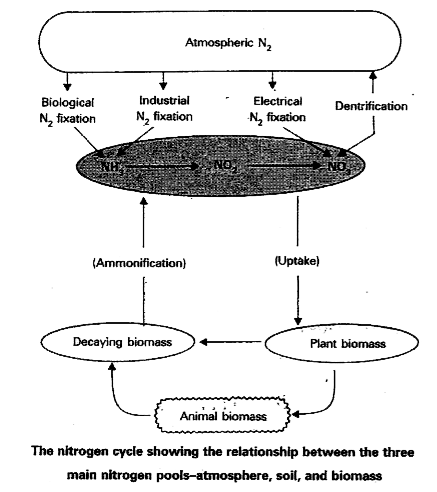
2) Nitrogen Assimilation: 1) The process of absorbing nitrates, Ammonia to produce organic nitrogen constituents is called nitrogen assimilation. It is the second step of nitrogen cycle. 2) Nitrates and Ammonia formed in the first step are-absorbed by plants and converted and constitute the organic nitrogen. 3) When plants are eaten by animals, this organic nitrogen is passed on into the animal body.
3) Ammonification: 1) The process of conversion of organic nitrogenous compounds from the dead bodies of plants and animals into ammonia is called Ammonification. It is mineralization process. 2) The bacteria responsible for this are called Ammonifying bacteria.
Eg : Bacillus ramosus, B. vulgaris, B. mycoides.
4) Nitrification :
1) This is fourth step of nitrogen cycle. It is an oxidative and an exergonic process.
2) The conversion of ammonia into nitrites and nitrates by bacteria is called nitrification. Such bacteria are called nitrifying bacteria. It occurs in two steps.
A) In the step, Ammonia is converted into nitrites by bacteria like Nitrosomonas and Nitrococcus.
`2NH_(3) + 3O_(2) to 2NO_(2)^(-) + 2H^(+) + 2H_(2)O`
B) In the next step, the nitrites are further oxidised to nitrates by Nitrobacter.
`2NO_(2)^(-) + O_(2) to 2NO_(3)^(-)`
5) Denitrification : This is. final step in nitrogen cycle. It is also exergonic process released around 11,000 cal of energy. Conversion of nitrates of soil into molecular dinitrogen is called denitrification. Denitrification occurs in four steps
`NO_(3)^(-) to NO_(2)^(-) to NO to N_(2)`
This process is brought about by denitrifying bacteria like Thiobacillus denitrificans, Pseudomonas denitrificans and Micrococcus denitrificans.


