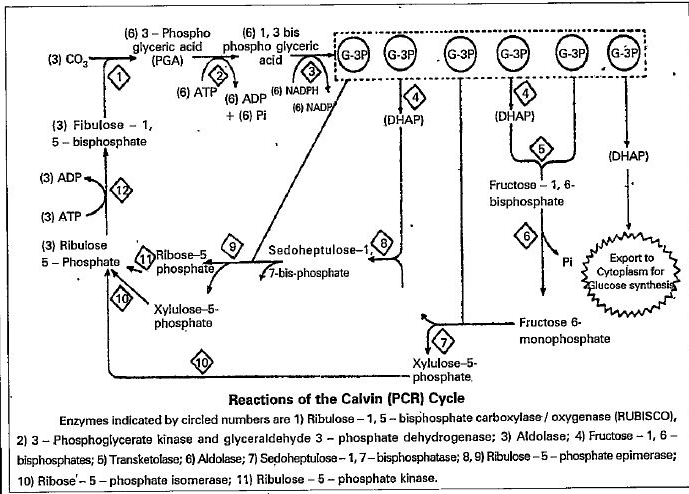
The plants in which the first stable product of photosynthesis is 3 - PGA are called `C_(3)` plants. The path of carbon in `C_(3)` plants was traced by Melvin Calvin, Benson and S.A. Bashaam (1945-1957).
The path of carbon in `C_(3)` plants can be represented in the form of a cycle called reductive pentose phosphate pathway or Calvin - Benson cycle or Photosynthetic Carbon Reduction (PCR) cycle. It takes place in stroma of the chloroplast and includes three main parts, namely carboxylation, reduction and regeneration.
I. Carboxylation : The carbon atom of carbondioxide is first fixed by RuBP, A6 - Carbon unstable compound is formed. It is spontaneously hydrolyserd into two molecules of PGA. The enzyme RuBP ase (Rubisco) catalyses the reaction. The enzyme is light activated.
II. Reduction : The second part of path of carbon is reduction of PGA to phosphoglyceraldehyde. This part includes the following reactions.
1. PGA is phosphorylated by phosphoglycero kinase to yield B is PGA. ATP donates the phosphate group.
2. Bis PGA is reduced by phosphoglycero dehydrogenase to yield phosphoglyceraldehyde. NADPH donates the hydrogen atoms. Energy rich phosphate group is released.
Some molecules of phosphoglyceradehyde are used to form starch.
III. Regeneration : For the continuity of photosynthetic carbon reduction, the primary acceptor RuBP should be regenerted. Regeneration of RuBP takes place in three pathways.
First pathway :
1. Some molecules of PGAL (3c) are isomerised by triose phosphate isomerase to yield DHAP (3c).
2. Some molecules of DHAP and PGAL are condensed into fructose bis-phosphate (6c) by aldolase.
3. Fructose bis - phosphate is dephosphorylated into fructose monophosphate (6c) by phosphatase. The enzyme is light activated. Energy rich phosphate radical is released.
4. Fructose monophosphate reacts with PGAL to form xylulose monophosphate (5c) and Erythrose monophosphate (4c). Transketolase catalyses the reaction.
5. Xylulose monophosphate is epimerised into Ribulose monophosphate (5c) by phosphopentose epimerase.
6. Ribulose monophosphate is phosphorylated by phosphoribulokinase to regenerate RuBP (5c). ATP donated the phosphate group. The enzyme is light activated.
Second Pathway :
1. Erythrose monophosphate (4c) condenses with DHAP (3c) to form Sedoheptulose bisphosphate (7c) Aldolase catalyses the reaction.
2. Sedoheptulose bis - phosphate is dephosphorylated byphosphatase into sedoheptulose monophyosphate (7c). Energy rich phosphate radical is released. The enzyme is light - activated.
3. Sedoheptulose monophosphate (7c) reacts with PGAL (3c) to form xyulose monophosphate (5c) and ribose monophosphate (5c). Transketolase catalyses the reaction.
4. Xylulose monophosphate is epimerised by phosphopentose epimerase into Ribulose monophosphate (5c).
5. Ribulose monophosphate is phosphorylated by phosphoribulokin-ase to regenerate RuBP. ATP donates the energy rich phosphate group. The enzyme is light activated.
Third Pathway :
1. Ribose monophosphate (5c) is isomerised by phosphopentose isomerase into ribulose monophosphate.
2. Ribose monophosphate is phosphorylated by phosphoribulokinase to regenerate RuBP. ATP donates the energy rich phosphate group. The enzyme is light activated.