Home
Class 12
BIOLOGY
Figure shows the effect of light on the ...

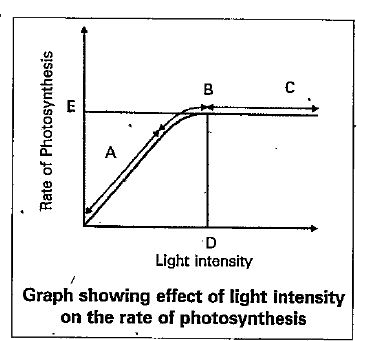
Figure shows the effect of light on the rate of photosynthesis. Based on the graph, answer the following questions.
a. At which points (A, B or C) in the curve is light a limiting factor ?
b. What could be the limiting factor/s in region A ?
c. What do C and D represent on the curve ?

Text Solution

Verified by Experts

a. In Region .A. Light is limiting factor where photosynthesis is minimum.
b. Light is the limiting factor in region A.
c. .D. shows the optimum point and gives the light intensity at which maximum photosynthesis is recorded. .C. shows the rate of photosynthesis remains constant after this point eveb though the density of light changes.
Promotional Banner

Topper's Solved these Questions

  • PHOTOSYNTHESIS IN HIGHER PLANTS

    VIKRAM PUBLICATION ( ANDHRA PUBLICATION)|Exercise IMPORTANT QUESTIONS |6 Videos
  • ORGANIC EVOLUTION

    VIKRAM PUBLICATION ( ANDHRA PUBLICATION)|Exercise SHORT ANSWER QUESTIONS |7 Videos
  • PLANT GROWTH AND DEVELOPMENT

    VIKRAM PUBLICATION ( ANDHRA PUBLICATION)|Exercise EXERCISES |13 Videos

Similar Questions

Explore conceptually related problems

Answer the following questions by observing the diagram. Identify the parts A,B,C and D

Draw a figure showing the following conditions. a) A,B,C are collinear points. b) A,D, C are non collinear points. c) Triangles formed by all these points.

Answer the following questions based on the diagram below involving 1 mole of ideal gas: The process which occurs in going from B rarr C is

Samples of four metals A, B, C and D were taken and added to the following solution one by one. The results obtained have been tabulated as follows. Use the Table above to answer the following questions about metals A, B, C and D. (i) Which is the most reactive metal? (ii) What would you observe if B is added to a solution of Copper(II) sulphate? (iii) Arrange the metals A, B, C and D in the order of decreasing reactivity.

Study the following isotherms of carbondioxide at various temperature and answer the following questions based on that: At 21.5°C decrease in volume(B-C) doesn't result into increase in pressure because

Answer the following questions based on the P-T phase diagram of CO_(2) : CO_(2) is heated to a temperature 70^(@) C and compressed Isothermally. What changes in its properties do you expect to observe ?

VIKRAM PUBLICATION ( ANDHRA PUBLICATION)-PHOTOSYNTHESIS IN HIGHER PLANTS -EXERCISES
  1. By looking at a plant externally can you tell whether a plant is C(3) ...

    Text Solution

    |

  2. By looking at a plant externally can you tell whether a plant is C(3) ...

    Text Solution

    |

  3. Even though a very few cells in a C(4) plant carry out the biosynthet...

    Text Solution

    |

  4. RUB is CO is an enzyme that acts as both as a carboxylase and oxygenas...

    Text Solution

    |

  5. Suppose there were plants that had a high concentration of chlorophyll...

    Text Solution

    |

  6. Why is the colour of a leaf kept in the dark frequently yellow or pale...

    Text Solution

    |

  7. Why was the plant kept in dark and then in sunlight ?

    Text Solution

    |

  8. Figure shows the effect of light on the rate of photosynthesis. Based ...

    Text Solution

    |

  9. Give comparison between the following : a. C(3) and C(4) pathways ...

    Text Solution

    |

  10. Cyanobacteria and some other photosynthetic bacteria do not have chlor...

    Text Solution

    |

  11. Why photorespiration does not occur in C(4) plants ?

    Text Solution

    |

  12. The orange colour of carrot root is due to the presence of

    Text Solution

    |

  13. What is the reason to keep a plant in dark for 48 hours to conduct exp...

    Text Solution

    |

  14. Photosynthetic organisms occur at different depths in oceam. Do they r...

    Text Solution

    |

  15. Look at the acivities listed below. Reason out whether or not, work is...

    Text Solution

    |

  16. The matrix of both chloroplast and mitochondria are similar in having

    Text Solution

    |

  17. Write some of the events that occur in the chloroplasts during photosy...

    Text Solution

    |

  18. Which of the following statements about absorption spectrum is correct...

    Text Solution

    |
