

Home
Class 11
PHYSICS
A rod is hinged (free to rotate) ast its...

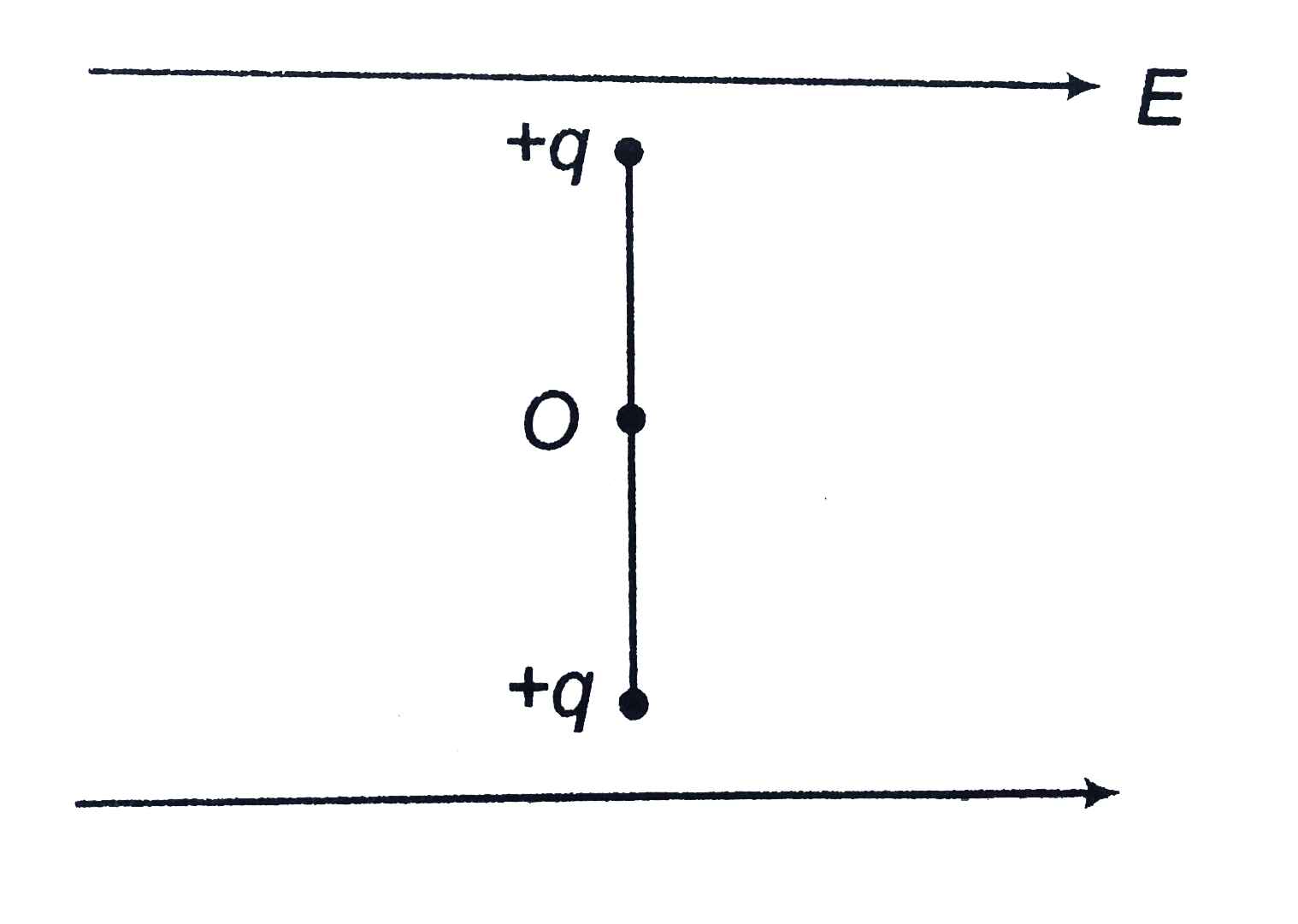
A rod is hinged (free to rotate) ast its centre O as shown in figue. Two point charge `+q` and `+q` are kept at its two ends. Rod is placed in uniform electric field E as shown. Space is gravity free. Choose the correct options.

Promotional Banner

Similar Questions

Explore conceptually related problems

Two concentric spherical shells have charges +q and -q as shown in figure. Choose the correct options.

A charge Q is placed at the centre of the line joining two point charges +q and +q as shown in figure. The ratio of charges Q and q is

A bead is contrained to move on rod in granvity free space as shown in figure. The rod rotating with ,angular velocity and angulnr acceleration alpha about its end. If mu is coefficient of friction. Mark the correct option. ( Rod rotates in the plane of paper.)

A uniform rod of length L and mass m is free to rotate about a frictionless pivot at one end as shown in figure. The rod is held at rest in the horizontal position and a coin of mass m is placed at the free end. Now the rod is released The reaction on the coin immediately after the rod starts falling is

A positive point charge Q is kept (as shown in the figure) inside a neutral conducting shell whose centre is at C. An external uniform electric field E is applied. Then :

A rod OA is suspended with the help of a massless string AB as shown in figure. Rod is hinged at point O . Draw free body diagrame of the rod.

A massless uniform rod is subjected to froce F at its free end as shown in figure. The ratio of tensile stress at plane P_(1) to stress at P_(2) is

A massless rod of length L has two equal charges (q) tied to its ends. The rod is free to rotate in horizontal plane about a vertical axis passing through a point at a distance (L)/(4) from one of its ends. A uniform horizontal electric field (E) exists in the region. (a) Draw diagrams showing the stable and unstable equilibrium positions of the rod in the field. (b) Calculate the change in electric potential energy of the rod when it is rotated by an angle Deltatheta from its stable equilibrium position. (c) Calculate the time period of small oscillations of the rod about its stable equilibrium position. Take the mass of each charge to be m.