Home
Class 12
PHYSICS
A tunnel is dug along a chord of non rot...

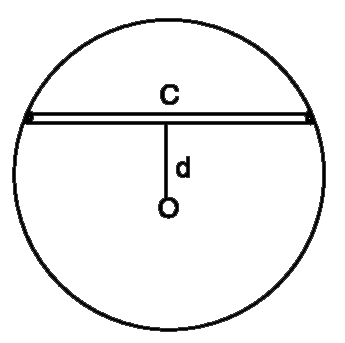
A tunnel is dug along a chord of non rotating earth at a distance `d=(R)/(2)` [R = radius of the earth] from its centre. A small block is released in the tunnel from the surface of the arth. The block comes to rest at the centre (C) of the tunnel. Assume that the friction coefficient between the block and the tunnel wall remains constant at `mu.`
Calculate work done by the friction on the block. Calculate `mu.`


Promotional Banner

Similar Questions

Explore conceptually related problems

A tunnel is dug along a chord of Earth having length sqrt(3)R is radius of Earth. A small block is released in the tunnel from the surfasce of Earth. The particle comes to rest at the centre of tunnel. Find coefficient of friction between the block and the surface of tunnel. Ignore the effect of rotation of Earth.

A tunnel is dug across the earth of mass 'M' and radius 'R' at a distance R//2 from the centre 'O' of the Earth as shown. A body is released from rest from one end of the smooth tunnel. The velocity acquired by the body when it reaches the centre 'C' of the tunnel is

A tunnel ois dug along a chord of the earth a perpendicular distance R/2 from the earth's centre. The wall of the tunnel may be assumed to be frictionless. Find the force exerted by the eall on a particle of mass m when it is at a distance x from the centre of the tunnel.

Imagine a smooth tunnel along a chord of nonrotating earth at a distance (R)/(2) from the centre. R is the radius of the earth. A projectile is fired along the tunnel from the centre of the tunnel at a speed V_(@)=sqrt(gR) [g is acceleration due to gravity at the surface of the earth]. (a) Is the angular momentum [about the centre of the earth] of the projectile onserved as it moves along the tunnel? (b) Calculate the maximum distance of the projectile from the centre of the earth during its course of motion.

A tunnel is dug along a chord of the earth at a perpendicular distance R//2 from the earth's centre. The wall of the tunnel may be assumed to be frictionless. A particle is released from one end of the tunnel. The pressing force by the particle on the wall, and the acceleration of the particle vary with x (distance of the particle from the centre) according to

Assume that a tunnel is dug along a chord of the earth, at a perpendicular distance (R//2) from the earth's centre, where 'R' is the radius of the Earth. The wall of the tunnel is frictionless. If a particle is released in this tunnel, it will execute a simple harmonic motion with a time period :

A smooth tunnel is dug along the radius of the earth that ends at the centre. A ball is released from the surface of earth along the tunnel. If the coefficient of restitution is 0.2 between the surface and ball, then the distance travelled by the ball before second collision at the centre is