Home
Class 10
PHYSICS
Fig. shows a light (blue + red + green) ...

Fig. shows a light (blue + red + green) incident on a prism and on a parallel sided glass slab. Complete the diagrams by drawing the refracted and the emergent rays.
` (##SEL_RPG_ICSE_PHY_X_C06_SLV_001_Q01.png" width="80%">

Text Solution

Verified by Experts
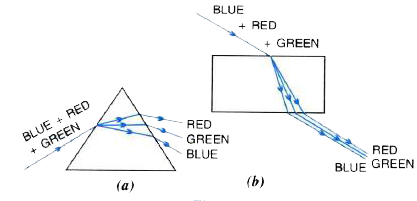
The completed ray diagrams are shown in Fig. 6.4.
In a prism, refraction takes place at two inclined surfaces, so the prism causes dispersion and deviation of light into its constituent colours and a spectrum is seen.
In case of a parallel sided glass slab, refraction takes place at two parallel surfaces. On the first surface, the colours are separated due to different deviation for the rays of different colours i.e., dispersion takes place. On the second surface, the ray of each colour is refracted such that the emergent ray is parallel to the incident ray on the first surface. Since there is no further separation of colours due to refraction at the second surface (as it is in case of the prism), so the emergent coloured rays are parallel to each other and they are so close that it is difficult to see the separate colours and the emergent light appears to be almost white (= blue + red + green).
Promotional Banner

Topper's Solved these Questions

  • SPECTRUM

    ICSE|Exercise EXERCISE A|40 Videos
  • SPECTRUM

    ICSE|Exercise EXERCISE A (MULTIPLE CHOICE TYPE)|6 Videos
  • SPECIMEN QUESTION PAPER

    ICSE|Exercise QUESTIONS|33 Videos
  • WORK,POWER AND ENERGY

    ICSE|Exercise DIAGRAM BASED MCQ|3 Videos

Similar Questions

Explore conceptually related problems

Match the properties and uses of alloys in List 1 with the appropriate answer from List 2. (##EVR_BLK_ICSE_CHE_X_C07_E06_054_Q01.png" width="80%">

Calculate the angles x,y and z if (x)/(3) = (y)/(4) =(z)/(5) (##SEL_RKB_ICSE_MAT_X_C17_E02_042_Q01.png" width="80%">

Two cars A and B move in mutually perpendicular, directions as shown in the figure . Find v_(BA) (##AAK_T1_PHY_C02_SLV_051_Q01.png" width="80%">

In the given figure. A is the centre of the circle , ABCD is a parallelogram and CDE is a straight line. Prove that : angle BCD = 2 angle ABE (##SEL_RKB_ICSE_MAT_X_C17_E02_036_Q01.png" width="80%">

In the given figure. AB is the diameter of the circle with centre O. (##SEL_RKB_ICSE_MAT_X_C17_E04_012_Q01.png" width="80%> If angle ADC = 32 ^(@) , find angle BOC.

A beam consisting of red, blue and yellow colours is incident normally on the face AB of an isosceles right angled prism ABC as shown in Fig. 6.5. Complete the diagram to show the refracted and the emergent rays. Given that the critical angle of glass-air interface for yellow colour is 45^(@)

Diagram (a) and (b) in figure below show the refraction of a ray of light of single colour through a prism and a parallel sided glass slab respectively. (i) In each diagram, label the incident, refracted, emergent rays and the angle of deviation. (ii) In what way the direction of the emergent ray in the two cases differ with respect to the incident ray ? explain your answer.

The given diagram is highly diagrammatic representation of mammalian heart. In this diagram (##EVR_ANM_ICSE_BIO_X_C07_E01_020_Q01.png" width="80%"> What do the arrows indicate ?

The diagram below shows two parallel rays A and B of red and violet light respectively incident from air on air-glass boundary. Complete the diagram showing the refracted rays for them in the glass. (i) How do the speeds of the rays differ in glass ? (ii) are the two refracted rays in glass parallel ? Give a reason for your answer. (iii) How does the refractive index of glass differ for the two rays ?

