

Home
Class 10
PHYSICS
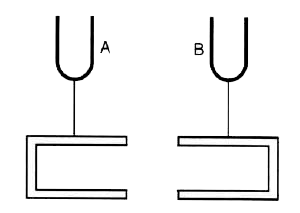
Fig. shows two tuning forks A and B of ...

Fig. shows two tuning forks A and B of the same frequency mounted on two separate sound boxes with their open ends facing each other. The fork A is set into vibration. (a) Describe your observation. (b) State the principle illustrated by this experiment.

Promotional Banner

Topper's Solved these Questions

  • SOUND

    ICSE|Exercise EXERCISE -7(B)( MULTIPLE CHOICE TYPE)|2 Videos
  • SOUND

    ICSE|Exercise EXERCISE -7(C )|47 Videos
  • SOUND

    ICSE|Exercise EXERCISE -7(A) (NUMERICALS )|14 Videos
  • SIMPLE MACHINES

    ICSE|Exercise DIAGRAM BASED MCQ|5 Videos
  • SPECIMEN PAPER (SOLVED)

    ICSE|Exercise SECTION II|78 Videos

Similar Questions

Explore conceptually related problems

Two tuning forks vibrate with the same amplitude but the frequency of the first is double the frequency of the second. Which fork produces more intense sound in air ?

Two tuning forks, A and B, produce notes of frequencies 258 Hz and 262 Hz. An unknown note sounded with A produces certain beats. When the same note is sounded with B, the beat frequency gets doubled. The unknown frequency is

Two tuning forks when sounded together produced 4beats//sec . The frequency of one fork is 256. The number of beats heard increases when the fork of frequency 256 is loaded with wax. The frequency of the other fork is

Two tuning forks A and B are vibrating at the same frequency 256 Hz. A listener is standing midway between the forks. If both tuning forks move to the right with a velocity of 5(m)/(s) , find the number of beats heard per second by the listerner (speed of sound in air is 330(m)/(s) ).

Two tuning forks A and B are vibrating at the same frequency 256 Hz. A listener is standing midway between the forks. If both tuning forks move to the right with a velocity of 5(m)/(s) , find the number of beats heard per second by the listerner (speed of sound in air is 330(m)/(s) ).

Two tuning fork A and B are sounded together gives 5 beats per second. If frequency of B is 260 Hz and after loading A with was the beat frequency increases the frequency of A is

Two tuning forks A and B produce 4 beats//s when sounded together . A resonates to 32.4 cm of stretched wire and B is in resonance with 32 cm of the same wire . Determine the frequencies of the two tuning forks .

Two tuning forks of frequencies 256 and 258 vibrations/second are sounded together. Then the time interval between two consecutive maxima heard by an observer is

Two tuning forks A and B having a frequency of 500 Hz each are placed with B to the right of A. An observer in between the forks in moving towards B with a speed of 25 m/s. The speed of sound is 345 m/s and the wind speed is 5 m/s from A to B. Calculate the difference in the two frequencies heard by observer.

A tuning fork of frequency n is held near the open end of tube, the tube is adjusted until resonance occurs. If the two shortest lengths to produce resonance are L_1 and L_2 , then the speed of the sound is

ICSE-SOUND-EXERCISE -7(B)
  1. The diagram in Fig. shows the displacement time graph of a vibrating b...

    Text Solution

    |

  2. The diagram in Fig. shows the displacement time graph of a vibrating b...

    Text Solution

    |

  3. A tuning fork is vibrating in air. State whether the vibrations are na...

    Text Solution

    |

  4. The diagram below shows the displacement-time graph for a vibrating bo...

    Text Solution

    |

  5. What are forced vibrations ? Give one example to illustrate your answe...

    Text Solution

    |

  6. When the stem of a vibrating tuning fork is gently pressed on the surf...

    Text Solution

    |

  7. State two differences between natural and forced vibrations.

    Text Solution

    |

  8. What is meant by Resonance ?

    Text Solution

    |

  9. State the condition for the resonance to occur.

    Text Solution

    |

  10. Complete the following sentence : Resonance is a special case of ........

    Text Solution

    |

  11. State two differences between the forced and resonant vibrations.

    Text Solution

    |

  12. Why is a loud sound heard at resonance ?

    Text Solution

    |

  13. Fig. shows two tuning forks A and B of the same frequency mounted on...

    Text Solution

    |

  14. A vibrating tuning fork, held over an air column of a given length wit...

    Text Solution

    |

  15. In Fig. , A, B, C and D represent the test tubes each of height 20 cm ...

    Text Solution

    |

  16. In Fig. , A, B, C and D represent the test tubes each of height 20 cm ...

    Text Solution

    |

  17. In Fig. , A, B, C and D represent the test tubes each of height 20 cm ...

    Text Solution

    |

  18. Marching soldiers are asked to break their steps while crossing a brid...

    Text Solution

    |

  19. Explain, why stringed musical instruments, like the guitar, are provid...

    Text Solution

    |

  20. How do you tune your radio set to a particular station ? Name the phen...

    Text Solution

    |