Home
Class 9
PHYSICS
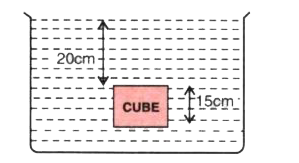
Fig. 4.11 shows a cube of each side 15 c...

Fig. 4.11 shows a cube of each side 15 cm immersed in a tube containing water of density `10^(3) kg m^(-3)` such that its top surface is 20 cm below the free surface of water.

Calculate (i) the pressure at the top of cube,
(ii) the pressure at the bottom of cube,
(iii) the resultant pressure on cube.
(iv) the resultant thrust on cube.
Take atmospheric pressure = `10^(5)` Pa and `g=9.8 N kg^(-1)`.

Text Solution

Verified by Experts

Given, atmospheric pressure `P_(0)=10^(5)Pa, g=9.8N kg^(-1)` , depth to top of the cube from the free surface of water `h_(1)=20 cm=0.2m` , depth of bottom of cube from the free surface of water `h_(2)=(20+15)cm=35=0.35 m`
(i) Pressure at the top surface of cube
`P_(1)=P_(0)+h_(1)rhog`
`=10^(5)+(0.20xx10^(3)xx9.8)`
`=1.0196xx10^(5)Pa`
(ii) Pressure at the bottom surface of cube
`P_(2)=P_(0)+h_(2)rhog`
`=10^(5)+(0.35xx10^(3)xx9.8)`
`=1.0343xx10^(5)Pa`
(iii) Resultant pressure on cube
`=P_(2)-P_(1)=1.0343xx10^(5)-1.0196xx10^(5)`
`=0.0147xx10^(5)Pa(or 1.47xx10^(3)Pa)`
(iv) Area of base of cube
`15cmxx15cm`
`=(15)/(100)mxx(15)/(100)m=225xx10^(-4)m^(2)`
`:.` Resultant pressure xx area of base
`=(1.47xx10^(3))xx(225xx10^(-4))`
`=33.074 N ("upwards")`
Note: The resultant pressure on cube will be upwards. The resultant thrust acting on cube in upward direction is called upthrust. Obviously this upthrust depends on the immersed volume (= area of base xx height) of the cube and not on its depth inside water. Here we can note that if cube is replaced by a lamina which has negligible thickness `( h to 0)`, pressure on the two sides of lamina will be equal, hence upthrust on it will be zero.
Promotional Banner

Topper's Solved these Questions

  • PRESSURE IN FLUIDS AND ATMOSPHERIC PRESSURE

    ICSE|Exercise Exercise-4(A)|31 Videos
  • PRESSURE IN FLUIDS AND ATMOSPHERIC PRESSURE

    ICSE|Exercise Exercise-4(A)multiple choice |4 Videos
  • MOTION IN ONE DIMENSION

    ICSE|Exercise EXERCISE -2 (C) ( Multiple choice type :) |17 Videos
  • PROPAGATION OF SOUND WAVES

    ICSE|Exercise EXERCISE -8(B) (Multiple choice type)|3 Videos

Similar Questions

Explore conceptually related problems

In the below figure shows a cube of each side 15 cm immersed in a tub containing water of density 10^3 "kgm"^(-3) such that its top surface in 20 cm below the free surface of water. Calculate the pressure at the top of the cube Take atmosphere pressure = 10^5 Pa and g=9.8 "ms"^(-2)

In the below figure shows a cube of each side 15 cm immersed in a tub containing water of density 10^3 "kgm"^(-3) such that its top surface in 20 cm below the free surface of water. Calculate the pressure at the bottom of cube Take atmosphere pressure = 10^5 Pa and g=9.8 "ms"^(-2)

In the below figure shows a cube of each side 15 cm immersed in a tub containing water of density 10^3 "kgm"^(-3) such that its top surface in 20 cm below the free surface of water. Calculate the resultant thrust on cube Take atmosphere pressure = 10^5 Pa and g=9.8 "ms"^(-2)

The surface area of a cube is 150 cm ^(2) Find : the volume of the cube :

If the volume of a cube is 125 cm^(3) , then its surface area is

The total surface area of a cube is 96 cm^(2) . The volume of the cube is

A cube of ice of side length 10 cm is floating in water of density 1000 kg//m^(3) . Then pick up the correct statement (density of ice = 900 kg//m^(3) )

The lateral surface area of a cube us 256m^(2) . The volume of the cube is.

At what depth below the surface of water will pressure be equal to twice the atmospheric pressure ? The atmospheric pressure is 10N cm^(-2) , density of water is 10^(3)kg m^(-3) and g=9.8 ms^(-2) .

How many cubes of side 2 cm can be made from a solid cube of side 10 cm ?
