Home
Class 9
MATHS
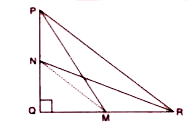
M and N are point on sides QR and PQ res...

M and N are point on sides QR and PQ respectively of `/_\ PQR`, right-angled at Q. Prove that :
`PM^(2)+RN^(2)=PR^(2)+MN^(2)`

Text Solution

Verified by Experts

The correct Answer is:

`PM^(2)+RN^(2)=PR^(2)+MN^(2)`
Promotional Banner

Topper's Solved these Questions

  • PYTHAGORAS THEORAM

    ICSE|Exercise EXERCISE 13(B)|18 Videos
  • MID-POINT THEOREM

    ICSE|Exercise 4 MARKS QUESTION |15 Videos
  • PYTHAGORAS THEOREM

    ICSE|Exercise 4 MARKS QUESTIONS|9 Videos

Similar Questions

Explore conceptually related problems

M and N are mid- point on sides QR and PQ respectively of /_\ PQR , right-anggled at Q. Prove that : PM^(2)+RN^(2)= 5 MN^(2) .

M and N are mid point on sides QR and PQ respectively of /_\ PQR , right-anggled at Q. Prove that : 4PM^(2)= 4PQ^(2)+QR^(2) .

M and N are the mid-points of the sides QR and PQ respectively of a DeltaPQR , right-angled at Q. Prove that : (i) PM^(2)+RN^(2)=5MN^(2) (ii) 4PM^(2)=4PQ^(2)+QR^(2) (iii) 4RN^(2)=PQ^(2)+4QR^(2) (iv) 4(PM^(2)+RN^(2))=5PR^(2)

P and Q are points on the sides C A and C B respectively of A B C , right-angled at C . Prove that A Q^2+B P^2=A B^2+P Q^2 .

D and E are points on the sides CA and CB respectively of a triangle ABC right angled at C. Prove that A E^2+B D^2=A B^2+D E^2 .

D and E are points on the sides CA and CB respectively of a triangle ABC right angled at C. Prove that A E^2+B D^2=A B^2+D E^2 .

In Figure, Pa n dQ are the midpoints of the sides C Aa n dC B respectively of A B C right angled at C. Prove that 4(A Q^2+B P^2)=5A B^2 .

In a right triangle A B C right-angled at C ,\ P and Q are the points on the sides C A and C B respectively, which divide these sides in the ratio 2:1 . Prove that 9AQ^2=9AC^2+4BC^2

In a right triangle A B C right-angled at B , if P a n d Q are points on the sides A Ba n dA C respectively, then (a) A Q^2+C P^2=2(A C^2+P Q^2) (b) 2(A Q^2+C P^2)=A C^2+P Q^2 (c) A Q^2+C P^2=A C^2+P Q^2 (d) A Q+C P=1/2(A C+P Q)dot

S and T are points on the sides PQ and PR, respectively of Delta PQR , such that PT = 2 cm, TR = 4 cm and ST is parallel to QR. Find the ratio of the areas of Delta PST and Delta PQR .
