


Topper's Solved these Questions
TANGENTS AND INTERSECTING CHORDS
ICSE|Exercise EXERCISE 18 (B)|18 VideosTANGENTS AND INTERSECTING CHORDS
ICSE|Exercise EXERCISE 18 (C)|42 VideosTANGENTS AND INTERSECTING CHORDS
ICSE|Exercise EXERCISE 18 (C)|42 VideosSPECIMEN QUESTION PAPER (MATHEMATICS)
ICSE|Exercise Section C|12 VideosTRIGONOMETRICAL IDENTITIES
ICSE|Exercise QUESTIONS|22 Videos
Similar Questions
Explore conceptually related problems
ICSE-TANGENTS AND INTERSECTING CHORDS-EXERCISE 18(A)
- Two concentric circles are of radii 5 cm and 3 cm. Find the length ...
Text Solution
|
- Three circles touch each other externally. A triangle is formed when t...
Text Solution
|
- A quadrilateral ABCD is ABCD is drawn to circumscribe a circle. Prove ...
Text Solution
|
- If the sides of a parallelogram touch a circle prove that the parallel...
Text Solution
|
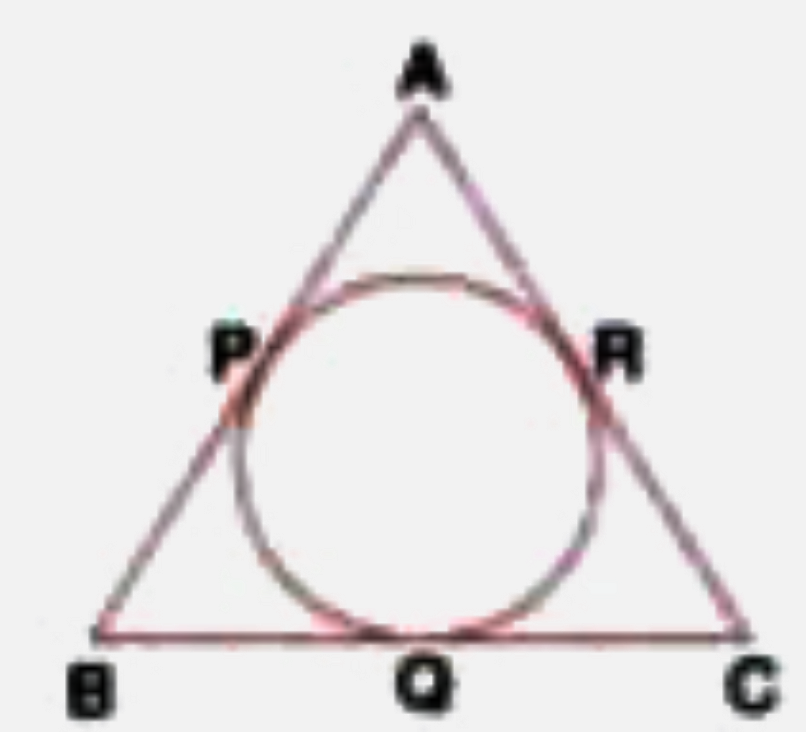
- From the given figure, prove that : AP+BQ+CR=BP+CQ+AR Also show tha...
Text Solution
|
- In the figure if AB=AC then prove that BR=CR
Text Solution
|
- Radii of two circles are 6.3 cm and 3.6 cm. State the distance between...
Text Solution
|
- From a point P outside a circle, with centre O, tangents PA and PB are...
Text Solution
|
- In the given figure, two circles touch each other externally at point ...
Text Solution
|
- Tangents AP and AQ are drawn to a circle, with centre O, from an exter...
Text Solution
|
- Two parallel tangents of a circle meet a third tangent at points P and...
Text Solution
|
- ABC is a right angled triangle with AB=12 cm and AC=13 cm. A circle, w...
Text Solution
|
- In a triangle ABC, the incircle (centre O) touches BC , CA and AB at p...
Text Solution
|
- In the following figure PQ and PR are tangents to the circle with the ...
Text Solution
|
- In the giben figure, AB is the diameter of the circle, with centre O a...
Text Solution
|
- In quadrilateral ABCD angled D=90^(@), BC=38cm and DC=25cm. A circle i...
Text Solution
|
- In the given figure, PT touches the circle with centre O at point R. D...
Text Solution
|
- PT is a tangent to the circle at T. If /ABC=70^(@) and /ACB=50^(@), ...
Text Solution
|
- In the given figure, O is the centre of the circumcircle of triangleAB...
Text Solution
|
- In the given PQ is a tangent to the circle at A. AB and AD are bisecto...
Text Solution
|