

Home
Class 12
PHYSICS
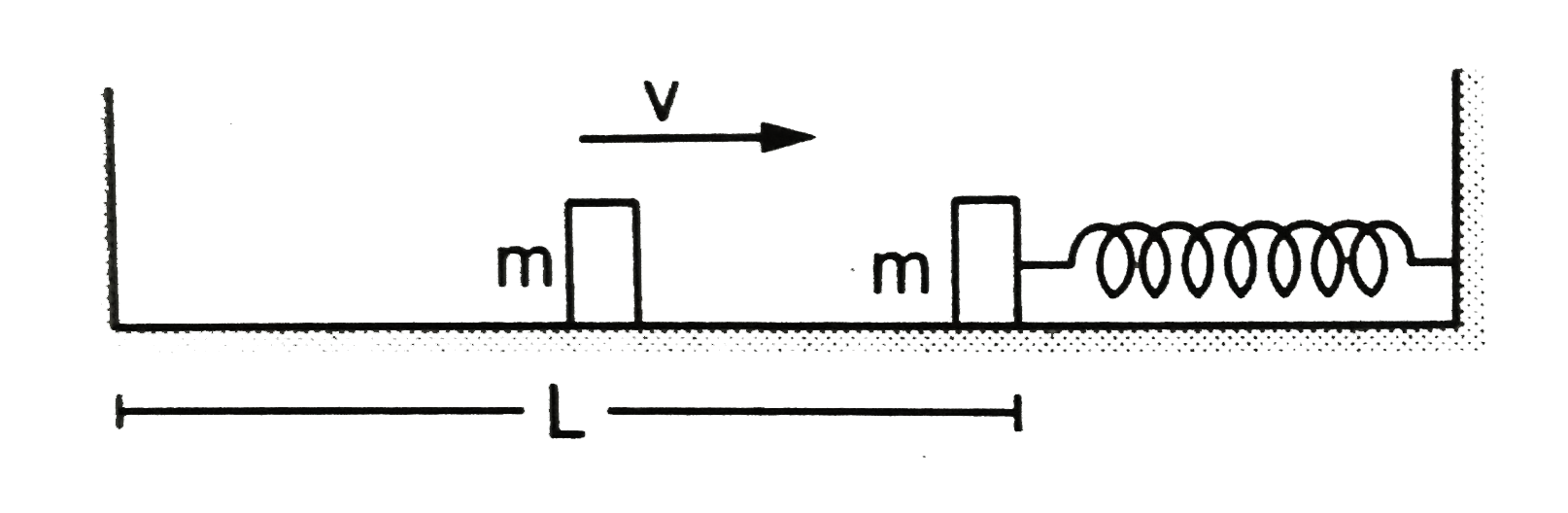
The left block in figure moves at a spee...

The left block in figure moves at a speed v towards the right block placed in equilibrium. All collilsions to take place are elastic and the surfaces are frictionless. Show that motion of the two blocks are periodic. Find the timepoerid of these periodic motions. Neglect the widths of the blocks.

Promotional Banner

Similar Questions

Explore conceptually related problems

The right block in figure moces at a speed V towards the left block placed in equilibrium. All the surfaces are smooth and all the collisions are elastic. Find the time period motion. Neglect the width of the blocks.

The right block in figure moces at a speed V towards the left block placed in equilibrium. All the surfaces are smooth and all the collisions are elastic. Find the time period motion. Neglect the width of the blocks.

A block of mass m moves with a speed v towards the right block which is in equilibrium with a spring attached to rigid wall. If the surface is frictionless and collisions are elastic, the frequency of collisions between the masses will be:

The left block in figure collides inelastically with the right block and striks to it. Find the amplitude of the resulting simple harmonic motion

The left block in figure collides inelastically with the right block and sticks to it. Find the amplitude of the resulting simple harmonic motion.

Find the elastic potential energy stored in each spring shown in figure, when the block is in equilibrium. Also find the time period of vertical oscillation of the block.

The left block in filgure collides inelastically with the right block and sticks to it. Find the amplitude of the resulting simple harmonic motion.

(a) The right block collides with left block and sticks to it. Find amplitude of the resulting SHM. (b) The block starts from left wall and moves with constant speed v. All collisions are elastic. Find time period of periodic motion.

Figure shows a small block of mass m which is started with a speed v on the horizontal part of the bigger block of mas m placed on a horizontal floor. The curved part of the surface shown is semicircular. All the surfaces are frictionless. Find the speed of the bigger block when the smaller block reaches the point A of the surface.

A block is placed on a rough horizontal plane. Three horizontalforces are applied on the block as shown in the figure. If the block is in equilibrium, find the friction force acting on the block.