

Home
Class 11
PHYSICS
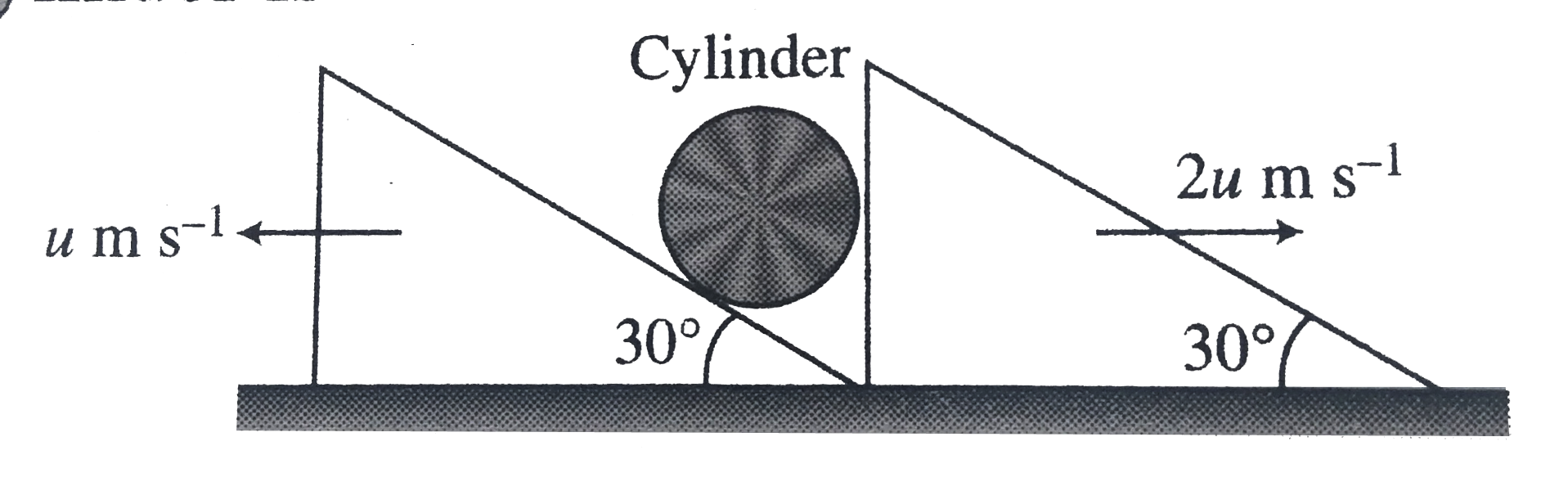
A system is shown in fig. Assume that th...

A system is shown in fig. Assume that the cylinder remains in contact with the two wedge. Then the velocity of cylinder is

Promotional Banner

Similar Questions

Explore conceptually related problems

System is shown in fig. and wedge is moving toward left with speed 2ms^(-1) . Find the velocity of the block B.

A system of identical cylinders and plates is shown in Fig. All the cylinders are identical and there is no slipping at any contact. The velocity of lower and upper plates are V and 2V , respectively, as shown in Fig. Then the ratio of angular speeds of the upper cylinders to lower cylinders is

A bullet of mass m moving with a velocity of u just grazes the top of a solid cylinder of mass M and radius R resting on a rough horizontal surface as shown and is embedded in the cylinder after impact. Assuming that the cylinder rolls without slipping, find the angular velocity of the cylinder and the final velocity of the bullet.

A cylinder is rotating with angular velocity omega_(0) and is gently put on a rough horizontal floor. Assume mass of the cylinder is m and radius R. Calculate the velocity of cylinder when it starts pure rolling on the surface.

A cylinder of radius R has been placed in a corner as shown in the fig. A wedge is pressed against the cylinder such that its inclined surfaces touches the cylinder at a height of (2R)/(5) from thw ground. Now the wedge is pushed to the left at a constant speed V = 15 m//s . With what speed will the cylinder move?

A cylinder of weight W and radius R is to be raised onto a horizontal step of height h as shown in Fig. A rope is wrapped around the cylinder and pulled horizontally with force F . Assuming the cylinder does not slip on the step, find the minimum force F necessary to raise the cylinder.

In the arrangement shown in figure the cylinder of mass M is at rest on an incline. The string between the cylinder and the pulley (P) is horizontal. Find the minimum coefficient of friction between the incline and the cylinder which can keep the system in equilibrium. Also find the mass of the block. Assume no friction between the pulley (P) and the string.

A hollow cylinder of radius R rotates about its axis which is vertical. A block remains in contact with the inner wall if the frequency of rotation is f hertz, but falls at lower frequaencies. The coefficient of friction between the block and the cylinder is

A cylinder of height H and diameter H//4 is kept on a frictional turntable as shown in Fig. The axis of the cylinder is perpendicular to the surface of the table and the distance of axis of the cylinder is 2H from the centre of the table. The angular speed of the turntable at which the cylinder will start toppling (assume that friction is sufficient to prevent slipping) is