

Home
Class 10
MATHS
The first figure above is an equilateral...


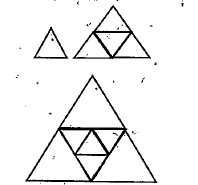
The first figure above is an equilateral triangle of sides 2 centimetres. The second figure is obtained by drawing lines passing thròugh' the vertices and parallei to the sides of the triangle in the first figure. The third figure is got by drawing lines' passing through the veritces and parallel to the sides of the triangle in the second figure.
a) Write the sequence of perimeters of biggest triangle in each figure obtained by continuing this process.
b)Write the sequence of areas of biggest triangle in each figure:
c)Write algebraic forms of both of the above sequences.

Promotional Banner

Topper's Solved these Questions

  • CIRCLES

    V PUBLICATION|Exercise QUESTION BANK|89 Videos

Similar Questions

Explore conceptually related problems

What is the circum radius of an equilateral triangle of sides 8 centimetres?

What is the area of the circumcircle of an equilateral triangle of sides 6 centimetres.

Find the in radius of an equilateral triangle of side 10cm . User r=A/s .

Write the sequence of the perimeters of the equilateral triangles having sides 1cm,2cm,3cm. Write the sequence of area.

We have seen how we can draw a series of right triangles as in the picture. What are the lengths of the sides of the tenth triangle? .

Write the sequence of the perimeters of the equilateral triangles having sides 1cm,2cm,4cm. Write the sequence of sum of angles.

In the figure, a side of the triangle is 12 centimetres and the angle at its ends are are 45∘ and 60∘ i) Find the length of the other two sides of the triangle. ii) Find the perimeter of this triangle.

The end points of one side of an equilateral triangle are -2 and 4 on the number line. Find the area and perimeter of this triangle.

In the figure small triangles are drawn joining the mid points of large triangle. Find the length of sides of large triangle.

V PUBLICATION-ARITHMETIC SEQUENCES-Question Bank
  1. Write down the first three terms of the sequence of natural numbers le...

    Text Solution

    |

  2. 'In these figures, the sides. of the smaller squares are in the arithm...

    Text Solution

    |

  3. The first figure above is an equilateral triangle of sides 2 centimetr...

    Text Solution

    |

  4. The first term of an arithmetic sequence is 2 and the common differenc...

    Text Solution

    |

  5. The 25^(th) term of an arithmetic sequence is 140 and the 27^(th) term...

    Text Solution

    |

  6. Sum of the first five terms of an arithmetic sequence is 45. What is t...

    Text Solution

    |

  7. a) Find the least three digit number which leaves a remainder one on d...

    Text Solution

    |

  8. Read the mathematical concept given below carefully and understand it....

    Text Solution

    |

  9. The algébraic form of an arithmetic sequence is 5n+3. a) What is the f...

    Text Solution

    |

  10. The algebraic form for the sum of first n terms of an arithmetic seque...

    Text Solution

    |

  11. There ạre 20 terms in an arithmetic sequence. Sum of the first and las...

    Text Solution

    |

  12. Consider the numbers between 100 and 300 which leave remainder 2 on di...

    Text Solution

    |

  13. Consider the arithmetic sequence 13,23,33,... What is the first three ...

    Text Solution

    |

  14. The algebraic form of an arithmetic sequence is 5n+4 a) What is its ...

    Text Solution

    |

  15. a) Write the sequence of odd numbers greater than 1 b) What is the a...

    Text Solution

    |

  16. The sum of first 9 terms of an arithmetic sequence is 45 and the sum o...

    Text Solution

    |

  17. Arithmetic sequence is1/7,2/7,3/7…What is the sum of the first 7 terms...

    Text Solution

    |

  18. a) What is the remainder on dividing the terms of the arithmetic seque...

    Text Solution

    |

  19. Find the following sum: a) 1+2+3+…..+100 b) 1+3+5+….+99 c) 2+4+6...

    Text Solution

    |

  20. If the terms of the arithmetic sequence 2/9,3/9,4/9,5/9,..... are repr...

    Text Solution

    |