

Home
Class 12
PHYSICS
Monochromatic light rays parallel to x-a...

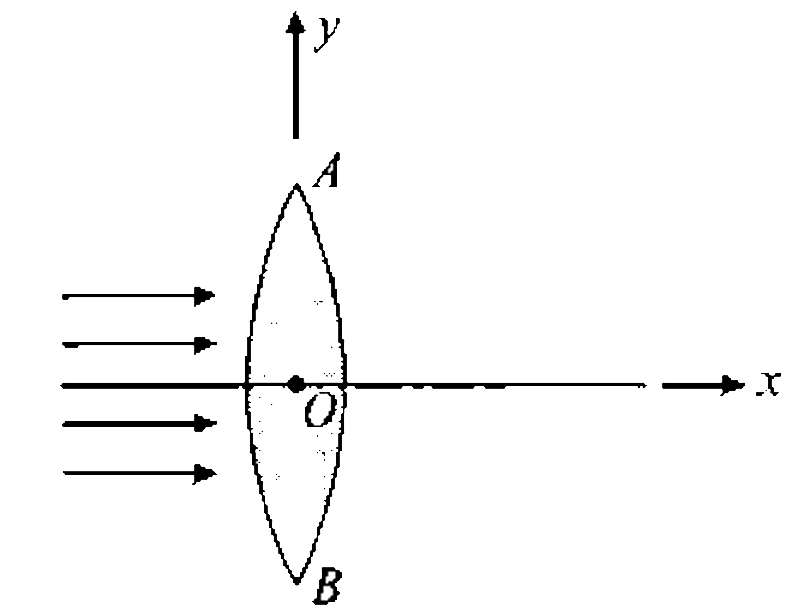
Monochromatic light rays parallel to x-axis strike a convex lens AB of refractive index `0.5`. If the lens oscillates such that AB tilts upto a small angle `theta` (in radian) on either side of y-axis, then find the distance between extreme positions of oscillating image:

A

`2f(sectheta-1)`

B

`fsec^(2)theta`

C

`f(sectheta-1)`

D

the image will not move

Text Solution

Verified by Experts


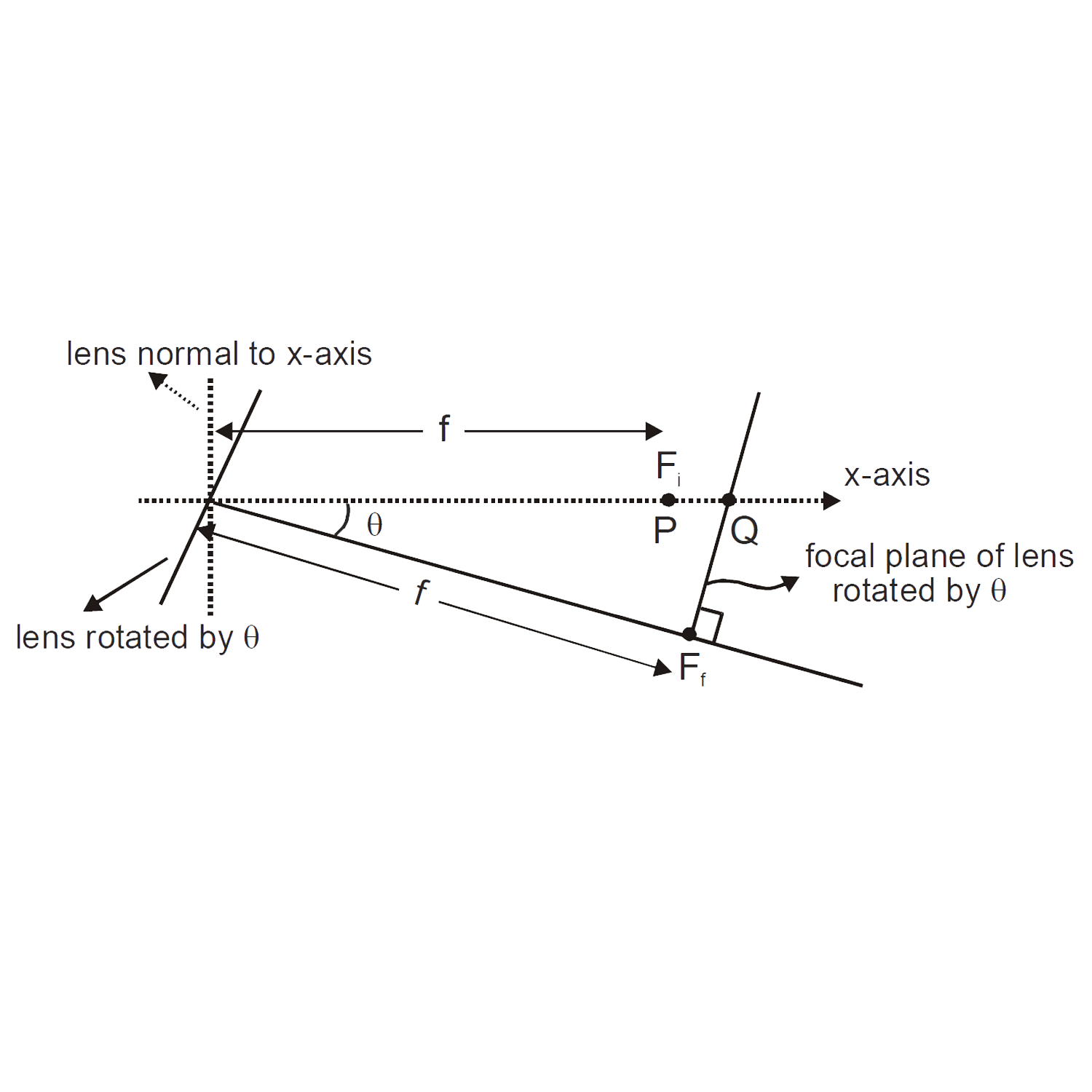
When the lens is tited by `theta`, the image is formed at the intersection (Q) of focal plane of lens in tited position and x-axis.
As the lens ocillates. The image shifts on x-axis in between P and Q
`therefore` Distance between two exterme position of the image `=PQ=(f)/(costheta)-f=f(sectheta-1)`
Promotional Banner

Topper's Solved these Questions

  • NUCLEAR PHYSICS

    RESONANCE ENGLISH|Exercise Advanced level solutions|16 Videos
  • SEMICONDUCTORS

    RESONANCE ENGLISH|Exercise Exercise 3|88 Videos

Similar Questions

Explore conceptually related problems

A parallel beam of light is incident on a lens of focal length 10 cm. A parallel slab of refractive index 1.5 and thickness 3 cm is placed on the other side of the lens. Find the distance of the final image from the lens. .

A light ray travelling parallel to the principal axis of a convex lens of focal length 12 cm strikes the lens at a height of 5 mm from the principal axis. What is the angle of deviation produced?

Fig. shows an equiconvex lens (of refractive index 1.5 ) in contact with a liquid layer on top of a plane mirror. A small needle with its tip on the principal axis is moved along the axis until its inverted image is found at the position of the needle. The distance of the needle from the lens is measured to be 45.0 cm . The liquid is removed and the experiment is repeated. The new distance is measured to be 30.0 cm . What is the refractive index of the liquid ?

Two equi-convex lenses of focal length 30cm and 70cm, made of material of refractive index =1.5, are held in contact coaxially by a rubber band round their edges.A liquidof refractive index 1.3 is introduced in the space between the lenses filling it completely. Find the position of the image of a luminous point object placed on teh axis of the combination lens at a distance of 90cm from it.

Two equi-convex lenses of focal length 30cm and 70cm, made of material of refractive index =1.5, are held in contact coaxially by a rubber band round their edges.A liquidof refractive index 1.3 is introduced in the space between the lenses filling it completely. Find the position of the image of a luminous point object placed on teh axis of the combination lens at a distance of 90cm from it.

A double convex thin lens made of glass (refractive index mu = 1.5 ) has both radii of curvature of magnitude 20 cm . Incident light rays parallel to the axis of the lens will converge at a distance L such that

A double convex thin lens made of glass (refractive index mu = 1.5 ) has both radii of curvature of magnitude 20 cm . Incident light rays parallel to the axis of the lens will converge at a distance L such that

An object is placed at a distance of 10cm to the left on the axis of convex lens A of focal length 20cm. A second convex lens of focal length 10cm is placed coaxially to the right of the lens A at a distance of 5cm from A. Find the position of the final image and its magnification. Trace the path of the rays.

A small object is placed 50 cm to the left of a thin convex lens of focal length 30 cm. A convex spherical mirror of radius of curvature 100 cm is placed to the right of the lens at a distance of 50 cm. The mirror is tilted such that the axis of the mirror is at an angle theta =30degree to the axis of the lens, as shown in the figure If the origin of the coordinate system is taken to be at the centre of the lens, the coordinates (in cm) of the point (x,y) at which the image is formed are

A light ray parallel to the principal axis is incident (as shown in the figure) on a thin planoconvex lens with radius of curvature of its curved part equal to 10 cm. Assuming that the refractive index of the material of the lens is 4//3 and medium on both sides of the lens is air, find the distance of the point from the lens where this ray meets the principal axis. Find your answer in the form (X)/(7)cm and fill value of X .

RESONANCE ENGLISH-REVISION DPP-All Questions
  1. The electric field intensity at the center of a uniformly charged hemi...

    Text Solution

    |

  2. A thin converging lens forms a real image of an object located far awa...

    Text Solution

    |

  3. Monochromatic light rays parallel to x-axis strike a convex lens AB of...

    Text Solution

    |

  4. At distance 'r' from a point charge, the ratio (U)/(V^(2)) (where 'U' ...

    Text Solution

    |

  5. Two satellites revolve around the ‘Sun’ as shown in the figure. First ...

    Text Solution

    |

  6. A small area is removed from a uniform spherical shell of mass M and r...

    Text Solution

    |

  7. In the figure shown an infinitely long wire of uniform linear charge d...

    Text Solution

    |

  8. A spherical uniform planet is rotating about its axis. The velocity of...

    Text Solution

    |

  9. The figure shows two equal, positive charges, each of magnitude 50 muC...

    Text Solution

    |

  10. Orbital velocity of a satellite in its orbit (around earth) of radius ...

    Text Solution

    |

  11. A solid spherical planet of mass 2m and radius 'R' has a very small tu...

    Text Solution

    |

  12. In the figure shown A & B are two charged particles having charges q a...

    Text Solution

    |

  13. A light ray enters into a medium whose refractive index varies along t...

    Text Solution

    |

  14. Two infinite, parallel, nonconducting sheets carry equal positive char...

    Text Solution

    |

  15. In the figure shown there is a hollow hemisphere of radius 'R'. It has...

    Text Solution

    |

  16. A planet revolves around the sun in elliptical orbit of semimajor axis...

    Text Solution

    |

  17. A satellite is orbiting around the earth in a circular orbit and in th...

    Text Solution

    |

  18. A uniform thin rod of mass m and length R is placed normally on surfac...

    Text Solution

    |

  19. Two persons A and B wear glasses of optical powers (in air) P1 = + 2 D...

    Text Solution

    |

  20. The final image  of the object O shown in the figure is formed at poi...

    Text Solution

    |