Home
Class 12
PHYSICS
There are two nonconducting spheres havi...

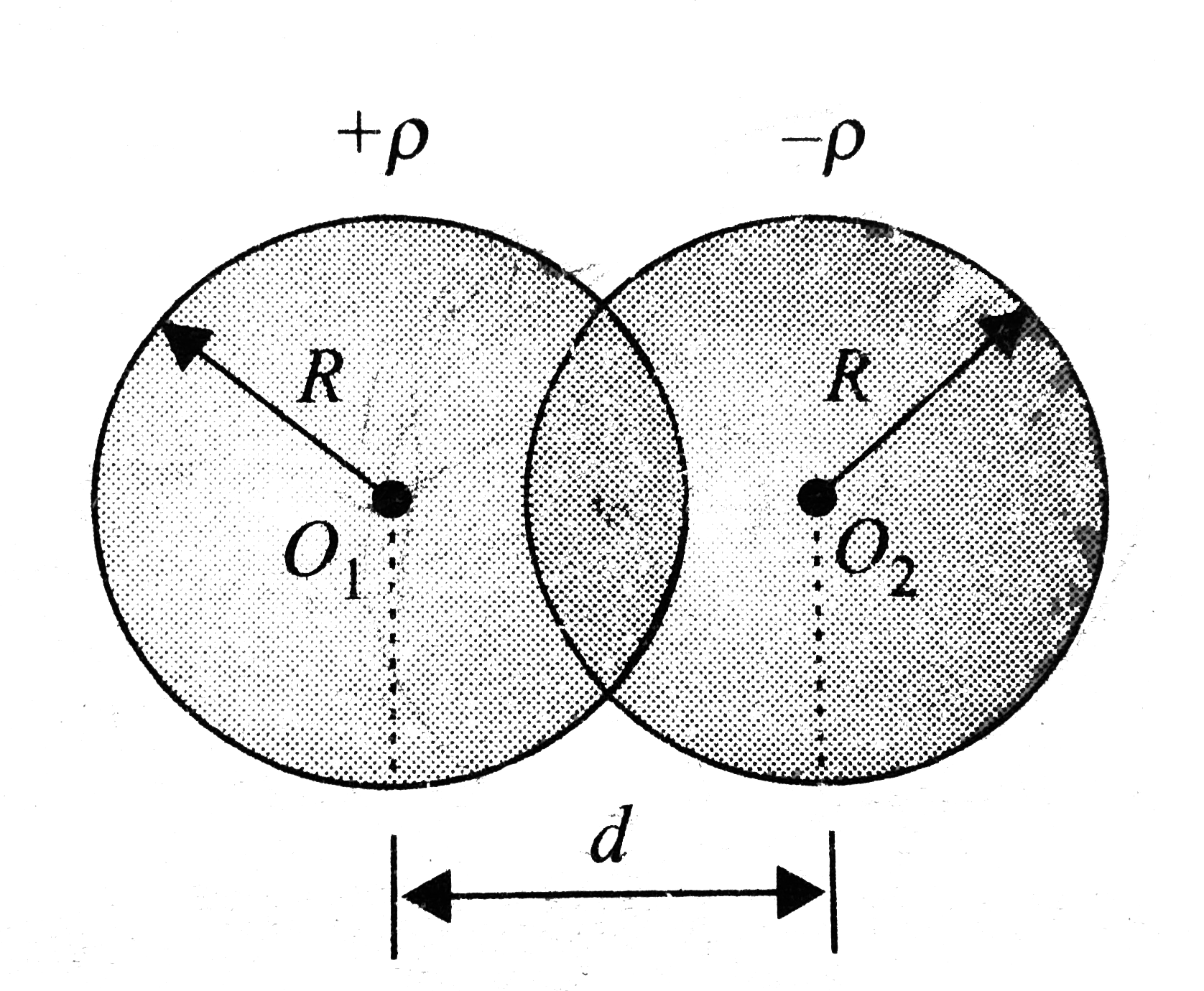
There are two nonconducting spheres having uniform volume charge densities `rho` and `- rho` . Both spheres have equal radius `R`. The spheres are now laid down such that they overlap as shown in Fig.2.125. Take `vec(d) = O_(1) vec(O_(2))`.

The potential difference `Delta V` between the centres of the two spheres for `d = R` is

A

`(rho)/(3in_(0))d^(2)`

B

`(rho)/(in_(0))d^(2)`

C

zero

D

`(2ho)/(in_(0))d^(2)`

Text Solution

Verified by Experts

`int_(v_(1))^(v_(2))V=-int_(0)^(d)(rhod)/(3epsilon_(0))dx,V_(2)-V_(1)=-(rhod^(2))/(3epsilon_(0)),|triangleV|=(rhod^(2))/(3epsilon_(0))`
Promotional Banner

Topper's Solved these Questions

  • NUCLEAR PHYSICS

    RESONANCE ENGLISH|Exercise Advanced level solutions|16 Videos
  • SEMICONDUCTORS

    RESONANCE ENGLISH|Exercise Exercise 3|88 Videos

Similar Questions

Explore conceptually related problems

There are two nonconducting spheres having uniform volume charge densities rho and - rho . Both spheres have equal radius R . The spheres are now laid down such that they overlap as shown in Fig.2.125. Take vec(d) = O_(1) vec(O_(2)) . The electric field vec(E) in the overlapped region is

There are two nonconducting spheres having uniform volume charge densities rho and - rho . Both spheres have equal radius R . The spheres are now laid down such that they overlap as shown in Fig.2.125. Take vec(d) = O_(1) vec(O_(2)) . The electric field vec(E) in the overlapped region is

Two non-conducting spheres of radii R_1 and R_2 and carrying uniform volume charge densities +rho and -rho , respectively, are placed such that they partially overlap, as shown in the figure. At all points in the overlapping region

A solid sphere having uniform charge density rho and radius R is shown in figure. A spherical cavity ofradius (R)/(2) is made in it. What is the potential at point O?

The electric potential due to uniformly charged sphere of radius R ,having volume charge density rho having a spherical cavity of radius R/2 as shown as in figure at point p is

An insulating solid sphere of the radius R is charged in a non - uniform manner such that the volume charge density rho=(A)/(r ) , where A is a positive constant and r is the distance from the centre. The potential difference between the centre and surface of the sphere is

A Uniformly charged solid non-conducting sphere of uniform volume charge density rho and radius R is having a concentric spherical cavity of radius r. Find out electric field intensity at following points, as shown in the figure : (i) Point A (ii) Point B (iii) Point C (iv) Centre of the sphere

Two non-conducting solid spheres of radii R and 2R, having uniform volume charge densities rho_1 and rho_2 respectively, touch each other. The net electric field at a distance 2R from the centre of the smaller sphere, along the line joining the centres of the spheres, is zero. The ratio rho_1/rho_2 can be

Two conducting spheres of radius R and 3R carry charges Q and -2 Q . Between these spheres a neutral conducting sphere of radius 2R is connected. The separation between the sphere is considerably large Charge flows through conducting wire due to potential difference. The final electric potential of sphere of radius 3R will be :

A nonconducting sphere of radius R is filled with uniform volume charge density -rho . The center of this sphere is displaced from the origin by vecd . The electric field vecE at any point P having position vector inside the sphere is

RESONANCE ENGLISH-REVISION DPP-All Questions
  1. The curve of angle of incidence versus angle of deviaton wshown has be...

    Text Solution

    |

  2. There are two nonconducting spheres having uniform volume charge densi...

    Text Solution

    |

  3. There are two nonconducting spheres having uniform volume charge densi...

    Text Solution

    |

  4. Consider a hypothetical solar system, which has two identical massive ...

    Text Solution

    |

  5. Consider a hypothetical solar system, which has two identical massive ...

    Text Solution

    |

  6. Consider a hypothetical solar system, which has two identical massive ...

    Text Solution

    |

  7. A charge q is divided into three equal parts and placed symmetrically ...

    Text Solution

    |

  8. A charge q is divided into three equal parts and placed symmetrically ...

    Text Solution

    |

  9. A charge q is divided into three equal parts and placed symmetrically ...

    Text Solution

    |

  10. Match the proper entries from column-2 to column-1 using the codes giv...

    Text Solution

    |

  11. A conducting sphere A of radius a, with charge Q, is placed concentric...

    Text Solution

    |

  12. A cannon fires successively two shells from the same point with veloci...

    Text Solution

    |

  13. Each of the two block shown in the figure has mass m. The pulley is sm...

    Text Solution

    |

  14. A particle is projected with speed 30m//s at angle 22.5^(@) with horiz...

    Text Solution

    |

  15. A block of mass m is pulled on an incline surface having coefficient ...

    Text Solution

    |

  16. Two cars A and B moving on two straight tracks inclined at an angle 60...

    Text Solution

    |

  17. Two rain drops reach the earth with their terminal velocities in the r...

    Text Solution

    |

  18. ABC is a triangle in vertical plane. Its two base angles angleBAC and ...

    Text Solution

    |

  19. A rope of negligible mass passes over a pulley of negligible mass atta...

    Text Solution

    |

  20. A balloon is tied to a block. The mass of the block is 2kg. The tensio...

    Text Solution

    |

