Home
Class 12
PHYSICS
A particle moving with velocity (2hati-3...

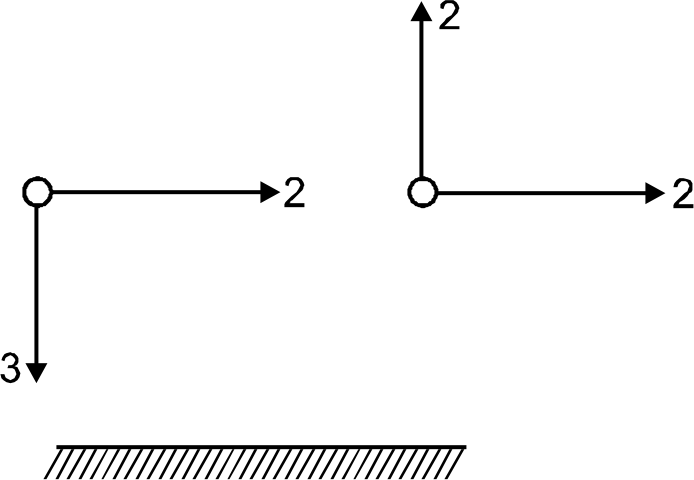
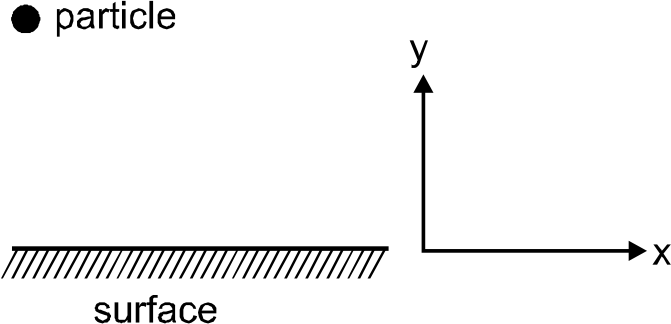
A particle moving with velocity `(2hati-3hatj)` m/s collides with a surface at rest in xz–plane as shown in figure and moves with velocity `(2hati+2hatj)` m/s after collision. Then coefficient of restitution is :

A

`2/3`

B

1

C

`sqrt(8/13)`

D

`4/5`

Text Solution

Verified by Experts


`e=(v_(sep))/(v_(opp))=2/3`
Promotional Banner

Topper's Solved these Questions

  • NUCLEAR PHYSICS

    RESONANCE ENGLISH|Exercise Advanced level solutions|16 Videos
  • SEMICONDUCTORS

    RESONANCE ENGLISH|Exercise Exercise 3|88 Videos

Similar Questions

Explore conceptually related problems

A particle of mass m moving with a velocity (3hati+2hatj)ms^-1 collides with another body of mass M and finally moves with velocity (-2hati+hatj)ms^-1 . Then during the collision

A body of mass 3 kg moving with a velocity (2hati+3hatj+3hatk) m/s collides with another body of mass 4 kg moving with a velocity (3hati+2hatj-3hatk) m/s. The two bodies stick together after collision. The velocity of the composite body is

A small sphere of mass m =1 kg is moving with a velocity (4hati-hatj) m//s . it hits a fixed smooth wall and rebounds with velocity (hati + 3hatj) m//s . The coefficient of restitution between the sphere and the wall is n//16 . Find the value of n .

A small sphere of mass 1kg is moving with a velocity (6hati+hatj)m//s . It hits a fixed smooth wall and rebounds with velocity (4hati+hatj)m//s . The coefficient of restitution between the sphere and the wall is

A particle of mass 'm' moving with a velocity (3 hat(i)+2hat(j))m//s collides with stationary mass 'M' and finally 'm' moves with a velocity (-2hat(i)+hat(j))m//s if (m)/(M) = (1)/(13) the velocity of the M after collision is?

A particle of mass 'm' moving with a velocity of (4hat(i)-hat(j))m//s strikes a fixed wall and finally moves with a velocity of (3hat(i)+2hat(j))m//s . Find (a) the impulse received by the particle. (b) the coefficient of restitution between them in the collision.

A particle of mass m with an initial velocity u hati collides perfectly elastically with a mass 3 m at rest . It moves with a velocity vhatj after collision , then , v is given by :

A particle of mass 2kg moving with a velocity 5hatim//s collides head-on with another particle of mass 3kg moving with a velocity -2hatim//s . After the collision the first particle has speed of 1.6m//s in negative x-direction, Find (a) velocity of the centre of mass after the collision, (b) velocity of the second particle after the collision. (c) coefficient of restitution.

A particle of mass 2kg moving with a velocity 5hatim//s collides head-on with another particle of mass 3kg moving with a velocity -2hatim//s . After the collision the first particle has speed of 1.6m//s in negative x-direction, Find (a) velocity of the centre of mass after the collision, (b) velocity of the second particle after the collision. (c) coefficient of restitution.

A particle A moves with velocity (2hati-3hatj)m//s from a point (4,5m)m . At the same instant a particle B , moving in the same plane with velocity (4hati+hatj)m//s passes through a point C(0,-3)m . Find the x -coordinate (in m ) of the point where the particles collide.

RESONANCE ENGLISH-REVISION DPP-All Questions
  1. Column I lists the field in a region and Column II lists the path of a...

    Text Solution

    |

  2. A block of mass m and length l is kept at rest on a rough horizontal g...

    Text Solution

    |

  3. A particle moving with velocity (2hati-3hatj) m/s collides with a surf...

    Text Solution

    |

  4. A ball is suspended from the top of a cart by a light string of length...

    Text Solution

    |

  5. Two blocks each of mass m are joined together using an ideal spring of...

    Text Solution

    |

  6. Two spherical bodies of masses M and 5M and radii R and 2R are release...

    Text Solution

    |

  7. Consider the system shown in figure. Pulley, string and spring are ide...

    Text Solution

    |

  8. In the figure shown a semicircular area is removed from a uniform squa...

    Text Solution

    |

  9. Power of the only force acting on a particle of mass m = 1 kg moving i...

    Text Solution

    |

  10. Sand is falling on a flat car being pulled with constant speed. The ra...

    Text Solution

    |

  11. A particle is moving along an elliptical path with constant speed. As ...

    Text Solution

    |

  12. A small bead of mass m = 1 kg is free to move on a circular hoop. The ...

    Text Solution

    |

  13. Two blocks of mass m(1) and m(2) (m(1) lt m(2)) are connected with an ...

    Text Solution

    |

  14. Three point masses are attached by light inextensible strings of vario...

    Text Solution

    |

  15. One end of a light rod of length 1m is attached with a string of lengt...

    Text Solution

    |

  16. Particle sticks to wooden loop, If particle reach at the lowest positi...

    Text Solution

    |

  17. Three large plates are arranged as shown. How much charge will flow th...

    Text Solution

    |

  18. Two identical blocks A and B of mass m each are connected to each othe...

    Text Solution

    |

  19. Three identical particles A, B and C of mass m lie on a smooth horizo...

    Text Solution

    |

  20. A particle is attached to an end of a rigid rod. The other end of the ...

    Text Solution

    |