

Home
Class 12
PHYSICS
In YDSE arrangement as shown in the figu...

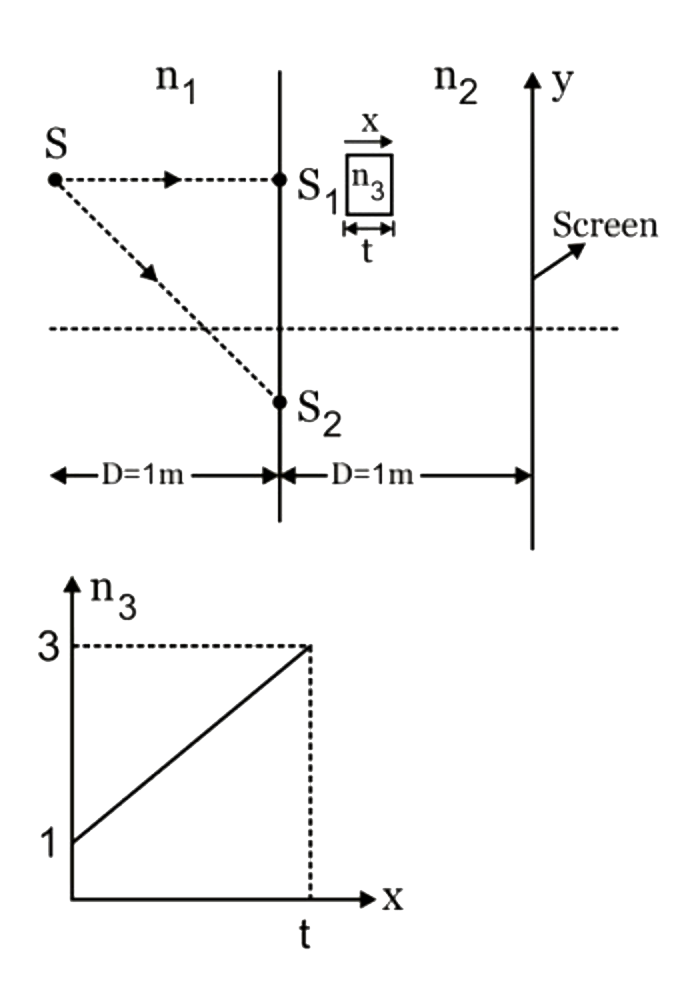
In YDSE arrangement as shown in the figure, fringes are seen on screen using monochromatic source S having wavelength `3000Å` (in the air). `S_(1) and S_(2)` are two slits separated by d = 1 mm and D = 1 m. Left of slits `s_(1) and s_(2)` medium of refractive index `n_(1)=2` is present and to the right of `S_(1) and S_(2)` medium of `n_(2)=(3)/(2)`, is present. A thin slab of thickness 't' is placed in front of `S_(1)`. The refractive index of `n_(3)` of the slab varies with distance from it's starting face as shown in figure.

In order of get central maxima at the centre of the screen, the thickness of the slab `("in "mum)` required is :

A

`1 mum`

B

` 2 mum`

C

`0.5 mum`

D

`1.5 mum`

Text Solution

Verified by Experts

Path difference
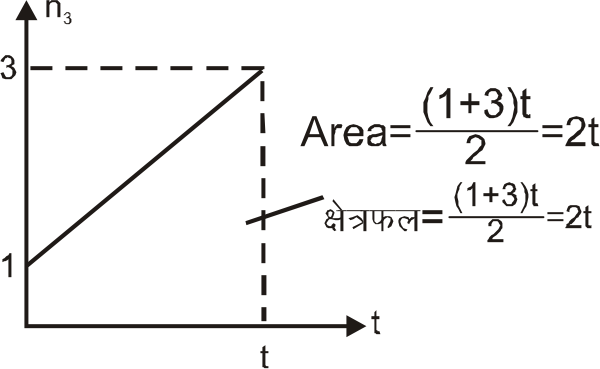
`Deltax=n_(1)S S_(2)+n_(2)S_(2)P-[(n_(1)S S_(1)+n_(2)S_(1)P)-int_(0)^(t)(n_(3)-n_(2)) dx]`
`= n_(1)(S S_(2)-S S_(1))+n_(2)(S_(2)P-S_(1)P)-int_(0)^(t) n_(3) dx+_ n_(2)t`
In order to get central maxima at centre of screen

`O=(2xx(1xx10^(-3))^(2))/(2xx1)+0-2t+(3t)/2`
`0.5 t =1 mu m`
`t= 2 mu m`
Promotional Banner

Topper's Solved these Questions

  • NUCLEAR PHYSICS

    RESONANCE ENGLISH|Exercise Advanced level solutions|16 Videos
  • SEMICONDUCTORS

    RESONANCE ENGLISH|Exercise Exercise 3|88 Videos

Similar Questions

Explore conceptually related problems

In YDSE arrangement as shown in figure, fringes are seen on screen using monochromatic source S having wavelength 3000 Å (in air). S_1 and S_2 are two slits seperated by d = 1 mm and D = 1m. Left of slits S_1 and S_2 medium of refractive index n_1 = 2 is present and to the right of S_1 and S_2 medium of n_2 = 3/2 , is present. A thin slab of thickness 't' is placed in front of S_1 . The refractive index of n_3 of the slab varies with distance from it's starting face as shown in figure. In order to get central maxima at the centre of screen, the thickness of slab required is :

In Young's double slit experiment S_(1) and S_(2) are two slits. Films of thickness t_(1) and t_(2) and refractive indices mu_(1) and mu_(2) are placed in front of S_(1) and S_(2) respectively. If mu_(1)t_(1) = mu_(2)t_(2) , then the central maximum will :

Two slits S_(1) and S_(2) illuminated by a white light source give a white central maxima. A transparent sheet of refractive index 1.25 and thickness t_(1) is placed in front of S_(1) . Another transparent sheet of refractive index 1.50 and thickness t_(2) is placed in front of S_(2) . If central maxima is not effected, then ratio of the thickness of the two sheets will be :

Two coherent sources S_(1)" and "S_(2) are separated by a small distance d. The fringes obtained on the screen will be:

In Young's double slit experiment the slits, S_(1) & S_(2) are illuminated by a parallel beam of light of wavelength 4000 Å from the medium of refractive index n_(1)=1.2 A thin film of thickness 1.2 mum and refractive index n=1.5 is placed infrom of S_(1) perpedicular to path of light. the refractive index of medium between plane of slits & screen is n_(2)=1.4 if the light coming from the film and S_(1)&S_(2) have equal intensities I then intensity at geometrical centre of the screen O is

In the set up shown in figure, the two slits S_1 and S_2 are not equidistant from the slit S. The central fringe at O is then

In the given figure ,C is middle point of line S_(1)S_(2) .A monochromatic light of wavelength gamma is incident on slits.The ratio of intensites of S_(3) and S_(4) is

Two monochromatic coherent point sources S_(1) and S_(2) are separated by a distance L. Each sources emits light of wavelength lambda , where L gt gt lambda . The line S_(1) S_(2) when extended meets a screen perpendicular to it at point A. Then

In YDSE shown in figure a parallel beam of light is incident on the slits from a medium of refractive index n_(1) . The wavelength of light in this medium is lambda_(1) . A transparent slab of thickness t and refractive index n_(3) is put in front of one slit. The medium between the screen and the plane of the slits is n_(2) . The phase difference between the light waves reaching point O (symmetrical, relative to the slits) is

RESONANCE ENGLISH-REVISION DPP-All Questions
  1. A fan operates at 200 volt (DC) consuming 1000W when running at full s...

    Text Solution

    |

  2. A body is thrown with a velocity of 9.8 m/s making an angle of 30^(@) ...

    Text Solution

    |

  3. In YDSE arrangement as shown in the figure, fringes are seen on screen...

    Text Solution

    |

  4. In YDSE arrangement as shown in the figure, fringes are seen on screen...

    Text Solution

    |

  5. In YDSE arrangement as shown in the figure, fringes are seen on screen...

    Text Solution

    |

  6. In Young's double slit experiment, the distance between two slits is m...

    Text Solution

    |

  7. Time varying magnetic filed is present in a circular region of radius ...

    Text Solution

    |

  8. In a series RLC AC circult, the frequency of source can be varied. Wh...

    Text Solution

    |

  9. Find the natural frequency of oscillation of the system as shown in fi...

    Text Solution

    |

  10. A thin uniform straight rod of mass 2 kg and length 1 m is free to rot...

    Text Solution

    |

  11. All sides of an equilateral triangle are diameter of three identical u...

    Text Solution

    |

  12. A block of dimensions lxtxh and uniform density rho(w) rests on a roug...

    Text Solution

    |

  13. An oscillation is superposition of three harmonic oscillations and dec...

    Text Solution

    |

  14. A uniform thin hemispherical shell is kept at rest and in equilibrium ...

    Text Solution

    |

  15. Find the natural frequency of the system shown in figure. The pulleys ...

    Text Solution

    |

  16. A massless stick of length L is hinged at one end and a mass m attache...

    Text Solution

    |

  17. A uniform disc of mass m is attached to a spring of spring constant k ...

    Text Solution

    |

  18. A particle is executing simple harmonic motion in a conservative force...

    Text Solution

    |

  19. Two particle of mass m each are fixed to a massless rod of length 2l ....

    Text Solution

    |

  20. Two copper balls of radius r and 2r are released at rest in a long tub...

    Text Solution

    |