

Home
Class 12
PHYSICS
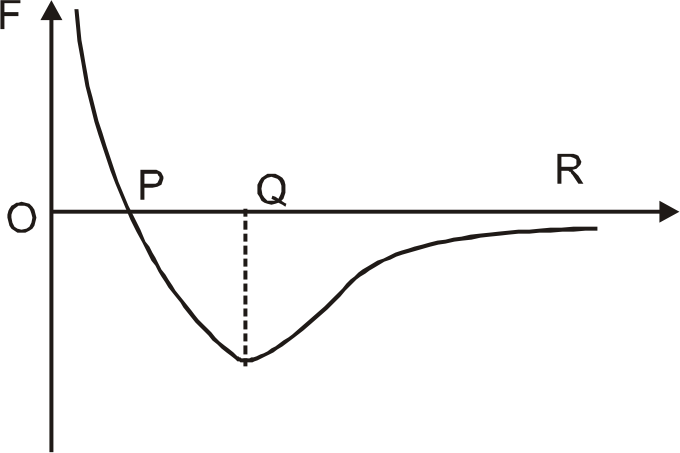
Figure shows roughly how the force F bet...

Figure shows roughly how the force F between two adjacent atoms in a solid varies with inter atomic separation r. Which of the following statements are correct ?

A

OQ is the equilibrium separation.

B

Hooke's law is obeyed near P.

C

The potential energy of the atoms is the gradient of the graph at all points.

D

The energy to separate the atoms completely is obtained from the magnitude of the area enclosed below the axis of r.

Text Solution

Verified by Experts

Since F-r curve is continuous, so
`(dF)/(dr)|_(P^(+))=(dF)/(dr)|_(P^(-))=(dF)/(dr)|_(P)=-alpha` and F (at P) =0 so Hooke's law valid near point P.
Energy required to separate the atoms =`|DeltaU|=|-intvec(F).vec(dr)|=`|Area enclosed between curve and r-axis|
Promotional Banner

Topper's Solved these Questions

  • NUCLEAR PHYSICS

    RESONANCE ENGLISH|Exercise Advanced level solutions|16 Videos
  • SEMICONDUCTORS

    RESONANCE ENGLISH|Exercise Exercise 3|88 Videos

Similar Questions

Explore conceptually related problems

For the energy levels in an atom , which of the following statement is correct ?

For the electrons of oxygen atom, which of the following statements correct?

For the electrons of oxygen atom, which of the following statements correct?

For the energy levels in an atom which one of the following statements is correct?

An atom of an element has electronic configuration 2,8,1. Which of the following statement is correct ?

For the energy levels in atom, which one of the following statement (s) is (are) correct?

Consider the following atomic orbitals : Which of the following statement(s) is /are correct regarding given orbital ?

A neutron collies head-on with a stationary hydrogen atom in ground state. Which of the following statements is/are correct ?

Which of the following statements (regarding an atom of H ) are correct?

Potential energy U(r ) varies with position r as shown in figure Which of the following conclusions are correct?

RESONANCE ENGLISH-REVISION DPP-All Questions
  1. In the given figure, two elastic rods P and Q are rigidly joined to en...

    Text Solution

    |

  2. Two forces F1 and F2 act on a thin uniform elastic rod placed in space...

    Text Solution

    |

  3. Figure shows roughly how the force F between two adjacent atoms in a s...

    Text Solution

    |

  4. A particle constrained to move along x-axis given a velocity u along t...

    Text Solution

    |

  5. A uniform ring having mass m, radius R, cross section area of the wire...

    Text Solution

    |

  6. A uniform disc of mass m and radius R is free to rotate about its fixe...

    Text Solution

    |

  7. A solid glass hemisphere of density d and radius R lies (with curved s...

    Text Solution

    |

  8. A 20gm particle is subjected to two simple harmonic motions x(1)=2 s...

    Text Solution

    |

  9. Three identical horizontal rods AB, CD and EF each of length 2m are on...

    Text Solution

    |

  10. A weightless rigid rod with a small iron bob at the end is hinged at p...

    Text Solution

    |

  11. A uniform rod of mass 200 grams and length L = 1m is initially at rest...

    Text Solution

    |

  12. A small block is kept on a platform executing SHM in the horizontal pl...

    Text Solution

    |

  13. Two particles P(1) and P(2) are performing SHM along the same line abo...

    Text Solution

    |

  14. A solid sphere (radius = R) rolls without slipping in a cylindrical th...

    Text Solution

    |

  15. Two opposite forcesF(1) = 120 N and F(2) = 80 N act on an elastic plan...

    Text Solution

    |

  16. A ring of radius r made of wire of density rho is rotated about a stat...

    Text Solution

    |

  17. The length of an elastic string is 5 metre when the longitudinal tensi...

    Text Solution

    |

  18. A block of mass m=2kg of shown dimensions is placed on a plank of mass...

    Text Solution

    |

  19. There are two ideal springs of force constants K1 and K2 respectively....

    Text Solution

    |

  20. There are two ideal springs of force constants K1 and K2 respectively....

    Text Solution

    |