Home
Class 12
PHYSICS
There are two ideal springs of force con...

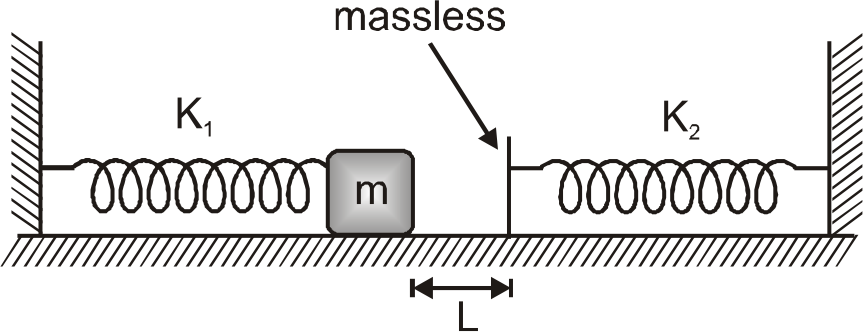
There are two ideal springs of force constants `K_1` and `K_2` respectively. When both springs are relaxed the separation between free ends is L. Now the particle of mass m attached to free end of left spring is displaced by distance 2L towards left and then released. assuming the surface to be frictionless. `((K_(1))/(K_(2))=4/3)`. (Neglect size of the block)

The time interval after which mass 'm' hits the right spring will be

A

`(7pi)/6sqrt(m/(K_(1)))`

B

`(4pi)/3sqrt(m/(K_(1)))`

C

`(3pi)/4sqrt(m/(K_(1)))`

D

`(7pi)/4sqrt(m/(K_(1)))`

Text Solution

Verified by Experts

Time taken by particle to go from
x=0 to x=A/2 is T/12
`:. ` time interval `=T/2+T/12=(7T)/12`
`=7/12 . 2pisqrt(m/(K_(1)))=(7pi)/6sqrt(m/(K_(1)))`
Assume, maximum compression in right spring is x. hence
`1/2 K_(1)(2L)^(2)=1/2 K_(1)(L+x)^(2)+1/2K_(2)x^(2)`
Put `K_(2)=3/4 K_(1)`, we get `x=(6L)/7`
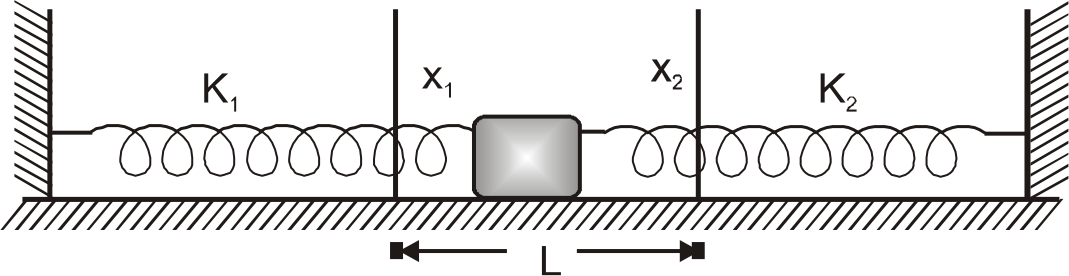
When mass m in equilibrium both spring will be in extended state.

`K_(1)x_(1)=K_(2)x_(2)` and `x_(1)+x_(2) =L`
`x_(1)=(3L)/7`.
Promotional Banner

Topper's Solved these Questions

  • NUCLEAR PHYSICS

    RESONANCE ENGLISH|Exercise Advanced level solutions|16 Videos
  • SEMICONDUCTORS

    RESONANCE ENGLISH|Exercise Exercise 3|88 Videos

Similar Questions

Explore conceptually related problems

There are two ideal springs of force constants K_1 and K_2 respectively. When both springs are relaxed the separation between free ends is L. Now the particle of mass m attached to free end of left spring is displaced by distance 2L towards left and then released. assuming the surface to be frictionless. ((K_(1))/(K_(2))=4/3) . (Neglect size of the block) The maximum compression produced in right spring will be

There are two ideal springs of force constants K_1 and K_2 respectively. When both springs are relaxed the separation between free ends is L. Now the particle of mass m attached to free end of left spring is displaced by distance 2L towards left and then released. assuming the surface to be frictionless. ((K_(1))/(K_(2))=4/3) . (Neglect size of the block) Suppose mass m hits the right spring and sticks to it. The extension in left spring when mass ‘m’ is in equilibrium position during its motion is :

Two springs have force constants k_(A) such that k_(B)=2k_(A) . The four ends of the springs are stretched by the same force. If energy stored in spring A is E , then energy stored in spring B is

Infinite springs with force constants k,2k, 4k and 8k … respectively are connected in series. What will be the effective force constant of springs, when k=10N//m

As shown in the figure, two light springs of force constant k_(1) and k_(2) oscillate a block of mass m. Its effective force constant will be

Four massless springs whose force constants are 2k, 2k, k and 2k respectively are attached to a mass M kept on a frictionless plane (as shown in figure). If the mass M is displaced in the horizontal direction.

The time period of a spring mass system of spring constant k and mass m is T. Now, the spring is cut into two equal parts and connected in parallel. If the same mass is attached to new arrangement, then new time period is

Tow identical springs of spring constant k are attached to a block of mass m and to fixed supports as shown in figure. When the mass is displaced from equilibrum position by a distance x towards right, find the restoring force.

Two light spring of force constants k_(1) and k_(2) and a block of mass m are in the line AB on a smooth horizontal table such that one end of each spring is fixed on right supports and the other end is free as shown in figure The distance CD between the free ends of the spring is 60 cm . If the block (k_(1) = 1.8 N//m, k_(2) = 3.2 N//m and m = 200g) . Is the motion simple harmonic?

A body of mass m attached to one end of an ideal spring of force constant k is executing simple harmonic motion. Establish that the time - period of oscillation is T=2pisqrt(m//k) .

RESONANCE ENGLISH-REVISION DPP-All Questions
  1. The length of an elastic string is 5 metre when the longitudinal tensi...

    Text Solution

    |

  2. A block of mass m=2kg of shown dimensions is placed on a plank of mass...

    Text Solution

    |

  3. There are two ideal springs of force constants K1 and K2 respectively....

    Text Solution

    |

  4. There are two ideal springs of force constants K1 and K2 respectively....

    Text Solution

    |

  5. There are two ideal springs of force constants K1 and K2 respectively....

    Text Solution

    |

  6. A rod of mass 'm and length L is attached to a L shaped plank at 'A'. ...

    Text Solution

    |

  7. A rod of mass 'm and length L is attached to a L shaped plank at 'A'. ...

    Text Solution

    |

  8. A rod of mass 'm and length L is attached to a L shaped plank at 'A'. ...

    Text Solution

    |

  9. Two blocks A and B of masses m and 2m are placed on a smooth horizonta...

    Text Solution

    |

  10. A uniform rod of mass M and length L, area of cross section A is place...

    Text Solution

    |

  11. A uniform rod of mass M and length L, area of cross section A is place...

    Text Solution

    |

  12. In Young's double slit experiment, the distance between two slits is m...

    Text Solution

    |

  13. A particle of mass m = 1 kg excutes SHM about mean position O with ang...

    Text Solution

    |

  14. In a spring block system on a horizontal smooth surface. K = spring co...

    Text Solution

    |

  15. A container open from top, filled with water (density rhow) upto the t...

    Text Solution

    |

  16. A uniform solid sphere of radius R is in equilibrium inside a liquid w...

    Text Solution

    |

  17. A large open tank is filled with water upto a height H. A small hole i...

    Text Solution

    |

  18. A capillary tube with inner cross-section in the form of a square of s...

    Text Solution

    |

  19. A sphere of mass m and radius r is projected in a gravity free space w...

    Text Solution

    |

  20. A spherical ball of mass 4m, density sigma and radius r is attached to...

    Text Solution

    |