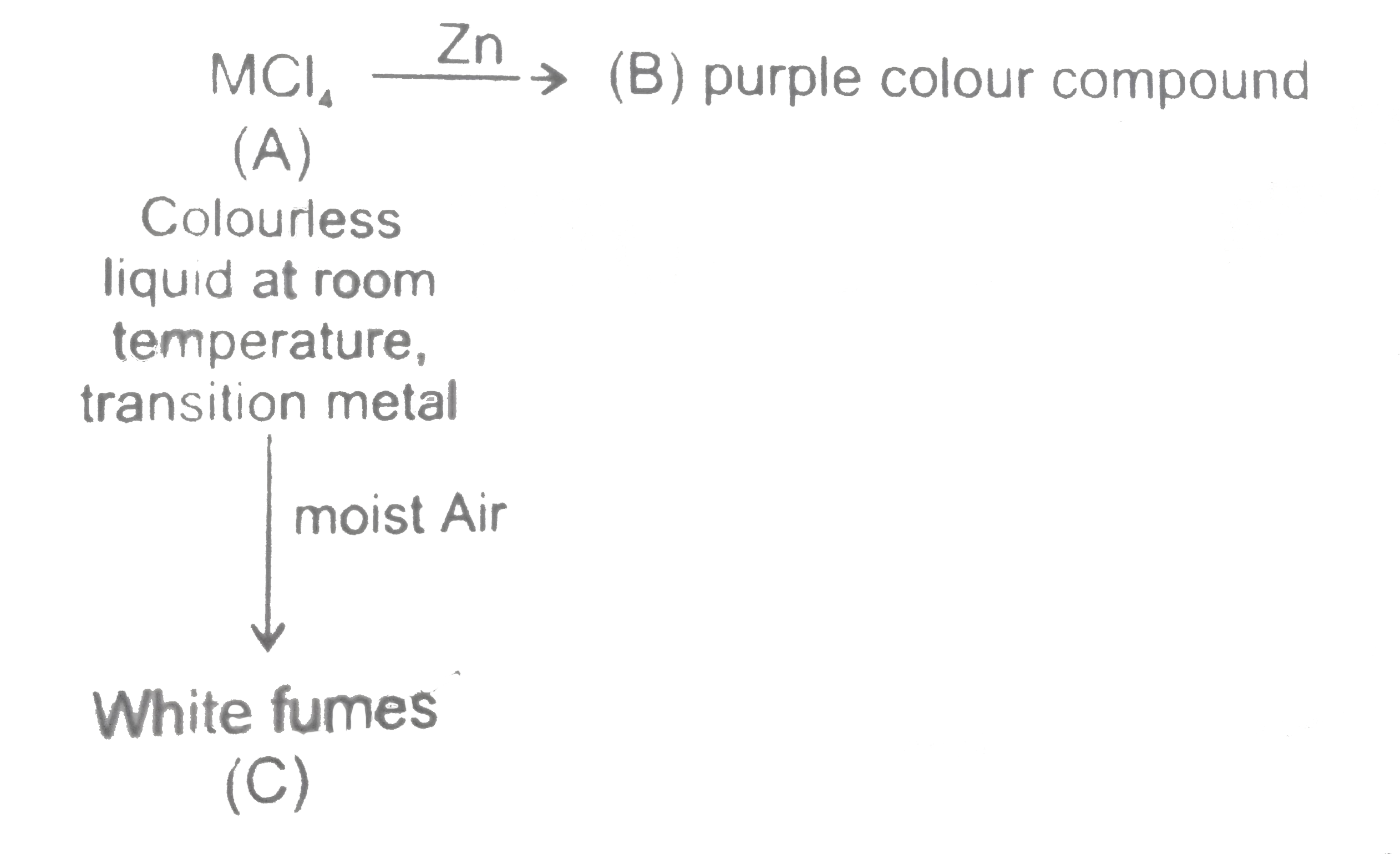
Text Solution
Verified by Experts
The correct Answer is:



Topper's Solved these Questions
D BLOCK ELEMENTS
RESONANCE ENGLISH|Exercise EXERCISE-3 PART-II|26 VideosD BLOCK ELEMENTS
RESONANCE ENGLISH|Exercise EXERCISE-3 PART-III|37 VideosD BLOCK ELEMENTS
RESONANCE ENGLISH|Exercise EXERCISE-2 PART-IV|7 VideosD & F BLOCK ELEMENTS
RESONANCE ENGLISH|Exercise ORGANIC CHEMISTRY(Aldehydes , Ketones, Carboxylic acid)|15 VideosDPP
RESONANCE ENGLISH|Exercise QUESTIONS|368 Videos
Similar Questions
Explore conceptually related problems
RESONANCE ENGLISH-D BLOCK ELEMENTS-EXERCISE-3 PART-I
- Which of the following species has an atom with +6 oxidation state?
Text Solution
|
- Write the balanced chemical equation for developing photographic films...
Text Solution
|
- In the neutralization of Na(2)S(2)O(3) using K(2)Cr(2)O(7) by idometry...
Text Solution
|
- Anhydrous feric chloride is prepared by:
Text Solution
|
- When MnO(2) fused with KOH, a coloured compound is formed . The produc...
Text Solution
|
- The product of oxidation of I^(-) with MnO(4)^(-) in alkaline medium i...
Text Solution
|
- The pair of compounds having metals in their highest oxidation state i...
Text Solution
|
- Which of the following pair of compounds is expected to exhibit same c...
Text Solution
|
- In black and white photography, the developed film is fixed by washing...
Text Solution
|
- Identify (A),(B) and (C). Also explain colour difference between MCl...
Text Solution
|
- Among the following the coloured compound is
Text Solution
|
- Oxidation state of Mn in the compound formed by alkaline oxidative fus...
Text Solution
|
- Oxidation state of Mn in the compound formed by alkaline oxidative fus...
Text Solution
|
- The colour of light absobed by an aqueous solution of CuSO4 is
Text Solution
|
- Which of the following halides react(s) with AgNO(3)(aq) to give a pre...
Text Solution
|