Home
Class 12
CHEMISTRY
Molar volume of an Ideal gas is 0.45 dm^...

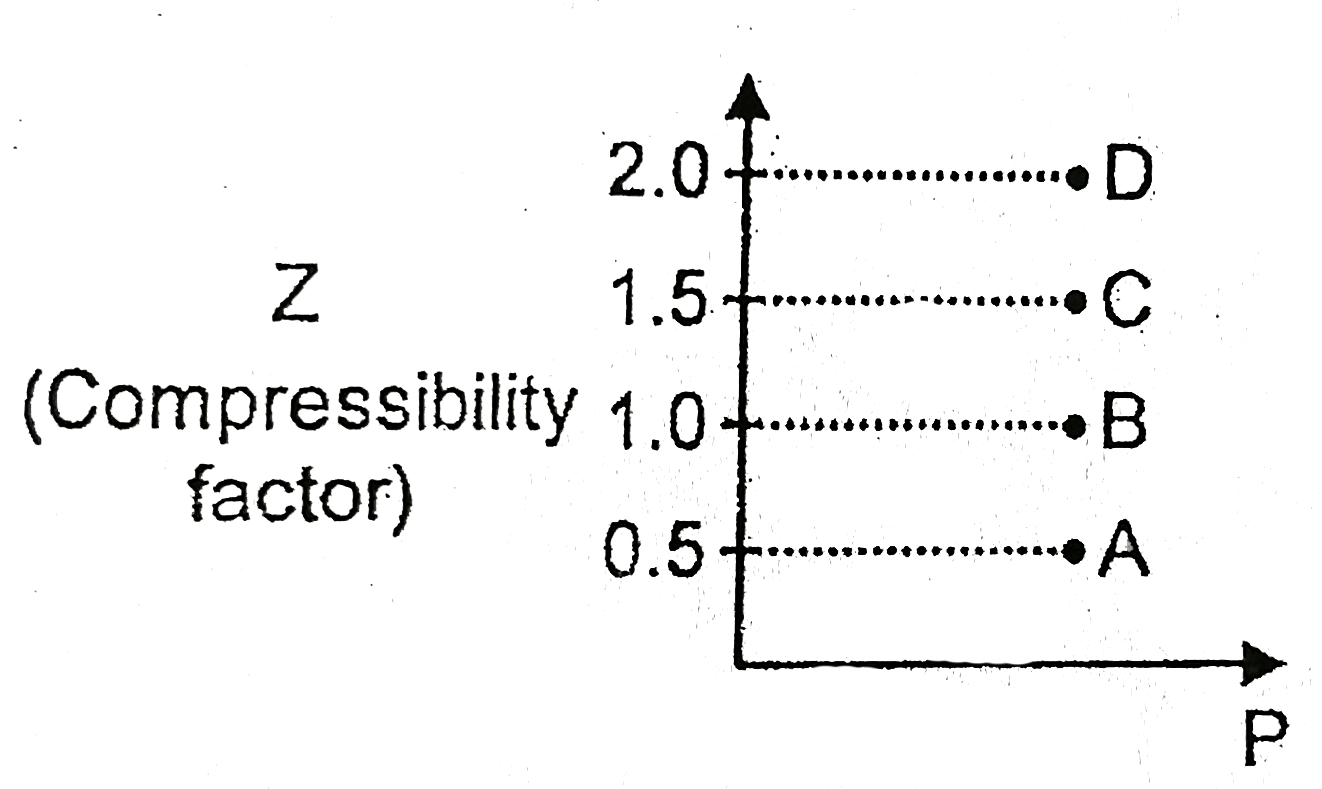
Molar volume of an Ideal gas is `0.45 dm^(3)//mol`. The molar volume of air (assumming as real gas) under the same condition is `0.9dm^(3)//mol`. The point which corresponds to air the given graph is :

A

`B`

B

`D`

C

`A`

D

None of these

Text Solution

Verified by Experts

The correct Answer is:

B

Molar volume of an ……….
`z = (0.9)/(0.45) =2` , `zgt1`
Promotional Banner

Similar Questions

Explore conceptually related problems

What is molar volume of an ideal gas under N.T.P. conditions ?

A gas at 350 K and 15 bar has molar volume 20 percent smaller than that for an ideal gas under the same conditions. The correct option above the gas and its compressibility factor (Z) is :

During electrolysis of water, the volume of oxygen liberated is 2.24 dm^(3). The volume of hydrogen liberated, under same conditions will be

The volume of 2N H_(2)SO_(4) solution is 0.1dm^(3) . The volume of its decinormal solution (in dm^(3) ) will be

At 47^(@)C and 16.0 atm, the molar volume of NH3 gas is about 10% less than the molar volume of an ideal gas. This is due to :

If one mole of a gas A (mol.wt-40) occupies a volume of 20 litres, under the same conditions of temperature and pressure the volume occupied by 2 moles of gas B (mol.wt=80) is

At a pressure of 3 atm air (treated as an ideal gas) is pumped into the tubes of a cycle rickshaw. The volume of each tube at given pressure is 0.004 m^(3) . One of the tubes gets punctured and the volume of the tube reduces to 0.0008 m^(3) . Find the number of moles of air that have leaked out? Assume that the temperature remains constant at 300K. (R = 25//3J mol^(-1)K^(-1))

For effusion of equal volume, a gas takes twice the time as taken by methane under similar conditions. The molar mass of the gas is

Three moles of an ideal gas (C_(v,m) = 12.5 J K^(-1) mol^(-1)) are at 300 K and 5 dm^(3) . If the gas is heated to 320K and the volume changed to 10 dm^(3) , calculate the entropy change.

One mole of an ideal gas undergoes a process in which T = T_(0) + aV^(3) , where T_(0) and a are positive constants and V is molar volume. The volume for which pressure with be minimum is
