Home
Class 12
CHEMISTRY
A cylindrical diathemic chamber fitted w...


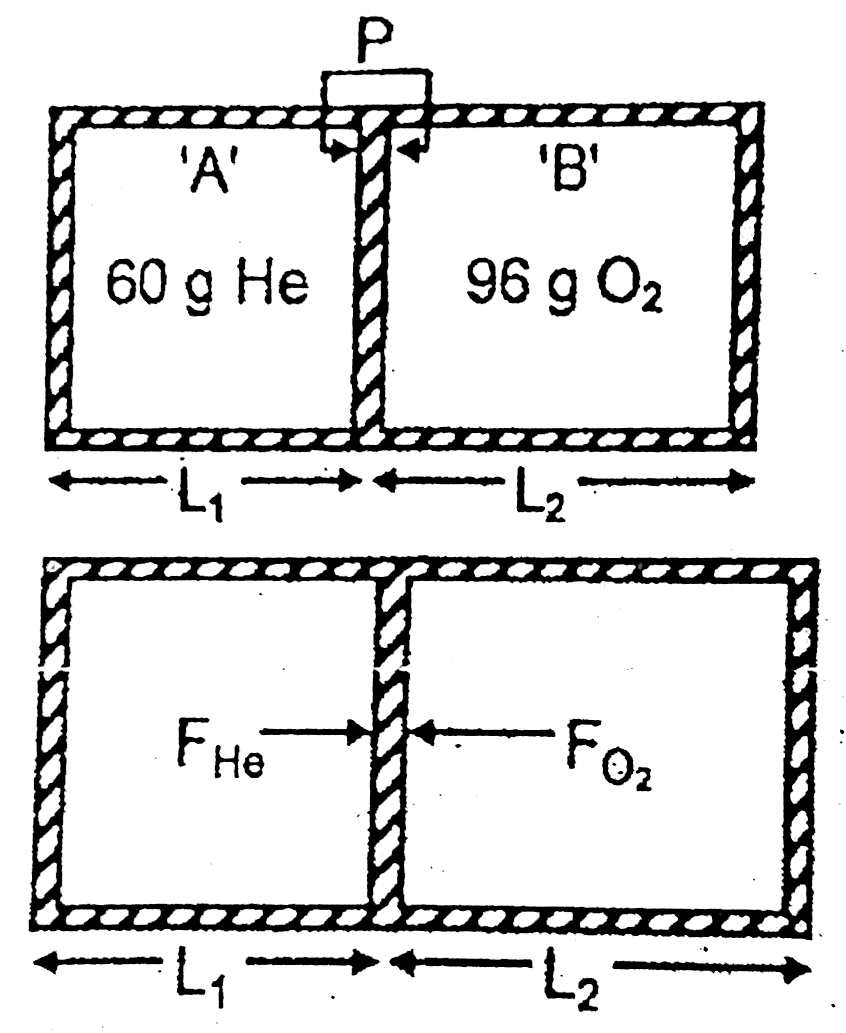
A cylindrical diathemic chamber fitted with movable, massless & frictionless piston. Initially piston was at rest by the stop pin `P` as shown in figure. Compartment `(A)` is filled with `60g` He gas & compartment `(B)` is filled with `96 g of O_(2)` gas ast `27^(@)C` . Assume ideal behaviour of gas, then calculate ratio `(L_(1))/(L_(2))` , if stop pin is suddenly removed ? \

A

`2`

B

`4`

C

`5`

D

`6`

Text Solution

Verified by Experts

The correct Answer is:
C


At equilibrium, `F_(He) = F_(O_(2))`
`n_(He)(RT)/(V_(He))xx A = (n_(O_(2))RTxxA)/(VO_(2))`
`(n_(He))/(L_(1)) = (n_(O_(2)))/(L_(2))`
`:. (L_(1))/(L_(2)) = (n_(He))/(n_(O_(2))) = (60//4)/(96//32) = (15)/(3) = 5`
Promotional Banner

Similar Questions

Explore conceptually related problems

In the figure, a container is shown to have a movable (without friction) piston on top. The container and the piston are all made of perfectly insulated material allowing no heat transfer between outside and inside the container. The container is divided into two compartments by a rigid partition made of a thermally conducting material that allows slow transfer of heat. The lower compartment of the container is filled with 2 moles of an ideal monoatomic gas at 700K and the upper compartment is filled with 2 moles of an ideal diatomic gas at 400K. The heat capacities per mole of an ideal monoatomic gas are C_V=3/2R, C_P=5/2R, and those for an ideal diatomic gas are C_V=5/2R, C_P=7/2R, Consider the partition to be rigidly fixed so that it does not move. When equilibrium is achieved, the final temperature of the gasses will be

In the figure, a container is shown to have a movable (without friction) piston on top. The container and the piston are all made of perfectly insulated material allowing no heat transfer between outside and inside the container. The container is divided into two compartments by a rigid partition made of a thermally conducting material that allows slow transfer of heat. The lower compartment of the container is filled with 2 moles of an ideal monoatomic gas at 700K and the upper compartment is filled with 2 moles of an ideal diatomic gas at 400K. The heat capacities per mole of an ideal monoatomic gas are C_V=3/2R, C_P=5/2R, and those for an ideal diatomic gas are C_V=5/2R, C_P=7/2R, Consider the partition to be rigidly fixed so that it does not move. When equilibrium is achieved, the final temperature of the gasses will be

A mixture of ethane (C_(2)H_(6)) and ethene (C_(2)H_(4)) occupies 40 L at 1.00 atm and at 400 K . The mixture reacts completely with 130 g of O_(2) to produce CO_(2) and H_(2)O . Assuming ideal gas behaviour, calculate the mole fractions of C_(2)H_(4) and C_(2)H_(6) in the mixture.

A mixture of ethane (C_(2)H_(6)) and ethene (C_(2)H_(4)) occupies 40 L at 1.00 atm and at 400 K . The mixture reacts completely with 130 g of O_(2) to produce CO_(2) and H_(2)O . Assuming ideal gas behaviour, calculate the mole fractions of C_(2)H_(4) and C_(2)H_(6) in the mixture.

A diatomic gas is enclosed in a vessel fitted with massless movable piston. Area of cross section of vessel is 1m^2 . Initial height of the piston is 1m (see the figure). The initial temperature of the gas is 300K. The temperature of the gas is increased to 400K, keeping pressure constant, calculate the new height of the piston. The piston is brought to its initial position with no heat exchange. Calculate the final temperature of the gas. You can leave answer in fraction.

An ideal gas is enclosed in a cylinder fitted with a frictionless piston. The piston is connected with a light rod to one plate of capacitor whose other plate is fixed as shown. Initially volume of the gas inside the cylinder is V_0 Atmospheric pressure is P_0 separation between the plates is L, area of the piston as well as of the capacitor plates is A and emf of battery is epsilon . A heater supplies heat to the gas so that pressure of the gas is given as P=P_(0)-("n"epsilon_0epsilon^2)/L^2 when piston is displaced by a distance L/2 . Find value of n.

A gas is enclosed in a cylindrical can fitted with a piston. The walls of the can and the piston are adiabatic. The initial pressure , volume and temperature of the gas are 100 kPa, 400cm^(3) and 300K respectively. The ratio of the specific heat capacities of the gas is (C_p / C_v = 1.5) Find the pressure and the temperature of the gas if it is (a) suddenly compressed (b) slowly compressed to 100 cm^(3) .

Figure shows an adiabatic cylindrical tube of volume (V_0) divided in two parts by a frictionless adiabatic separator . Initially, the separator is kept in the middle, an ideal gas at pressure (P_1) and the temperatures (T_1) is injected into the left part and the another ideal gas at pressures (P_2) and temperature (T_2) is injected into the right part. (C_p / C_v = gamma) is the same for both the gases. The separator is slid slowly and is released at a position where it can stay in equilibrium. Find (a) the volumes of the parts, (b) the heat given to the gas in the left part and (c) the final common pressure of the gases.

A monatomic ideal gas, initially at temperature T_(1) is enclosed in a cylinder fitted with a frictionless pistion. The gas is allowed to expand adiabatically to a temperature T_(2) . By releasing the piston suddenly. IF L_(1) and L_(2) are th lengths of the gas column before and after expansion respectively, then T_(1)//T_(2) is given by

When 2g of a gas A is introduced into an evacuated flask kept at 25^@C , the pressure is found to be one atmosphere. If 3 g of another gas B are then added to the same flask, the total pressure becomes 1.5 atm. Assuming ideal gas behaviour, calculate the ratio of molecular weights M_A : M_B .

