Home
Class 12
PHYSICS
In the figure shown a thin light inexten...

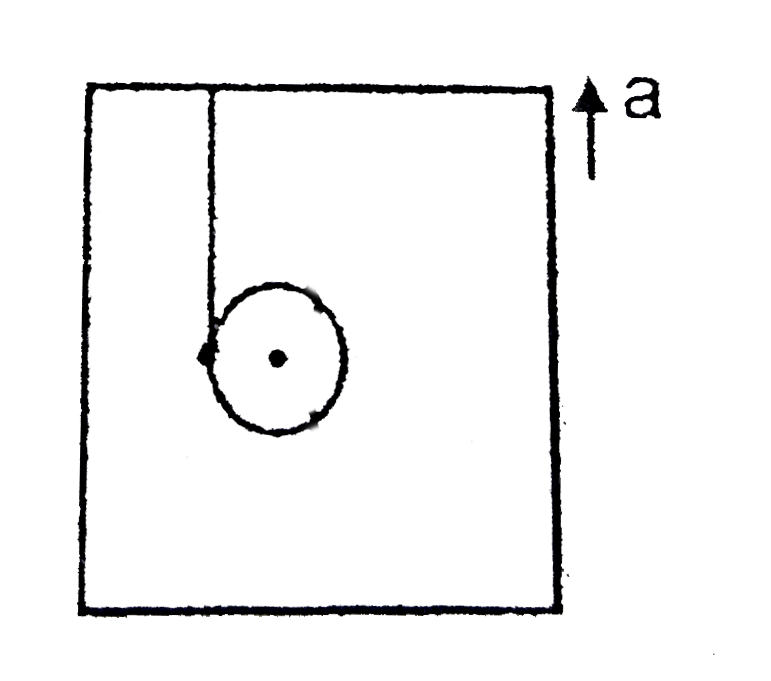
In the figure shown a thin light inextensible string is wrapped around a uniform disc. One end of the strin is fixed to the ceiling of the lift and the other end is fied to the circumference of the disc. Acceleration `'a'` of the lift is such that the centre of the disc not move with respect to ground. Find the value of `(a)/(g)`. String does not slip on pulley.

Text Solution

Verified by Experts

The correct Answer is:
2

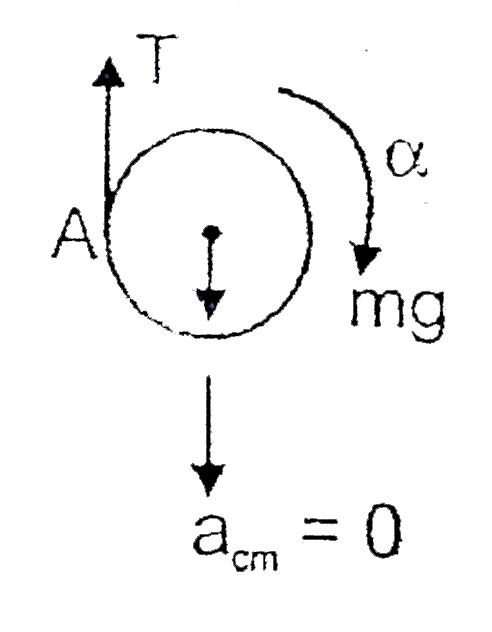
`a_(A) = a = alpha.R` …….(i)
`T - mg = 0` ……(ii)
`T.R = (mR^(2))/(2).alpha"……….."(iii)`

`:. g = (a)/(2)`
Promotional Banner

Topper's Solved these Questions

  • TEST PAPERS

    RESONANCE ENGLISH|Exercise PHYSICS|784 Videos
  • TEST PAPERS

    RESONANCE ENGLISH|Exercise PART - II PHYSICS SEC - 2|20 Videos
  • SIMPLE HARMONIC MOTION

    RESONANCE ENGLISH|Exercise Advanced Level Problems|13 Videos
  • TEST SERIES

    RESONANCE ENGLISH|Exercise PHYSICS|130 Videos

Similar Questions

Explore conceptually related problems

A string is wrapped over the edge a uniform disc and the free end is fixed with the ceiling. The disc moves down, unwinding the string. Find the downward acceleration of the disc.

A disc of mass M has a light, thin string wrapped several times around its circumference. The free end of string is attaced to the ceiling and the disc is released from rest. Find the acceleration of the disc and the tension in the string.

A string is wrapped on a uniform disc and the other end of the string connected to a wall. The system is placed on a smooth plane, inclined at an angle theta , with the string parallel to the plane, as shown in the figure. The acceleration of the disc is

Consider the arrangement shown in figure. The string is wrapped around a uniform cylinder which rolls without slipping. The other end of the string is passed over a masslessm frictionless pulley to a falling weight, determine the acceleration of the falling mass m in terms of only the mass of the cylinder M , the mass m and g

One end of a string of length L is tied to the celling of lift accelerating upwards with an accelerating 2g The other end of the string is free. The linear mass density of the string varies linearly from 0 of lamda from bottom to top :-

The pulley shown in figure has a moment of inertia I about it's axis and its radius is R. Find the magnitude of the acceleration of the two blocks. Assume that the string is light and does not slip on the pulley.

One end of spring of spring constant k is attached to the centre of a disc of mass m and radius R and the other end of the spring connected to a rigid wall. A string is wrapped on the disc and the end A of the string (as shown in the figure) is pulled through a distance a and then released. The disc is placed on a horizontal rough surface and there is no slipping at any contact point. What is the amplitude of the oscillation of the centre of the disc?

A mas m hangs with help of a string wraped around a pulley on a frictionless bearling. The pulley has mass m and radius R. Assuming pulley to be a perfect uniform circular disc, the acceleration of the mass m, if the string does not slip on the pulley, is:

A block of mass m is attached to one end of a light string which is wrapped on a disc of mass 2m and radius R. The total length of the slack portion of the string is l . The block is released from rest. The angular velocity of the disc just after the string becomes taut is

One end of a string of length L is tied to the ceiling of a lift acceleration upwards with an acceleration 2g . The other end of the string is free. The linear mass density of the string varies linearly from 0 to lambda from bottom to top. Choose the correct option(s)

RESONANCE ENGLISH-TEST PAPERS-PART - II PHYSICS
  1. Two identical vehicles are moving with same velocity v towards an inte...

    Text Solution

    |

  2. A block of mass 5 kg is held against a wall with a force of 100 N. as ...

    Text Solution

    |

  3. In the figure shown a thin light inextensible string is wrapped around...

    Text Solution

    |

  4. Consider the following unbalanced redox reaction: H(2)O+AX+BYrarrHA+...

    Text Solution

    |

  5. 1 mol of an ideal gas undergoes different thermodynamical process in P...

    Text Solution

    |

  6. 1 mol of an ideal gas undergoes different thermodynamical process in P...

    Text Solution

    |

  7. Boyle's temperature (T(B)) : It is the temperature at which a real gas...

    Text Solution

    |

  8. Boyle's temperature (T(B)) : It is the temperature at which a real gas...

    Text Solution

    |

  9. A particle is moving on a circular path of radius R with constant spee...

    Text Solution

    |

  10. A particle is moving on a circular path of radius R with constant spee...

    Text Solution

    |

  11. A particle is moving on a circular path of radius R with constant spee...

    Text Solution

    |

  12. Why does -NH2 group directs the incoming group at the ortho and para ...

    Text Solution

    |

  13. 1 mol of a real gas obeys P(V(m) - b) = RT , where 'b' and 'R' are con...

    Text Solution

    |

  14. One gram of a metallic chloride was found to contain 0.835 g of chlori...

    Text Solution

    |

  15. The graph of compressibility factor (Z) vs. P for one mole of a real g...

    Text Solution

    |

  16. N(2) undergoes photochemical dissociation into one normal N-atom and o...

    Text Solution

    |

  17. One mole of an ideal gas (C(v,m)=(5)/(2)R) at 300 K and 5 atm is expan...

    Text Solution

    |

  18. The vapour density of the mixture at equilibrium is 38.3 at 33^(@)C ...

    Text Solution

    |

  19. N(2)O(3) dissociates into NO and NO(2). At equilibrium pressure of 3 a...

    Text Solution

    |

  20. The total number of contriburing structures showing hurperconjugation ...

    Text Solution

    |

