Home
Class 11
PHYSICS
An adiabatic cylindrical tube is fitted ...

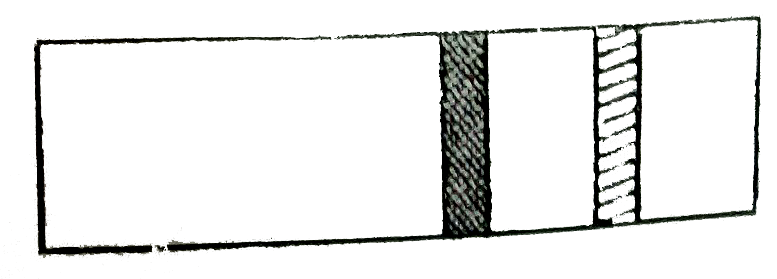
An adiabatic cylindrical tube is fitted with an adiabatic separator as shown in figure. Initial separator is in equilibrium and divides a tube in two equal parts. The seperator can be slide into the tube by an extermal mechanism. An ideal gas `(gamma = 1.5)` is injected in the two slides at equal pressure and temperature. Now separator is slid to a piston where it divides the tube in the ratio `7 :3` The ratio of the temperature in the two parts of the vessel is `sqrt(n) : sqrt(7)` find `n`.

Text Solution

Verified by Experts

The correct Answer is:

3
Promotional Banner

Topper's Solved these Questions

  • KTG & THERMODYNAMICS

    RESONANCE ENGLISH|Exercise SECTION|138 Videos
  • KTG & THERMODYNAMICS

    RESONANCE ENGLISH|Exercise Exercise-2|1 Videos
  • KTG & THERMODYNAMICS

    RESONANCE ENGLISH|Exercise SECTION (J)|2 Videos
  • KINETIC THEORY OF GASES AND THERMODYNAMICS

    RESONANCE ENGLISH|Exercise Exercise|64 Videos
  • MAGNETIC FIELD AND FORCES

    RESONANCE ENGLISH|Exercise Exercise|64 Videos

Similar Questions

Explore conceptually related problems

Figure shows a cylindridcal tube with a adibatic walls and fitted with an adiabatic separtor. The separator can be slid into the tube by an external mechanism. An ideal gas (gamma=1.5) is injected in the two sides at equal pressures and temperatures . The separator remains in equilibrium at the middel. It is now slid to a position where it divides the tube in the ratio 1:3 Find the ratio of the tempertures in the two parts of the vessel.

Shows a cylindrical tube with adiabatic walls and fittled with a diathermic separetor. The separetor can be slid in the tube by and external mechanism. An ideal gas is injected into the two sides at equal pressures and equal temperatures. The separetor remaons in equilibrium at the middle. It is now slid to pisition where it devides the tube in the ratio of 1:3. Find the ratio of the pressures in the two parts of the vessel.

A uniform tube of volume V contains an ideal monatomic gas at a uniform pressure P the temperature of the gas varies linearly along te length of the tube ad T and 2 T are the temperature at the ends.

Figure shows an adiabatic cylindrical tube of volume (V_0) divided in two parts by a frictionless adiabatic separator . Initially, the separator is kept in the middle, an ideal gas at pressure (P_1) and the temperatures (T_1) is injected into the left part and the another ideal gas at pressures (P_2) and temperature (T_2) is injected into the right part. (C_p / C_v = gamma) is the same for both the gases. The separator is slid slowly and is released at a position where it can stay in equilibrium. Find (a) the volumes of the parts, (b) the heat given to the gas in the left part and (c) the final common pressure of the gases.

The volume of an ideal gas (gamma = 1.5 ) is changed adiabatically from 4.00 liters to 3.00 liters . Find the ratio of (a) the final pressure to the initial pressure and (b) the final temperature to the initial temperature.

A container with insulating walls is divided into two equal parts by a partition fitted with a valve. One part is filled with an ideal gas at a pressure P and temperature T, whereas the other part is completely evacuated . If the valve is suddenly opened, the pressure and temperature of the gas will be

A container with insulating walls is divided into two equal parts by a partition fitted with a valve. One part is filled with an ideal gas at a pressure P and temperature T, whereas the other part is completely evacuated . If the valve is suddenly opened, the pressure and temperature of the gas will be

In given figure, an adiabatic cylindrical tube of volume 2V_(0) is divided in two equal parts by a frictionless adiabatic separator. An ideal gas in left side of a tube having pressure P_(1) and temperature T_(1) where as in the right side having pressure P_(2) and temperature T_(2).C_(p)//C_(v) =gamma is the same for both the gases. The separator is slid slowly and is released at a position where it can stay in equilibrium. Find (a) the final volumes of the two parts (b) the heat given to the gas in the left part and (c) the final common pressure of the gases,

For an adiabatic expansion of an ideal gas the fractional change in its pressure is equal to

Compare the pressure at the point P in the three tubes shown in the figure .

RESONANCE ENGLISH-KTG & THERMODYNAMICS-PART -II
  1. When an ideal gas is compressed isothermally then its pressure increas...

    Text Solution

    |

  2. A vessel of volume V = 5 litre contains 1.4 g nitrogen and 0.4g of He ...

    Text Solution

    |

  3. In given figure, an ideal gas is trapped between a mercury column and ...

    Text Solution

    |

  4. Two vessels A and B, thermally insulated, contain an ideal monoatomic ...

    Text Solution

    |

  5. Consider a vertical tube open at both ends. The tube consistss of two ...

    Text Solution

    |

  6. When 2g of gas A is introduced into an evacuated flask kept at 25^(@)C...

    Text Solution

    |

  7. Two moles of an ideal monoatomic gas undergo a cyclic process which is...

    Text Solution

    |

  8. In figure, a sample of 3 moles of an ideal gas is undergoing through a...

    Text Solution

    |

  9. During the expansion process the volume of the gas changes form 4m^(3)...

    Text Solution

    |

  10. A balloon containing an ideal gas has a volume of 10 litre and tempera...

    Text Solution

    |

  11. One mole of an ideal gas is kept enclosed under a light piston (area =...

    Text Solution

    |

  12. 3 moles of an ideal mono atomic gas performs a cycle as shown in fig. ...

    Text Solution

    |

  13. An adiabatic cylindrical tube is fitted with an adiabatic separator as...

    Text Solution

    |

  14. A diatomic ideal gas undergoes a thermodynamic change according to the...

    Text Solution

    |

  15. A thermodynamic process of one mole ideal monoatomic gas is shown in f...

    Text Solution

    |

  16. P-V indicator diagram for a given sample of monoatomic ideal gas is sh...

    Text Solution

    |

  17. A thermally insulated piston divides a nonconducting container in two ...

    Text Solution

    |
