Home
Class 11
PHYSICS
A thermodynamic system is taken from an ...

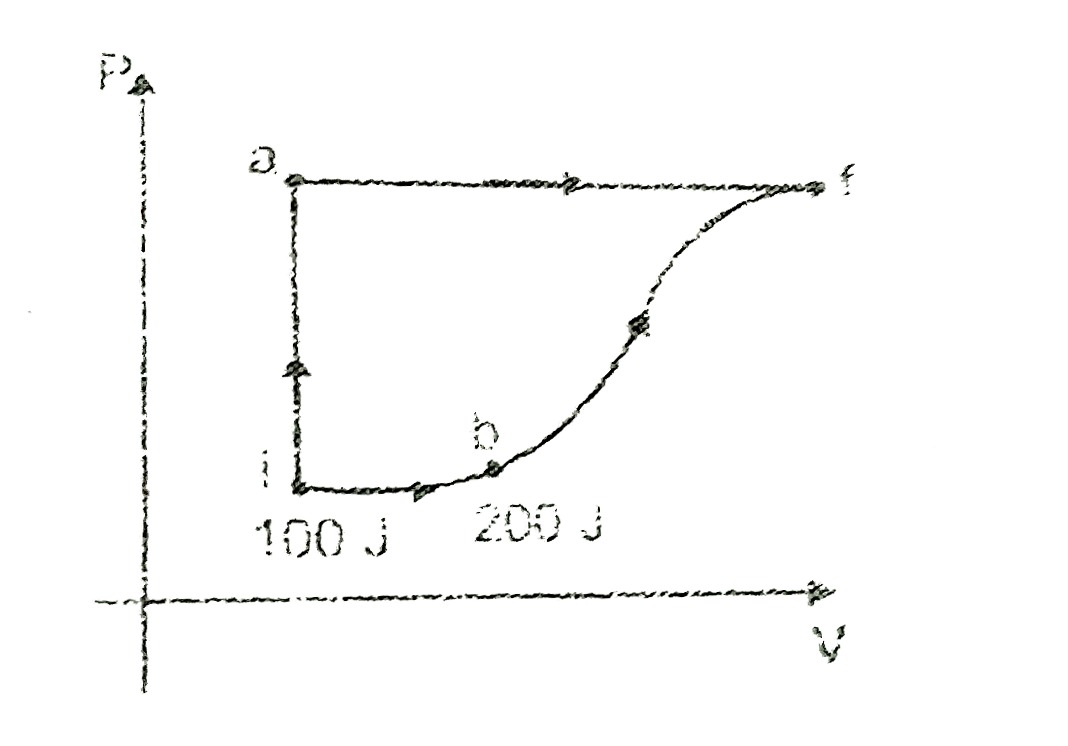
A thermodynamic system is taken from an initial state i with internal energy `U_i = 100 J` to the final state f along two different paths iaf and ibf, as schematically shown in the figure. The work done by the system along in the paths af, ib and bf are `W_(af) = 200 J, W _(jb) = 50 J` and `W_(bf) = 100 J` respectively. The heat supplied to the system along the path jaf, jb and are `Q_(jaf), Q_(jb)` and `Q_(bf)` respectively. If the internal energy of the system in the state b is `U_b = 200 J` and `Q_(Ja f)= 500 J`, the ratio `Q_(bf)//Q_(jb) ` is.

Text Solution

Verified by Experts

The correct Answer is:
2

`w_(ibf) = 150J`

`w_(iaf) = 200 J`
`Q_(iaf) = 500 J So U_(iaf) =300 J`
So `U_(f) = 400 J`
`U_(ib) = 100 J`
`Q_(ib) = 100 +50 = 150 J`
`Q_(ibf) = 300 +150 = 450 J`
So the required ratio `(Q_(ibf))/(Q_(ib)) - (450-150)/(150) = 2`
Promotional Banner

Topper's Solved these Questions

  • KTG & THERMODYNAMICS

    RESONANCE ENGLISH|Exercise PART - II|27 Videos
  • KTG & THERMODYNAMICS

    RESONANCE ENGLISH|Exercise Advancel Level Problems|1 Videos
  • KTG & THERMODYNAMICS

    RESONANCE ENGLISH|Exercise Exercise-3|1 Videos
  • KINETIC THEORY OF GASES AND THERMODYNAMICS

    RESONANCE ENGLISH|Exercise Exercise|64 Videos
  • MAGNETIC FIELD AND FORCES

    RESONANCE ENGLISH|Exercise Exercise|64 Videos

Similar Questions

Explore conceptually related problems

A thermodynamic system is taken from an initial state I with internal energy U_i=-100J to the final state f along two different paths iaf and ibf, as schematically shown in the figure. The work done by the system along the pat af, ib and bf are W_(af)=200J, W_(ib)=50J and W_(bf)=100J respectively. The heat supplied to the system along the path iaf, ib and bf are Q_(iaf), Q_(ib),Q_(bf) respectively. If the internal energy of the system in the state b is U_b=200J and Q_(iaf)=500J , The ratio (Q_(bf))/(Q_(ib)) is

In the above question, if the work done on the system along the curved path 'ba' is 52J , heta abosrbed is

A system has internal energy U_1 . If 500 J of heat is supplied to it and at the same time it does 300 J of work. Calculate the internal energy of the system in the new state,

In the figure given two processes A and B are shown by which a thermodynamic system goes from initial state I to final state F. if DeltaQ_(A) and DeltaQ_(B) are respectively the heats supplied to the systems then

When a system is taken from state i to state f along the path iaf, it is found that Q=50 cal and W=20 cal . Along the path ibf Q=36cal . W along the path ibf is

When a system is taken from state i to state f along the path iaf, it is found that Q=50 cal and W=20 cal . Along the path ibf Q=36cal . W along the path ibf is

For a gaseous state if heat supplied to the system is 100 J and work done by the system is 25 J. then internal energy of the system is

A system goes from P to Q by two different paths in the p-V diagram as shown in figure. Heat given to the system in path 1 is 1000 J. The work done by the system along path 1 is more than path 2 by 100 J. What is the heat exchanged by the system in path 2 ?

When a thermodynamic system is taken from an initial state I to a final state F along the path IAF, as shown in Fig. the heat energy absorbed by the system is Q = 55 J and work done by the system is W = 25 J . If the same system is taken along the path IBF, the value of Q = 35 J . (a) If W = - 15 J for the curved path FI, how much heat energy is lost by the system along this path ? (b) If U_(1) = 10 J , what is U_(F) ? (d) If U_(B) = 20 J , what is Q for the process BF and IB ?

A system goes from A to B by two different paths in the P-V diagram as shown in figure Heat given to the system in path 1 is 1100 j, the work done by the system along path 1 is more than path 2 by 150 J. The heat exchanged by the system in path 2 is

RESONANCE ENGLISH-KTG & THERMODYNAMICS-PART - I
  1. Calorie is defined as the amount of heat required to raise temperature...

    Text Solution

    |

  2. Statement-1: The total translational kinetic energy of fall the molecu...

    Text Solution

    |

  3. An ideal gas is expanding such that PT^2=constant. The coefficient of ...

    Text Solution

    |

  4. Cv and Cp denote the molar specific heat capacities of a gas at consta...

    Text Solution

    |

  5. The figure shows the P-V plot of an ideal gas taken through a cycle AB...

    Text Solution

    |

  6. A real gas behaves like an ideal gas if its

    Text Solution

    |

  7. One mole of an ideal gas in initial state A undergoes a cyclic process...

    Text Solution

    |

  8. A diatomic ideal gas is compressed adiabatically to 1/32 of its initia...

    Text Solution

    |

  9. 5.6 liter of helium gas at STP is adiabatically compressed to 0.7 lite...

    Text Solution

    |

  10. A mixture of 2 moles of helium gas ( (atomic mass)=4a.m.u ) and 1 mole...

    Text Solution

    |

  11. Two moles of ideal helium gas are in a rubber balloon at 30^@C. The ba...

    Text Solution

    |

  12. Two non-reactive monoatomic ideal gases have their atomic masses in th...

    Text Solution

    |

  13. The figure below shows the variation of specific heat capacity (C) of ...

    Text Solution

    |

  14. A thermodynamic system is taken from an initial state i with internal ...

    Text Solution

    |

  15. In the figure a container is shown to have a movable (without friction...

    Text Solution

    |

  16. In the figure a container is shown to have a movable (without friction...

    Text Solution

    |

  17. A container of fixed volume has a mixture of a one mole of hydrogen an...

    Text Solution

    |

  18. An ideal monoatomic gas is confined in a horizontal cylinder by a spri...

    Text Solution

    |

