Home
Class 11
PHYSICS
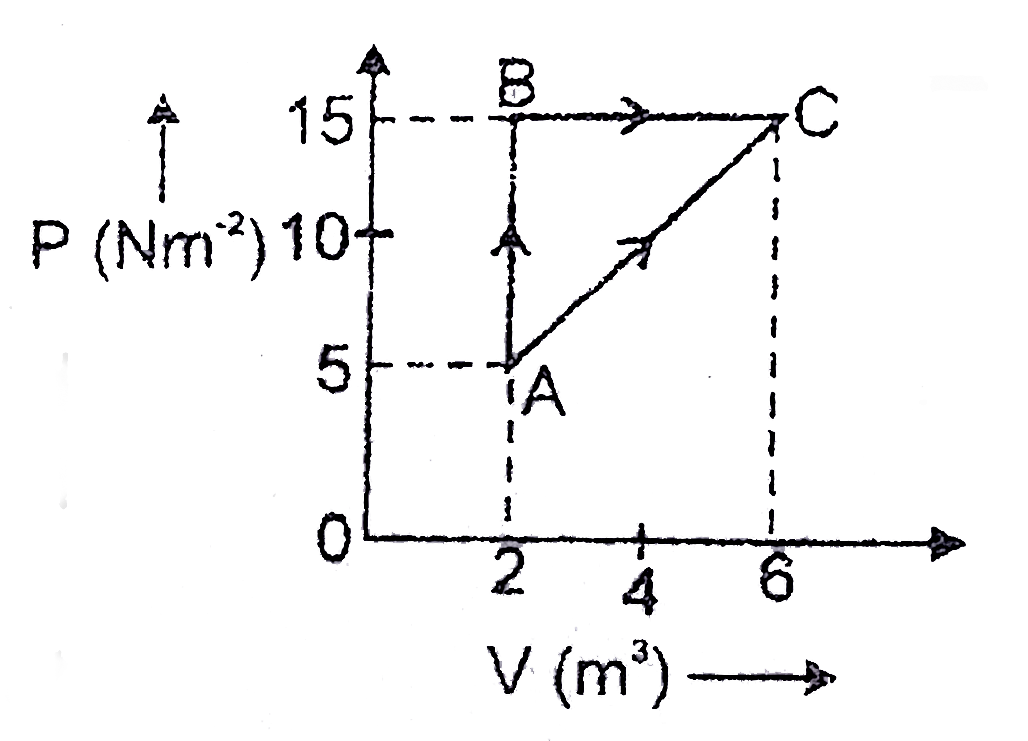
In the given figure, an ideal gas change...

In the given figure, an ideal gas changes it state from `A` to state `C` by two paths `ABC` and `AC`.
(i) Find the path along which work done is the least.
(ii) The internal energy of the gas at `A` to `10J` and the amount of heat supplied to change its state to `C` through the path `AC` is `200J`. Calculate the internal energy at `C`.
(iii) The internal energy of the gas at state `B` is `30J`. Find the amount of heat supplied to the gas to go from `A to B`.

Text Solution

Verified by Experts

The correct Answer is:
(i) along `AC`
(ii) `170J` (iii) `20J`

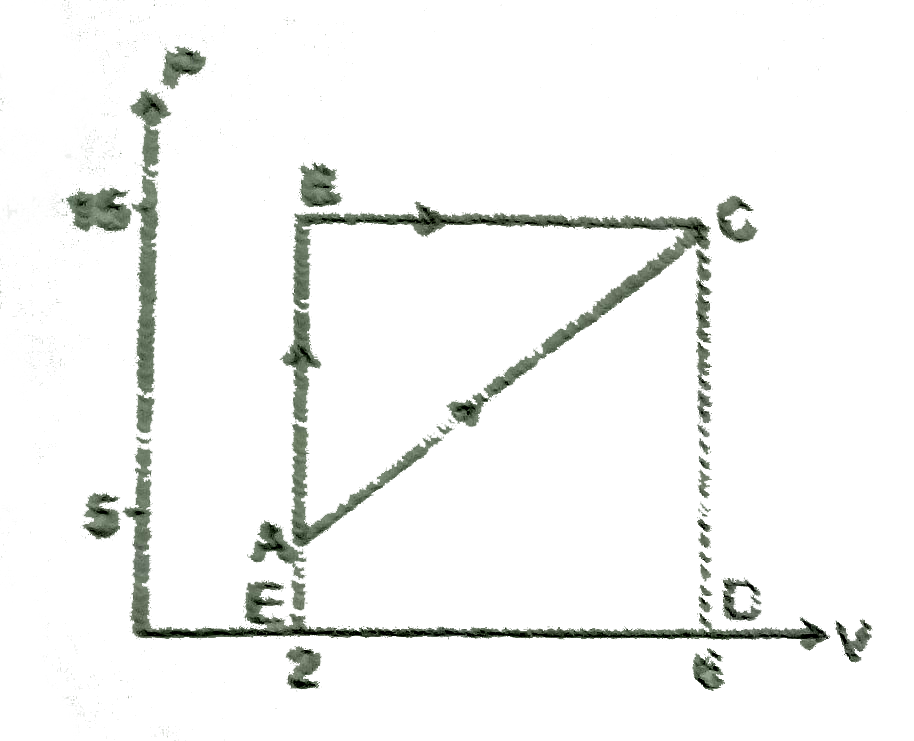
(i) Along path `AC` work done is least. As areas under `P -V` diagram along `AC` is less as compare to along path `ABC`
`DeltaW_(ABC) = `Area under the `EABCDE = 15 xx 4 = 60J`.
`DeltaW_(AC) =` Area under `EACDE = 5 xx 4 +(10 xx4)/(2) = 40J`.

(ii) `DeltaW_(AC) = 40 J` (as calculated above)
`DeltaQ_(AC) = 200J`.
`:. DeltaU_(AC) = DeltaQ_(AC) - DeltaW_(AC) = 200 - 40 = 160`
`U_(AC) = U_(C) -U_(A) = 160`
`:. U_(C) = U_(A) +160 = 10 +160 = 170 J`,
(iii) `DeltaW_(AB) = 0`
Ideal gas equation `PV = nRT`
`DeltaP. V = n R DeltaT ( :' V = "const")`
`DeltaT = (DeltaP.V)/(nR)`
`DeltaU = nC_(v)DeltaT = nC_(v). (DeltaPV)/(nR) =- (C_(v))/(R ) . DeltaP.V`
`:. U_(B) = (C_(V))/(R ) P_(B). V`
`U_(A) = (C_(V))/(R)P_(A).V`
Given `U_(B) = 30`
`(C_(V))/(R) xx P_(B) xx V = (C_(V))/(R) xx 15 xx2`
`=30 xx (C_(V))/(R) = 30, (C_(V))/(R) = 1`
`:. U_(A) = (C_(V))/(R) = 30, (C_(V))/(R) =1`
`:. U_(A) = (C_(V))/(R) xx P_(A) xx V = 1 xx5 xx2 = 10 J`
`:. DeltaU_(AB) = U_(B) - U_(A) = 30 - 10 = 20J`
`:. DeltaQ_(A rarr B) = DeltaU_(A rarr B) +DeltaW_(A rarr B) = 20 +0 = 20J`.
Promotional Banner

Topper's Solved these Questions

  • KTG & THERMODYNAMICS

    RESONANCE ENGLISH|Exercise Advancel Level Problems|1 Videos
  • KINETIC THEORY OF GASES AND THERMODYNAMICS

    RESONANCE ENGLISH|Exercise Exercise|64 Videos
  • MAGNETIC FIELD AND FORCES

    RESONANCE ENGLISH|Exercise Exercise|64 Videos

Similar Questions

Explore conceptually related problems

In the given figure an ideal gas changes its state from A to state C by two paths ABC and AC . (i) Find the path along which work done is the least. (ii) The internal energy of gas at A and B is 10J and 20 J respectively amount of heat supplied to change its state to C through the path AC is 200J . Calculate the internal energy at C . (iii) How much is the heat involved in the process ABC and ADC ?

In the given figure, an ideal gas changes its state from A to state C by two paths ABC and AC. Along which path the work done by the gas is least.

In the given graph, an ideal gas changes its state from A to C by two paths ABC and AC. (a) Find the path along which work done is less. (b) The internal energy of gas at A is 10J and the amount of heat supplied in path AC is 200J. Calculate the internal energy of gas at C. (c) The internal energy of gas at state B is 20J. Find the amount of heat supplied to the gas to go from A to B.

In the given an ideal gas can change its state from A to C by two paths ABC or AC . Then

The given figure shows a change of state A to state C by two paths ABC and AC for an ideal gas. Calculate. a. The path along which work done is least. b. The internal energy at C if the internal energy of gas at A is 10J and amount of heat supplied to change its state to C through the path AC is 200J . c. The amount of heat supplied to the gas to go from A to B , if internal energy of gas at state B is 10J .

The given figure shown a change of state A to state C by two paths ABC and AC for an ideal gas. Calculate the : (a) Path along which work done is least. (b) Internal energy at C if the internal energy of gas at A is 10 J and amount of heat supplied to change its state to C through the path AC is 200 J . (c) Amount of heat supplied ot the gas to go from A to B, if internal energy of gas at state B is 10 J .

Figure shows an ideal gas changing its state A to state C by two different path ABC and AC . The internal energy of the gas at A is 10 J and the amount of heat supplied to change its state to C through the path AC is 200 J . Find the internal energy at C .

In the given figure, an ideal gas changes its state from state state C by two paths ABC and AC. How much is the heat involved in the process ABC and ADC ? The internal energy of gas at A and B is 10 J and 20 J respectively

In the given figure, an ideal gas changes its state from state state C by two paths ABC and AC. The internal energy of gas at A is 10 J and the amount of heat supplied to change its state to C through path AC is 200 J.Calculate the internal energy of gas at C

In the given figure, an ideal gas changes its state from A to C by four paths. The path for which work done is least, is

RESONANCE ENGLISH-KTG & THERMODYNAMICS-SUBJECTIVE QUESTIONS
  1. A sample of 2 kg of monatomic helium (assumed ideal) is taken through ...

    Text Solution

    |

  2. Two moles of an ideal monoatomic gas are confined within a cylinder by...

    Text Solution

    |

  3. Two vessels A and B, thermally insulated, contain an ideal monoatomic ...

    Text Solution

    |

  4. One mole of a diatomic ideal gas (gamma = 1.4) is taken through a cyc...

    Text Solution

    |

  5. In the given figure, an ideal gas changes it state from A to state C b...

    Text Solution

    |

  6. One mole of an ideal monoatomatic gas is taken round the cylic process...

    Text Solution

    |

  7. Two moles of an ideal monoatomic gas initially at pressure P(1) and vo...

    Text Solution

    |

  8. A weightless piston divides a thermally insulated cylinder into two pa...

    Text Solution

    |

  9. Two containers A and B of equal volume V(0)//2 each are connected by a...

    Text Solution

    |

  10. In given figure, an adiabatic cylindrical tube of volume 2V(0) is divi...

    Text Solution

    |

  11. In the given figure a glass tube lies horizontally with the middle 20c...

    Text Solution

    |

  12. A cylindrical tube with adiabatic walls having volume 2V(0)contains an...

    Text Solution

    |

  13. A mass of 8g of oxygen at the pressure of one atmosphere and at temper...

    Text Solution

    |

  14. An ideal gas ((C(p))/(C(v))=gamma)has initial volume V(0) is kept in a...

    Text Solution

    |

  15. An ideal gas (C(p)//C(v) =gamma) having initial pressure P(0) and volu...

    Text Solution

    |

  16. An insulting container of volume 2V(0) is divided in two equal parts b...

    Text Solution

    |

  17. An ideal gas (gamma=3//2) is compressed adiabatically form volume 400c...

    Text Solution

    |

  18. Two samples A and B of the same gas have equal volumes and pressures ....

    Text Solution

    |

  19. A Carnot engine cycle is shown in the Fig. (2). The cycle runs between...

    Text Solution

    |

  20. Cloud formation condition Consider a simplified model of cloub forma...

    Text Solution

    |

