Text Solution
Verified by Experts



Topper's Solved these Questions
CALORIMETRY AND THERMAL EXPANSION
RESONANCE ENGLISH|Exercise Solved miscellaneous problems|1 VideosCALORIMETRY AND THERMAL EXPANSION
RESONANCE ENGLISH|Exercise Problem|26 VideosCALORIMETRY AND THERMAL EXPANSION
RESONANCE ENGLISH|Exercise Advanced Level Problems|13 VideosCALORIMETRY
RESONANCE ENGLISH|Exercise Exercise|19 VideosCAPACITOR
RESONANCE ENGLISH|Exercise Exercise|45 Videos
Similar Questions
Explore conceptually related problems
RESONANCE ENGLISH-CALORIMETRY AND THERMAL EXPANSION-Example
- In following equiation calculate value of H: 1kg ice at -20^@C=H+1kg w...
Text Solution
|
- 1 kg ice at -20^(@)C is mixed with 1 kg steam at 200^(@)C. The equilib...
Text Solution
|
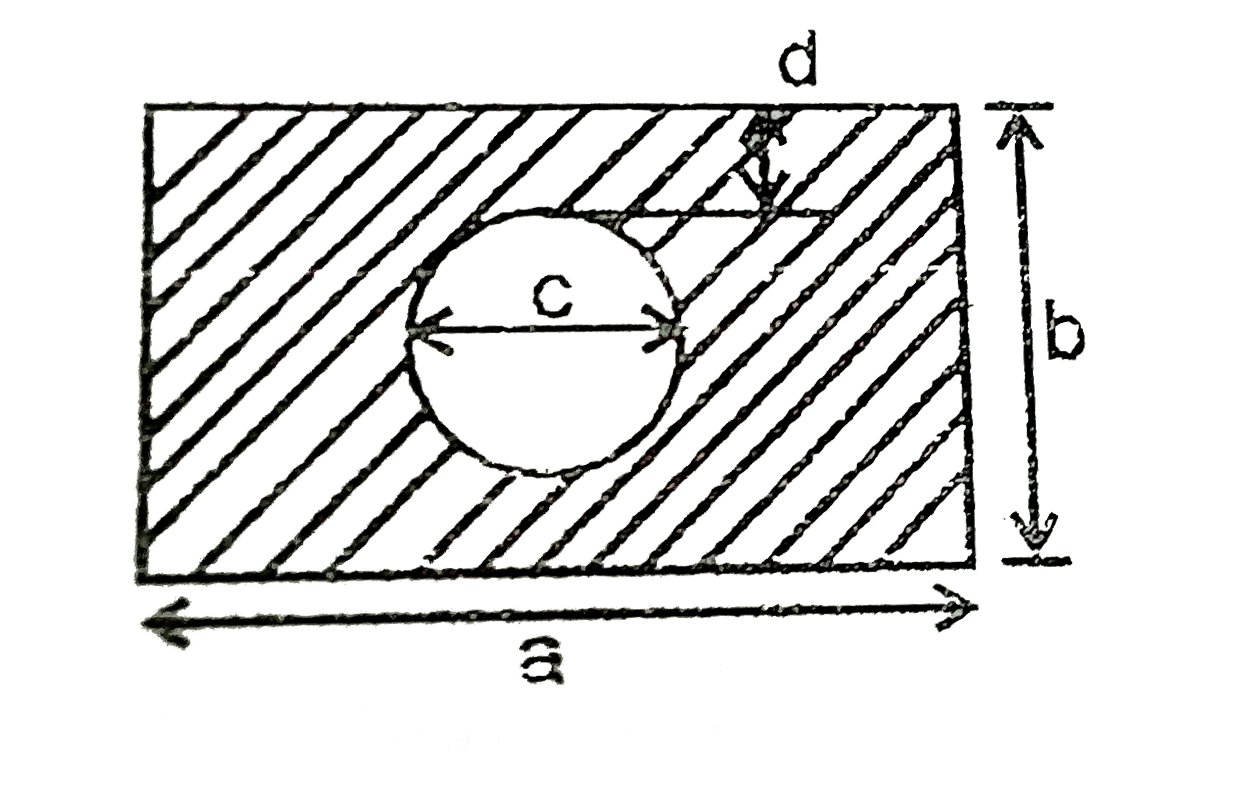
- A rectangular plate has a circular cavity as shown in the figure. If w...
Text Solution
|
- In the given figure, when temperature is increased then which of the f...
Text Solution
|
- What is the percentage change in length of 1m iron rod it its temperat...
Text Solution
|
- In the given figure, a rod is free at one end and other end is fixed. ...
Text Solution
|
- An iron ring measuring 15.00 cm in diameter is a be shrunk on a pulley...
Text Solution
|
- A steel rod of length 1 m rests on a smooth horizontal base. If it is ...
Text Solution
|
- A steel rod is clamped at its two ends and rests on a fixes horizontal...
Text Solution
|
- A steel wire of cross-sectional area 0.5mm^2 is held between two fixed...
Text Solution
|
- A pendulum clock consists of an iron rod connected to a small, heavy b...
Text Solution
|
- A bar measured with a vernier caliper is found to be 180 mm long. The ...
Text Solution
|
- A plane lamina has area 2m^(2) at 10^(@)C then what is its area at 110...
Text Solution
|
- The volume of a glass vessel is 1000 cc at 20^@C. What volume of mercu...
Text Solution
|
- If percentage change in length is 1% with change in temperature of a c...
Text Solution
|
- The densities of wood and benzene at 0^(@)C are 880 kg//m^(3) and 900 ...
Text Solution
|
- A glass vessel of volume 100 cm^(3) is filled with mercury and is heat...
Text Solution
|
- A body is float inside liquid. If we increase temperature then what ch...
Text Solution
|
- In previous question discuss the case when body move downward, upwards...
Text Solution
|
- The readings of a thermometer at 0^(@)C and 100^(@)C are 50 cm and 75 ...
Text Solution
|